A town with more to fix than most. With a D overall, Wilkinsburg is better than 10% of U.S. towns and ranks 1003rd of 1032 in Pennsylvania. Its lowest grade is for safety (D): it reports more crime per resident than 89% of U.S. towns, including 91 violent crimes reported to the FBI in 2025. Where it does best is walkability (A+). Homes run about $156K for a typical one, 2.1 times the Pittsburgh metro’s $76K median household income. The town’s violent crime rate is 6.7 per 1,000 residents, where Pennsylvania’s towns sit at 0.7 and U.S. towns at 1.6. This Pennsylvania town has 5 places on the National Register of Historic Places, among them John F. Singer House and Pennsylvania Railroad Station-Wilkinsburg.
Figures: FBI crime data, 2025 · home values, Zillow · incomes, Census ACS, 2020–24 · National Register of Historic Places.
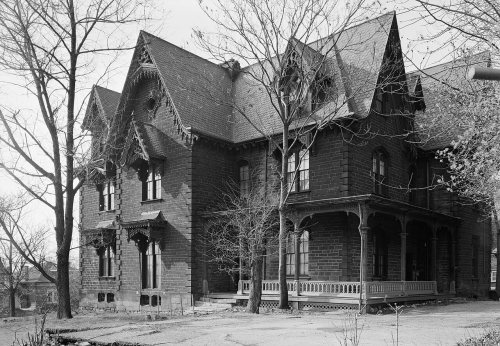
John F. Singer House · National Register of Historic Places
Wilkinsburg’s story
236 years in pictures
Census counts: 1,529 in 1880, a peak of 31,418 in 1950, 14,349 in 2020. The archive holds 6 old photos and papers going back to 1884 and 4 maps from 1904 on.
5 places on the National Register of Historic Places.
Its grades run from A+ for walkability (better than 99% of comparable towns) to D for safety (better than 11%), so the D overall blends very different results.
Wilkinsburg is healthier than towns with similar incomes and has homes that are cheap against local pay, but it reports violent crime at 3 times the Pennsylvania rate.
Violent crime runs at 6.7 per 1,000 residents, 3 times the Pennsylvania rate; the Safety Grade counts each violent crime four times, so this weighs most on its D. Each of the 3 graded towns on its borders reports less crime per resident, from Pittsburgh (D) to Churchill (A−).
For Wilkinsburg, the property crime rate is 17.8 per 1,000 residents.
Two of its 6 schools are below, each with the reason it’s listed. Wilkinsburg Borough SD runs its public schools. 2 public schools serve Wilkinsburg, with 476 students in all.
The FEMA hazard score for Wilkinsburg comes to 8 of 100. FEMA puts 71% of the town’s expected hazard losses down to inland flooding, and 17% to cold waves. Flood insurance has paid one claim here since 2013.
24.1% of workers work from home, against 15.6% across Pennsylvania.
Wilkinsburg’s middle household income is $46,000. Most working residents leave Wilkinsburg for work: only 3% work in town. For workers here, the share who work from home is 24%. The top destinations are Pittsburgh (49%), Monroeville (3%) and Ross Township (2%).
3%work in town
Wilkinsburg
Pennsylvania towns
U.S. towns
Work from home
24%
12%
11%
Below the poverty line
20%
7.6%
9.6%
Median household income
$46,000
$81,000
$80,000
Average trip to work
30 minutes
26 minutes
25 minutes
Where working residents work
In Wilkinsburg3%
Pittsburgh49%
Monroeville3%
Ross Township2%
O'Hara Township2%
6 mi
median commute distance
3,722
jobs based in Wilkinsburg
A commuter town
jobs vs. working residents
A+
Walkability grade: among the most walkable U.S. towns
The median household earns $46,416, against $77,971 across Pennsylvania, one input to its C− for jobs and income. Only 30.1% of households own their home, against 69.3% across Pennsylvania.
Since 2020, Wilkinsburg has lost 4.9% of its people, to 13,602 in the Census Bureau’s 2025 estimate. Adults 18 to 34 are 28% of residents (22% statewide); children under 18 are 15% of residents (21% statewide). 37% of adults 25 and older have a bachelor’s degree or more, vs 35% across Pennsylvania.
40median age · PA 40.9
Wilkinsburg
Pennsylvania towns
U.S. towns
Under 18
15%
20%
22%
Bachelor’s degree or more, 25+
37%
29%
29%
Median age
40 years
43.2 years
40.5 years
Aged 65 or older
21%
21%
18%
WilkinsburgPennsylvaniaUnited States
Ages · share of residents
20%
<1010–1718–2425–3435–4445–5455–6465–7475+
Education · adults 25 and older
No diploma7%
High school23%
Some college19%
Associate’s15%
Bachelor’s19%
Graduate18%
Women and men · all residents
57% women, 43% men
WomenPAU.S.Men
About 76 men for every 100 women (the survey’s margin: ±3 points). Across Pennsylvania, 50.7% of residents are women.
At 2.1 years of the Pittsburgh metro’s $76K median household income, the typical home costs less against local pay than in 89% of Pennsylvania towns; that ratio is one input to its B− for cost of living.
A home in Wilkinsburg typically sold within 64 days of listing. Only 3 of the 1,035 Pennsylvania towns we compare have a lower home-ownership rate than Wilkinsburg. Homes in Wilkinsburg sold for 92.5% of their list price on average.
Wilkinsburg is a borough in Allegheny County, Pennsylvania, United States. The borough has a population of 14,349 as of the 2020 census. Wilkinsburg is part of the Pittsburgh metropolitan area. The borough was named for John Wilkins Jr., a United States Army officer who served as Quartermaster General of the United States Army from 1796 to 1802.
Braddock Hills has fewer than 2,500 residents, so it gets subject grades but no overall grade. Penn Hills and Braddock Hills report no FBI crime data of their own. Penn Hills isn’t graded (fewer than 1,000 residents, or not enough data). Compare Wilkinsburg with a neighbor →
Questions about Wilkinsburg
Short answers, built from the data on this page.
Is Wilkinsburg, PA a good place to live?
Wilkinsburg grades D overall, better than 10% of U.S. towns and #1003 of 1032 in Pennsylvania. It grades C− for health, D for safety and C− for schools. Safety is its weak spot, with a D.
Is Wilkinsburg, PA expensive?
The typical home is worth about $156,000, 46% below the Pennsylvania typical home. Cost of living, which also weighs rents, property taxes and how many households pay 30% or more of their income for housing, grades B−.
What is Wilkinsburg, PA known for?
25 notable people were born here, including Paul Taylor and Virgil.


 4 mi
 7 mi
 7 mi
 6 mi
 2 mi


