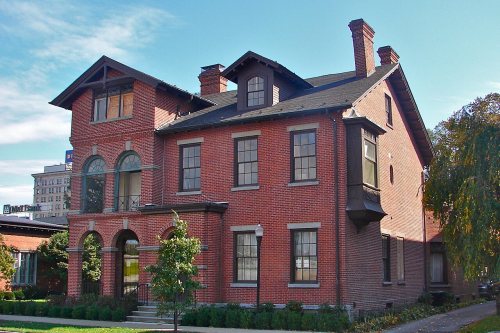
Several subjects drag its grade down. Health is its weak spot (D): residents are less healthy than 88% of U.S. towns on CDC estimates. Overall, Wilkes-Barre earns a D, better than 6% of U.S. towns. It ranks 1019th of 1032 in Pennsylvania. At about $186K, a typical home costs 2.9 years of the Scranton metro’s $65K median household income. Where it does best is walkability (A) — it is more walkable than 90% of U.S. towns. Schools are weaker too — its schools rank behind 87% of the state's. History is its standout character grade: an A+, better than 100% of U.S. towns, with 17 places on the National Register.
Figures: health, CDC PLACES · home values, Zillow · incomes, Census ACS, 2020–24 · schools, state test and graduation results.
Catlin Hall, Wilkes College · National Register of Historic Places
Wilkes-Barre’s story
257 years in pictures
Its 17 National Register listings are more than in 98% of Pennsylvania towns with a listing.
Census counts: 835 in 1800, a peak of 86,626 in 1930, 44,328 in 2020. The archive holds 12 old photos and papers going back to 1840 and 5 maps from 1891 on.
Wilkes-Barre is healthier than towns with similar incomes, but it carries more natural-hazard risk than most of Pennsylvania (mostly inland flooding) and reports more crime than Plains Township and its other graded neighbors.
Against the 5,217 U.S. towns with household incomes like Wilkes-Barre’s, it is less healthy than 66%, so its D isn’t only a matter of income.
17% of adults report frequent physical distress in Wilkes-Barre. The share of adults in Wilkes-Barre who had a checkup this year is 78%, where Pennsylvania’s towns sit at 79% and U.S. towns at 79%. Among adults locally, 42% sleep under 7 hours and 20% smoke cigarettes. Of 26 CDC measures, Wilkes-Barre beats the Pennsylvania average on 1 and trails it on 13.
Home values rose 52% in five years, to about $186K, against 23% across Pennsylvania.
Over the 12 months to September 2026, the typical home gained 2.3% in value. Among households in Wilkes-Barre, 51% own their home. The median rent for Wilkes-Barre comes to $946 a month, below both Pennsylvania’s towns ($1,116 a month) and U.S. towns ($1,185 a month). A home in Wilkes-Barre typically sold within 15 days of listing.
Each of the 3 graded towns on its borders reports less crime per resident, from Plains Township (B−) to Kingston (B−). At 32.1 crimes per 1,000 residents a year, it reports more crime than 90% of Pennsylvania’s graded towns.
The violent crime rate in Wilkes-Barre is 4.1 per 1,000 residents. The property offense rate here is 15.2 per 1,000 residents.
FEMA rates its natural-hazard risk higher than 91% of Pennsylvania towns, with expected losses of about $315 per resident a year; that rating is what its C− for hazard risk is built on. 523 flood insurance claims have been filed here, and 90 properties have flooded more than once.
Federal disaster aid has reached households in Wilkes-Barre after 5 declared disasters, most recently in 2011. The town’s FEMA hazard score stands at 69 of 100. Flood insurance has paid out on 523 claims locally since 1978. Of the losses FEMA expects in the town, 76% come from inland flooding and 9% from cold waves.
In Wilkes-Barre, the typical journey to work is 21 minutes. Commuting out is the norm in the town: 18% of working residents work locally. Also worth knowing: for residents locally, the share who live below the poverty line is 23%. Jobs based in Wilkes-Barre grew to 22,793 in 2023, 2,068 more than in 2013.
18%work in town
Wilkes-Barre
Pennsylvania towns
U.S. towns
Below the poverty line
23%
7.6%
9.6%
Median household income
$49,000
$81,000
$80,000
Working residents who work in town
18%
6.3%
8%
Average trip to work
21 minutes
26 minutes
25 minutes
Where working residents work
In Wilkes-Barre18%
Hanover Township10%
Plains Township7%
Wilkes-Barre Township5%
Pittston Township3%
7 mi
median commute distance
22,793
jobs based in Wilkes-Barre
Balanced
jobs vs. working residents
A
Walkability grade: more walkable than 90% of U.S. towns
Wilkes-Barre ( WILKS-bair(-ee) or WILKS-bar) is a city in Pennsylvania, which functions as both the administrative hub and the primary population center of Luzerne County. Located along the Susquehanna River in Northeastern Pennsylvania, it had an estimated population of 44,523 in 2025. It is part of the Wyoming Valley metropolitan area, which includes five cities and more than 40 boroughs forming a contiguous urban corridor with an estimated 574,000 residents. Wilkes-Barre is surrounded by the Pocono Mountains to the east, the Endless Mountains to the north and west, and the Lehigh Valley to the south. The city was founded in 1769, incorporated as a borough in 1806, and re-incorporated as …
Edwardsville and Larksville report no FBI crime data of their own. Georgetown isn’t graded (fewer than 1,000 residents, or not enough data). Compare Wilkes-Barre with a neighbor →
Questions about Wilkes-Barre
Short answers, built from the data on this page.
Is Wilkes-Barre, PA a good place to live?
Wilkes-Barre grades D overall, better than 6% of U.S. towns and #1019 of 1032 in Pennsylvania. It grades D for health, C− for safety and D for schools. Health is its weak spot, with a D.
Is Wilkes-Barre, PA expensive?
Cost of living, which also weighs rents, property taxes and how many households pay 30% or more of their income for housing, grades B−.
What is Wilkes-Barre, PA known for?
40 notable people were born here, including William Daniel Phillips and Joseph L. Mankiewicz.


 15 mi
 35 mi
 21 mi
 18 mi
 30 mi