On its age, its old homes and the National Register, Westmont is more historic than 95% of U.S. towns, #126 of 1,035 in Pennsylvania. All 3 inputs are above most U.S. towns; its National Register listings ranks highest and its age lowest.
A
HistoryA character grade: shown, never part of Westmont’s overall grade.
Pennsylvania towns list about as much on the Register as the country (a typical Pennsylvania town has 2.1 per 10,000 residents, the U.S. 2.4), so Westmont’s 886 sits above most of its state (97% of Pennsylvania towns have fewer) while its 430 historic buildings outnumber those of 97% of U.S. towns.
NoteThe founding year comes from Wikidata alone; no second source gives 1788.
How sure. Graded on any two of the three inputs instead, the letter would range from A− to A+. The pre-1940 share is a Census survey estimate (±7.0 points).
Founding year: Wikidata (other dates in Quick answers). Homes: Census ACS 2020–24. National Register: National Park Service, May 2026 list; each listing counted once (boundary changes and added documentation belong to their listing), and a historic district counts its contributing buildings. How TownRatings grades history →
What stands out about Westmont’s past
Read from the archive, the National Register and the record. The page puts what stands out first.
Before the Johnstown Flood of 1889, the Yoder Hill area consisted of nothing more than a few farms, accessible by only a few steep, muddy roads. However, since the flood was so devastating to the city and to its major employer, the Cambria Iron Company, the iron company decided to develop the top of the hill as a suburb for its top personnel to live in. The company commissioned the famous landscape architect, Charles Miller, to lay out the grid for the settlement of "Tiptop", later renamed Westmont. Westmont was located on a ridge high above the valley in which Johnstown is located, and thus in a place of safety. As such, it was also above the smoke, noise, and stench of the city, and attracted the well-to-do of the town, eager to escape what (in many cases) their own factories had wrought. An inclined railway, the Johnstown Inclined Plane, was built for easy travel to the city. With th…
In 1788, according to Wikidata. the census of 1900 counted 499 people here.
How does Westmont rank for history?
Westmont is more historic than 95% of U.S. towns, #126 of 1,035 in Pennsylvania. The History grade combines the town’s founding era, the share of homes built before 1940 and its National Register listings. It’s a character grade, so it isn’t part of the overall grade. How it works.
What is on the National Register in Westmont?
Two places: the Johnstown Inclined Railway (listed 1973) and the Westmont Historic District (1995).
How old are the homes in Westmont?
24% of Westmont’s homes were built before 1940 (Census estimate, ±7.0 points), against a typical 18% for a Pennsylvania town; the median home was built in 1953.
Founding dates: Wikidata, Wikipedia, the U.S. post office records of Blevins & Helbock (CC0) and the Census. Homes by year built: Census ACS 2020–24. National Register of Historic Places: National Park Service (list of May 22, 2026). Old photos, postcards and papers: Wikimedia Commons, the Library of Congress and other public archives, credited on each item’s page. Maps: U.S. Geological Survey historical topographic maps (via Esri) and Sanborn fire-insurance maps (Library of Congress). History text and census tables: Wikipedia (CC BY-SA 4.0). Places that used to be: USGS Geographic Names Information System (2021).
From Wikimedia Commons (6), the National Register of Historic Places (2), Wikipedia, U.S. Geological Survey historical maps, U.S. Census counts (via Wikipedia) and the USGS Geographic Names Information System. Archive images are copied here with their credits and licenses, shown on each photo’s page. Refreshed monthly.


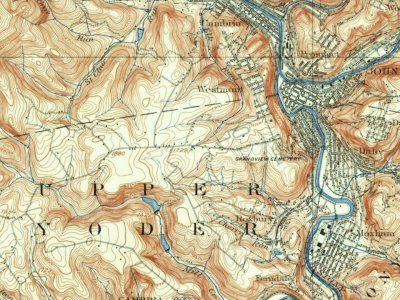
 2013
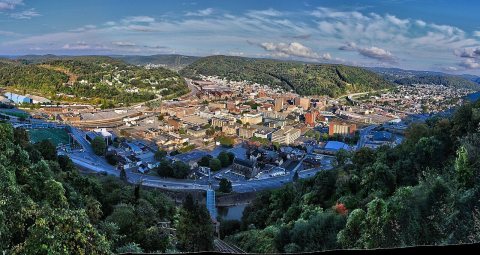 2011
 2005
 2003
 2003
 2003


