Founding year: Wikidata; Wikipedia’s history section gives the same year. First post office: 1892.
History grade
What drives Taylor’s History grade
On its age, its old homes and the National Register, Taylor is more historic than 70% of U.S. towns, #464 of 1,035 in Pennsylvania. Its share of homes from before 1940 holds the grade up; its National Register listings pull it down.
B+
HistoryA character grade: shown, never part of Taylor’s overall grade.
Pennsylvania towns list about as much on the Register as the country (a typical Pennsylvania town has 2.1 per 10,000 residents, the U.S. 2.4), so Taylor’s 0.0 sits below most of its state (25% of Pennsylvania towns have fewer) while its 0 listings outnumber those of 23% of U.S. towns.
How sure. Graded on any two of the three inputs instead, the letter would range from B− to A. The pre-1940 share is a Census survey estimate (±8.3 points). Two sources give 1790.
Founding year: Wikidata (other dates in Quick answers). Homes: Census ACS 2020–24. National Register: National Park Service, May 2026 list; each listing counted once (boundary changes and added documentation belong to their listing), and a historic district counts its contributing buildings. How TownRatings grades history →
What stands out about Taylor’s past
Read from the archive, the National Register and the record. The page puts what stands out first.
Wikipedia doesn’t have a history of Taylor yet. The photos, dates and memories neighbors add here are how it gets written.
Taylor is a borough in Lackawanna County, Pennsylvania, United States, 3 miles (5 km) southwest of Scranton on the Lackawanna River. It was founded in 1790 by Cornelius Atherton. Silk manufacturing and coal mining were once practiced in the borough. Most of Taylor is built over abandoned mines. The Pennsylvania Turnpike Northeast Extension (I-476), accessible via the Keyser Avenue Interchange, passes through Taylor, going north to Clarks Summit and south to Philadelphia. The population of Taylor at the 2020 census was 6,302.
Taylor was established in 1790. Its population held steady between the last two censuses: 6,263 in 2010, 6,294 in 2020.
Intro from Wikipedia. Population: U.S. Census Bureau.
From the old history books
What they wrote about Taylor, 1912–1928
Passages that mention Taylor, cut from the printed page as they were published.
Jubilee history commemorative of the fiftieth anniversary of the creation of Lackawanna County, Pennsylvania ..1928 · page 1035Read the page →
Read the text
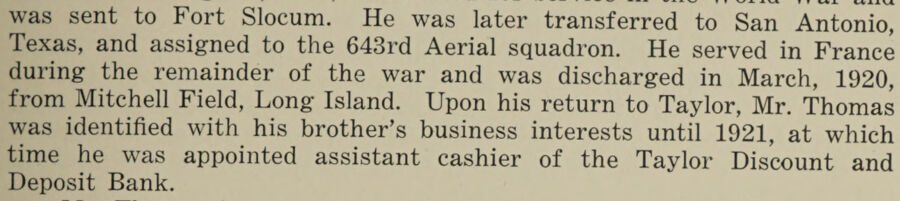
was sent to Fort Slocum. He was later transferred to San Antonio, Texas, and assigned to the 643rd Aerial squadron. He served in France during the remainder of the war and was discharged in March, 1920, from Mitchell Field, Long Island. Upon his return to Taylor, Mr. Thomas was identified with his brother’s business interests until 1921, at which time he was appointed assistant cashier of the Taylor Discount and Deposit Bank.
Text read by machine from the scan; it may contain errors.
Jubilee history commemorative of the fiftieth anniversary of the creation of Lackawanna County, Pennsylvania ..1928 · page 778Read the page →
Read the text
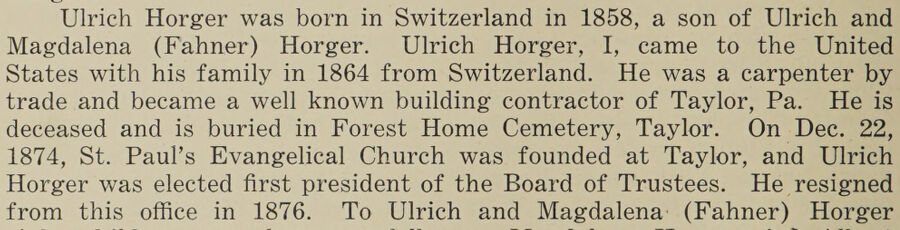
Ulrich Horger was born in Switzerland in 1858, a son of Ulrich and Magdalena (Fahner) Horger. Ulrich Horger, I, came to the United States with his family in 1864 from Switzerland. He was a carpenter by trade and became a well known building contractor of Taylor, Pa. He is deceased and is buried in Forest Home Cemetery, Taylor. On Dec. 22, 1874, St. Paul’s Evangelical Church was founded at Taylor, and Ulrich Horger was elected first president of the Board of Trustees. He resigned from this office in 1876. To Ulrich and Magdalena: (Fahner) Horger
Text read by machine from the scan; it may contain errors.
History of the Taylor family, the decendants of William and Ann (Wilson) Taylor of Lawrence County, Pennsylvania1925Read the page →
Read the text
351 Harriet Taylor, born Dec. 4, 1869 352 Anna Taylor 353 Jessie Maud Taylor, born Sept. 29, 1877 354 Georgette Taylor, born 1879 355 Kenneth Ray Taylor, born July 22, 1885 DANIEL WEBSTER3 TAYLOR (Samuel,2 William1) en¬ listed in 1861 in battery B, First Pennsylvania Light artillery, and was mustered in the early part of June, 1861, for three
Text read by machine from the scan; it may contain errors.
History and directory of Newton and Ransom townships, Lackawanna County, Pennsylvania1912 · page 97Read the page →
Read the text
Shook School Adam Taylor was the first settler in this district, on the farm now owned by Ira Drake. This was about 1825. He made a clearing and built his log-house near the spring, above the house where Philip Winters is living. Christopher Taylor, (his brother), Silas Sutton, William Brink, David Shook and others came later.
Text read by machine from the scan; it may contain errors.
Scans and text from the Internet Archive. Books published in 1930 or earlier, which are in the public domain.
By decade
Taylor, decade by decade
One decade in the archive so far: the 1910s. Scroll each row; tap a photo for its story.
Nothing in the archives for these yearsWeddings on Main Street, storms, parades, school pictures, the old store. If it’s in your family album, it belongs here.
In 1790, according to Wikidata and Wikipedia’s history of the town. Taylor’s post office opened in 1892, and the census of 1900 counted 4,215 people here.
How does Taylor rank for history?
Taylor is more historic than 70% of U.S. towns, #464 of 1,035 in Pennsylvania. The History grade combines the town’s founding era, the share of homes built before 1940 and its National Register listings. It’s a character grade, so it isn’t part of the overall grade. How it works.
How old are the homes in Taylor?
31% of Taylor’s homes were built before 1940 (Census estimate, ±8.3 points), against a typical 18% for a Pennsylvania town; the median home was built in 1960.
Founding dates: Wikidata, Wikipedia, the U.S. post office records of Blevins & Helbock (CC0) and the Census. Homes by year built: Census ACS 2020–24. National Register of Historic Places: National Park Service (list of May 22, 2026). Old photos, postcards and papers: Wikimedia Commons, the Library of Congress and other public archives, credited on each item’s page. Maps: U.S. Geological Survey historical topographic maps (via Esri) and Sanborn fire-insurance maps (Library of Congress). History text and census tables: Wikipedia (CC BY-SA 4.0). Places that used to be: USGS Geographic Names Information System (2021).
From Wikimedia Commons (11), Wikidata and Wikipedia for famous people, U.S. Geological Survey historical maps, U.S. Census counts (via Wikipedia), the US Post Offices dataset (Blevins & Helbock), the USGS Geographic Names Information System, Sanborn fire insurance maps (Library of Congress) and old county and town histories (Internet Archive). Archive images are copied here with their credits and licenses, shown on each photo’s page. Refreshed monthly.




 1916
 1916
 1916
 1916
 2026
 2015
 2015
 2014
 2013
 2012
