Founding year: Wikipedia. First post office: 1811.The full story ↓
History grade
What drives Plymouth’s History grade
On its age, its old homes and the National Register, Plymouth is more historic than 68% of U.S. towns, #505 of 1,035 in Pennsylvania. Its share of homes from before 1940 holds the grade up; its National Register listings pull it down.
B+
HistoryA character grade: shown, never part of Plymouth’s overall grade.
Pennsylvania towns list about as much on the Register as the country (a typical Pennsylvania town has 2.1 per 10,000 residents, the U.S. 2.4), so Plymouth’s 0.0 sits below most of its state (25% of Pennsylvania towns have fewer) while its 0 listings outnumber those of 23% of U.S. towns.
NoteThe founding year comes from Wikipedia alone; no second source gives 1769.
How sure. Graded on two of the three inputs, so a change in either one moves the letter more than it would with three. The pre-1940 share is a Census survey estimate (±6.5 points).
Founding year: Wikipedia (other dates in Quick answers). Homes: Census ACS 2020–24. National Register: National Park Service, May 2026 list; each listing counted once (boundary changes and added documentation belong to their listing), and a historic district counts its contributing buildings. How TownRatings grades history →
What stands out about Plymouth’s past
Read from the archive, the National Register and the record. The page puts what stands out first.
Every edition of the U.S. Geological Survey’s map of Plymouth. Tap a year, or press play to watch the town change.
1891Wilkes-Barre sheet · 1:62,500
U.S. Geological Survey historical topographic maps (public domain), via Esri’s collection of the scans. The red ring marks the center of Plymouth.
Every building
Plymouth, building by building, 1884–1912
Fire insurance maps drew every building, what it was made of and what it was used for, so insurers could price the risk of fire. Pick a year, then a sheet.
Plymouth was first settled in 1769 by New Englanders under the Susquehanna Company of Connecticut. In its earliest days, Plymouth was a quiet, agricultural community resembling a traditional New England village. However, its territory was a central battleground for the Pennamite-Yankee Wars, a series of armed land clashes between Connecticut and Pennsylvania settlers. The dispute was finally resolved in favor of Pennsylvania through the Compromise Act of 1799, which permanently secured landowners' properties under Pennsylvania's jurisdiction.
Passages that mention Plymouth, cut from the printed page as they were published.
A history of Wilkes-Barré, Luzerne County, Pennsylvania1909 · page 121Read the page →
Read the text
Jackson Township is part of the original township of Plymouth. It was organized in 1844, but, of course, its settlement history goes much farther back. The first settler in this part of Plymouth Township was Palmer Ran-
Text read by machine from the scan; it may contain errors.
A history of Wilkes-Barré, Luzerne County, Pennsylvania1909 · page 158Read the page →
Read the text
Larksville, incorporated as a borough on November 10, 1909, was formerly a village of Plymouth Township, and at one time was known as Blind Town. Many references to Blind Town will be found in the history of Plymouth Township. Hendrick B. Wright's work is the most extensive. Here it may be said that the industry of the borough, also that of the township, has always been mainly coal mining, with the progress that normally comes to a steadily operated mining property.
Text read by machine from the scan; it may contain errors.
Scans and text from the Internet Archive. Books published in 1930 or earlier, which are in the public domain.
Timeline
Plymouth, 1769 to 1959
Woven from the archive, old maps, post office records, the National Register and the people born here.
In 1769, according to Wikipedia’s history of the town. Plymouth’s post office opened in 1811, and the census of 1870 counted 2,684 people here.
How does Plymouth rank for history?
Plymouth is more historic than 68% of U.S. towns, #505 of 1,035 in Pennsylvania. The History grade combines the town’s founding era, the share of homes built before 1940 and its National Register listings. It’s a character grade, so it isn’t part of the overall grade. How it works.
How old are the homes in Plymouth?
45% of Plymouth’s homes were built before 1940 (Census estimate, ±6.5 points), against a typical 18% for a Pennsylvania town; the median home was built in 1944.
Founding dates: Wikidata, Wikipedia, the U.S. post office records of Blevins & Helbock (CC0) and the Census. Homes by year built: Census ACS 2020–24. National Register of Historic Places: National Park Service (list of May 22, 2026). Old photos, postcards and papers: Wikimedia Commons, the Library of Congress and other public archives, credited on each item’s page. Maps: U.S. Geological Survey historical topographic maps (via Esri) and Sanborn fire-insurance maps (Library of Congress). History text and census tables: Wikipedia (CC BY-SA 4.0). Places that used to be: USGS Geographic Names Information System (2021).
From Wikimedia Commons (12), Wikipedia, Wikidata and Wikipedia for famous people, U.S. Geological Survey historical maps, U.S. Census counts (via Wikipedia), the US Post Offices dataset (Blevins & Helbock), the USGS Geographic Names Information System, Sanborn fire insurance maps (Library of Congress) and old county and town histories (Internet Archive). Archive images are copied here with their credits and licenses, shown on each photo’s page. Refreshed monthly.
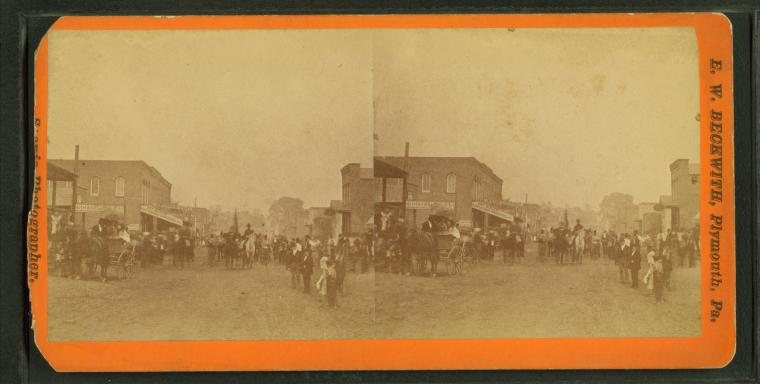




 1864
 1864
 1864
 1869
 1873
 1873
 1873
 1873
 c. 1873

