On its age, its old homes and the National Register, Huntington Township is more historic than 69% of U.S. towns. All 2 inputs are above most U.S. towns; its share of homes from before 1940 ranks highest and its National Register listings lowest.
B+
HistoryA character grade: shown, never part of Huntington Township’s overall grade.
Pennsylvania towns list about as much on the Register as the country (a typical Pennsylvania town has 2.1 per 10,000 residents, the U.S. 2.4), so Huntington Township’s 4.3 sits above most of its state (65% of Pennsylvania towns have fewer) while its 1 listings outnumber those of 51% of U.S. towns.
How sure. Graded on two of the three inputs, so a change in either one moves the letter more than it would with three. The pre-1940 share is a Census survey estimate (±6.0 points).
Founding year: our sources. Homes: Census ACS 2020–24. National Register: National Park Service, May 2026 list; each listing counted once (boundary changes and added documentation belong to their listing), and a historic district counts its contributing buildings. How TownRatings grades history →
What stands out about Huntington Township’s past
Read from the archive, the National Register and the record. The page puts what stands out first.
Huntington Township is the oldest township in Adams County. It was founded in 1745. Latimore Township was formed out of Huntington Township in 1807. The Borough of York Springs was separated from Huntington in 1868, and functioned as a business, social and religious center for Huntington for centuries.
Since the Civil War, Huntington Township has been a Republican stronghold due largely to its social conservatism and rural character. Republican candidates for office regularly obtain over 80% of the popular vote in general elections.
Passages that mention Huntington Township, cut from the printed page as they were published.
history of adams county pennsylvania.1886 · page 295Read the page →
Read the text
The early tradesmen and manufacturers of this settlement and township are named in the original assessment roll. A few, however, little more modern, but still old, are noticed here. The distillery, grist-mill and saw-mill of Samuel White, in Huntington Township were offered for sale in January, 1819. The Good Intent Woolen Factory operated in 1847 by Jacob A. Myers, on Bermudian Creek, near York Springs, was a large industry. Chestnut Grove Iron Works, formerly owned by J. R. Group & Co., were purchased in July, 1880, by Markley, Weitzel, Reck & Co., of Reading.
Text read by machine from the scan; it may contain errors.
Scans and text from the Internet Archive. Books published in 1930 or earlier, which are in the public domain.
Timeline
Huntington Township, 1832 to 1933
Woven from the archive, old maps, post office records, the National Register and the people born here.
Huntington Township is more historic than 69% of U.S. towns. The History grade combines the town’s founding era, the share of homes built before 1940 and its National Register listings. It’s a character grade, so it isn’t part of the overall grade. How it works.
What is on the National Register in Huntington Township?
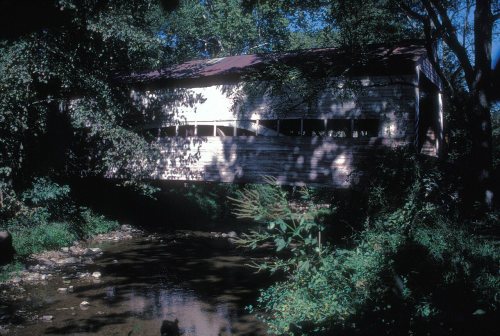
One place: the Heikes Covered Bridge (listed 1980).
How old are the homes in Huntington Township?
17% of Huntington Township’s homes were built before 1940 (Census estimate, ±6.0 points), against a typical 18% for a Pennsylvania town; the median home was built in 1983.
Founding dates: Wikidata, Wikipedia, the U.S. post office records of Blevins & Helbock (CC0) and the Census. Homes by year built: Census ACS 2020–24. National Register of Historic Places: National Park Service (list of May 22, 2026). Old photos, postcards and papers: Wikimedia Commons, the Library of Congress and other public archives, credited on each item’s page. Maps: U.S. Geological Survey historical topographic maps (via Esri) and Sanborn fire-insurance maps (Library of Congress). History text and census tables: Wikipedia (CC BY-SA 4.0). Places that used to be: USGS Geographic Names Information System (2021).
From Wikimedia Commons (3), Wikidata (1), the National Register of Historic Places (1), Wikipedia, Wikidata and Wikipedia for famous people, U.S. Census counts (via Wikipedia), the US Post Offices dataset (Blevins & Helbock), the USGS Geographic Names Information System and old county and town histories (Internet Archive). Archive images are copied here with their credits and licenses, shown on each photo’s page. Refreshed monthly.


 Date?
 2025
 2015