Bradford dates to 1823, and 62% of its homes were built before 1940
More historic than 98% of U.S. towns · #69 of 1,035 in Pennsylvania. What drives it
4 places in town are on the National Register, among them a historic district with 129 buildings. Below: 17 old photos and papers, maps from 1886 on, and the census since 1880.
Founding year: Wikidata. First post office: 1854.The full story ↓
History grade
What drives Bradford’s History grade
On its age, its old homes and the National Register, Bradford is more historic than 98% of U.S. towns, #69 of 1,035 in Pennsylvania. All 3 inputs are above most U.S. towns; its share of homes from before 1940 ranks highest and its age lowest.
A+
HistoryA character grade: shown, never part of Bradford’s overall grade.
Pennsylvania towns list about as much on the Register as the country (a typical Pennsylvania town has 2.1 per 10,000 residents, the U.S. 2.4), so Bradford’s 172 sits above most of its state (91% of Pennsylvania towns have fewer) while its 132 historic buildings outnumber those of 91% of U.S. towns.
NoteThe founding year comes from Wikidata alone; no second source gives 1823.
How sure. Graded on any two of the three inputs instead, the letter would range from A to A+. The pre-1940 share is a Census survey estimate (±5.6 points).
Founding year: Wikidata (other dates in Quick answers). Homes: Census ACS 2020–24. National Register: National Park Service, May 2026 list; each listing counted once (boundary changes and added documentation belong to their listing), and a historic district counts its contributing buildings. How TownRatings grades history →
What stands out about Bradford’s past
Read from the archive, the National Register and the record. The page puts what stands out first.
National Park Service, National Register of Historic Places. Photos from Wikimedia Commons, credited on each place’s page.
Every building
Bradford, building by building, 1886–1925
Fire insurance maps drew every building, what it was made of and what it was used for, so insurers could price the risk of fire. Pick a year, then a sheet.
Nothing in the archives for these yearsWeddings on Main Street, storms, parades, school pictures, the old store. If it’s in your family album, it belongs here.
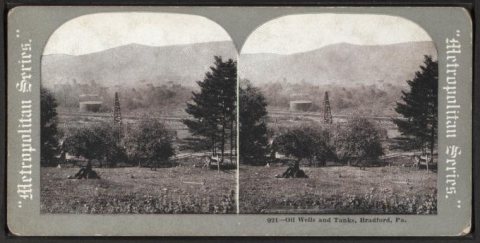
Settled in 1823, Bradford was chartered as a city in 1837 and emerged as a wild oil boomtown in the Pennsylvania oil rush in the late 19th century. The area's Pennsylvania Grade crude oil has superior qualities and is free of asphaltic constituents, contains only trace amounts of sulfur and nitrogen, and has excellent characteristics for refining into lubricants. The Bradford & Foster Brook Railway was built in 1876 as one of, if not the first, monorails in America, when Bradford was a booming oil town. World-famous Kendall racing oils were produced in Bradford.
Passages that mention Bradford, cut from the printed page as they were published.
An outline history of Tioga and Bradford counties in Pennsylvania, Chemung, Steuben, Tioga, Tompkins and Schuyler in New York1885 · page 101Read the page →
Read the text
Towanda borough was incorporated in the year 1828, and additions have since been made to it. It is the county seat of Bradford county, and one of the most flourishing and populous boroughs in Northern Pennsylvania. The Lehigh Valley railroad, the Towanda and Barclay railroad and the Sullivan and State Line railroads have stations in the borough. There are several large manufacturing establishments, giving employment to a large number of men. The borough is finely located upon the west bank of the Susquehanna, and co::tains a population of about four thousand inhabitants.
Text read by machine from the scan; it may contain errors.
An outline history of Tioga and Bradford counties in Pennsylvania, Chemung, Steuben, Tioga, Tompkins and Schuyler in New York1885 · page 114Read the page →
Read the text
easterly through Big Flats enters the town of Elmira, and passes through the center of the city of Elmira, thence southerly through the town of Southport, and along the eastern line of Ashland, enters and runs through the town of Chemung, and passes out of the county and state, into Bradford county Pennsylvania. The valley through which this river runs is one of the most fertile, productive and beautiful in the state of New York. . It was originally inhabited by Indians of the six nations, who occupied its productive lands,
Text read by machine from the scan; it may contain errors.
History of Bradford County, Pennsylvania, with biographical selections1891 · page 392Read the page →
Read the text
Anthony Vander Poel came about 1790, to Bradford county. He was the ancestor of the large family of that name now in Bradford. His first stopping-place was Aquaga, where he remained a year or two and then came to Durell creek, and from thence moved into the French settlement and engaged in the employ of that colony. He built a small log mill on Fowler creek, and lived there four or five years, but, being despoiled of the title to his land, removed to Wyalusing, and after a short time moved to the hill near Moody's pond,
Text read by machine from the scan; it may contain errors.
History of Bradford County, Pennsylvania1878 · page 176Read the page →
Read the text
In 1820 the legislature of Pennsylvania passed an act incorporating the Agricultural and Manufacturing Society of Bradford County, and in December of that year a constitution and by-laws were adopted and a public meeting held at Towanda, at which Joseph Kingsbury was elected president, Ethan Baldwin secretary, Andrew Irvine treasurer, and ten directors were chosen from different parts of the county. June 22, 1822, the Bradford Settler pub-
Text read by machine from the scan; it may contain errors.
Scans and text from the Internet Archive. Books published in 1930 or earlier, which are in the public domain.
Timeline
Bradford, 1823 to 1942
Woven from the archive, old maps, post office records, the National Register and the people born here.
In 1823, according to Wikidata. Bradford’s post office opened in 1854, and the census of 1880 counted 9,197 people here.
How does Bradford rank for history?
Bradford is more historic than 98% of U.S. towns, #69 of 1,035 in Pennsylvania. The History grade combines the town’s founding era, the share of homes built before 1940 and its National Register listings. It’s a character grade, so it isn’t part of the overall grade. How it works.
What is on the National Register in Bradford?
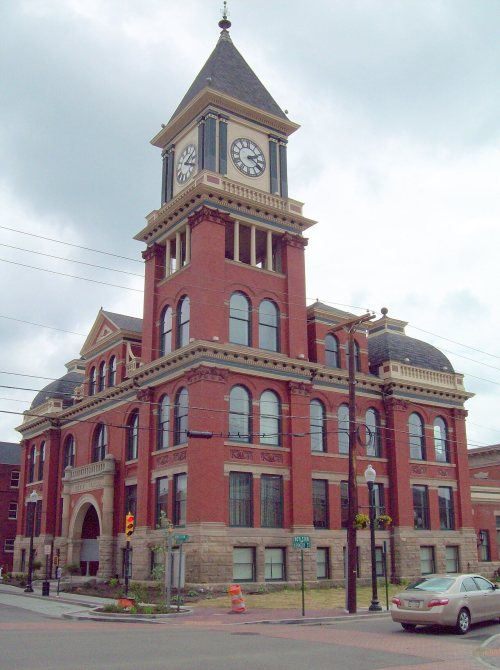
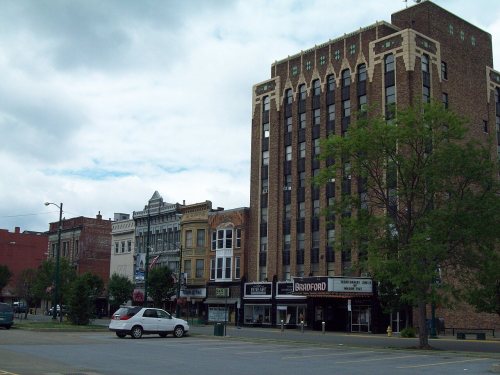
4 listings: 3 buildings, among them the Bradford Old City Hall (listed 1976, the first), and 1 historic district, the Bradford Downtown Historic District, with 129 contributing buildings. 132 historic buildings in all.
How old are the homes in Bradford?
62% of Bradford’s homes were built before 1940 (Census estimate, ±5.6 points), against a typical 18% for a Pennsylvania town; the median home was built in 1938.
Founding dates: Wikidata, Wikipedia, the U.S. post office records of Blevins & Helbock (CC0) and the Census. Homes by year built: Census ACS 2020–24. National Register of Historic Places: National Park Service (list of May 22, 2026). Old photos, postcards and papers: Wikimedia Commons, the Library of Congress and other public archives, credited on each item’s page. Maps: U.S. Geological Survey historical topographic maps (via Esri) and Sanborn fire-insurance maps (Library of Congress). History text and census tables: Wikipedia (CC BY-SA 4.0). Places that used to be: USGS Geographic Names Information System (2021).
From Wikimedia Commons (8), the Library of Congress (9), the National Register of Historic Places (4), Wikipedia, Wikidata and Wikipedia for famous people, U.S. Geological Survey historical maps, U.S. Census counts (via Wikipedia), the US Post Offices dataset (Blevins & Helbock), the USGS Geographic Names Information System, Sanborn fire insurance maps (Library of Congress) and old county and town histories (Internet Archive). Archive images are copied here with their credits and licenses, shown on each photo’s page. Refreshed monthly.





 c. 1860
 c. 1860
 c. 1860
 c. 1860
 c. 1860
 c. 1860
 1860
 1860
 1875
 1878
 1891
 1895
 1904
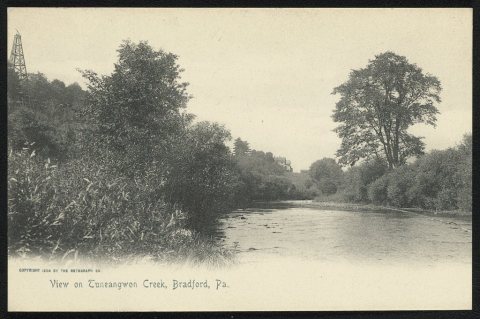 1904
 1904
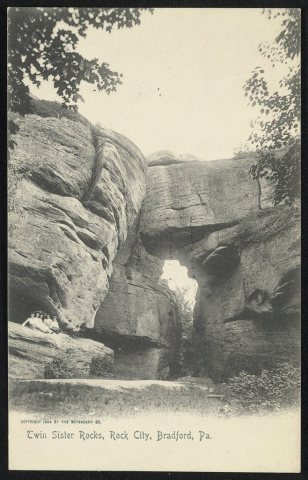 1904
 1904


