Bloomsburg dates to 1797, and 25% of its homes were built before 1940
More historic than 95% of U.S. towns · #118 of 1,035 in Pennsylvania. What drives it
2 places in town are on the National Register, among them a historic district with 668 buildings. Below: 18 old photos and papers, maps from 1885 on, and the census since 1820.
Founding year: Wikidata. First post office: 1807.The full story ↓
History grade
What drives Bloomsburg’s History grade
On its age, its old homes and the National Register, Bloomsburg is more historic than 95% of U.S. towns, #118 of 1,035 in Pennsylvania. All 3 inputs are above most U.S. towns; its National Register listings ranks highest and its age lowest.
A
HistoryA character grade: shown, never part of Bloomsburg’s overall grade.
Pennsylvania towns list about as much on the Register as the country (a typical Pennsylvania town has 2.1 per 10,000 residents, the U.S. 2.4), so Bloomsburg’s 513 sits above most of its state (94% of Pennsylvania towns have fewer) while its 668 historic buildings outnumber those of 98% of U.S. towns.
How sure. Graded on any two of the three inputs instead, the letter would range from A− to A+. The pre-1940 share is a Census survey estimate (±5.1 points). Two sources give 1797.
Founding year: Wikidata (other dates in Quick answers). Homes: Census ACS 2020–24. National Register: National Park Service, May 2026 list; each listing counted once (boundary changes and added documentation belong to their listing), and a historic district counts its contributing buildings. How TownRatings grades history →
What stands out about Bloomsburg’s past
Read from the archive, the National Register and the record. The page puts what stands out first.
National Park Service, National Register of Historic Places. Photos from Wikimedia Commons, credited on each place’s page.
Every building
Bloomsburg, building by building, 1885–1922
Fire insurance maps drew every building, what it was made of and what it was used for, so insurers could price the risk of fire. Pick a year, then a sheet.
Nothing in the archives for these yearsWeddings on Main Street, storms, parades, school pictures, the old store. If it’s in your family album, it belongs here.
The first signs of European settlement date to the year 1772, when James McClure established a log cabin in the area. Until the mid-19th century, it was just a small village, known as Bloom Township. Traditionally, Bloomsburg's founding in 1802 has been ascribed to settler Ludwig Eyer, son of Johann Martin Eyer, acting as agent for his brother Johann Adam. For 75 years after the discovery of ore in the area, Bloomsburg developed a booming iron industry.
Passages that mention Bloomsburg, cut from the printed page as they were published.
A history of Columbia County, Pennsylvania. From the earliest times.1883 · page 87Read the page →
Read the text
The town of Bloomsburg was laid out in 1802 by Ludwig Eyer. The name was pronounced as if spelled Oyer, and the place was known as Oyersburg. Many of the descendants of the Proprietor still reside here and are of our most thrifty and respected citizens. Mr. Eyer rested in the Lutheran burying ground which he gave to the congregation, for many years, but his remains were recently removed to Catawissa. He was a generous hearted and liberal minded man, of a stock of whom Pennsylvania is proud.
Text read by machine from the scan; it may contain errors.
A history of Columbia County, Pennsylvania. From the earliest times.1883 · page 93Read the page →
Read the text
The site of the Town of Bloomsburg was owned by John Adam Oyer, and the town was laid out in 1802 by Ludwig Oyer, his agent, and was known for some years as Oyersburg. The original town plot was from West to Iron streets, and from First to Third. The old tannery was built by Daniel Snyder in 1806, and the Marr store buildings were begun to be erected in the same year, by Abram Grotz. In that building Mr. John K. Grotz was
Text read by machine from the scan; it may contain errors.
A history of Columbia County, Pennsylvania1883 · page 87Read the page →
Read the text
The town of Bloomsburg was laid out in 1802 by LudwigEyer. The name was pronounced as if spelled Oyer, and the place was known as Oyersburg. Many of the descendants of the Proprietor Btill reside here and are of our most thrifty and respected citizens. Mr. Eyer rested in the Lutheran burying ground which he gave to the congregation, for many years, but his remains were recently removed to Catawissa. He was a generous hearted and liberal minded man, of a stock of whom Pennsylvania is proud.
Text read by machine from the scan; it may contain errors.
A history of Columbia County, Pennsylvania1883 · page 93Read the page →
Read the text
The site of tlie Town of Bloomsburg was owned by John Adam Oyer, and the town was laid out in 1802 by Ludwig Oyer, his agent, an<l Avas known for some years as Oyersburg. The original town ])lot Avas from West to Iron streets, and from First to Third. The old tannery was built by Daniel Snyder in 1806, and the Mai-r store buildings were begun to be erected in the same year, by Abram Grotz. In that building Mr. John K. Grotz Avas
Text read by machine from the scan; it may contain errors.
Scans and text from the Internet Archive. Books published in 1930 or earlier, which are in the public domain.
Timeline
Bloomsburg, 1797 to 1981
Woven from the archive, old maps, post office records, the National Register and the people born here.
In 1797, according to Wikidata. Bloomsburg’s post office opened in 1807, and the census of 1820 counted 1,626 people here.
How does Bloomsburg rank for history?
Bloomsburg is more historic than 95% of U.S. towns, #118 of 1,035 in Pennsylvania. The History grade combines the town’s founding era, the share of homes built before 1940 and its National Register listings. It’s a character grade, so it isn’t part of the overall grade. How it works.
What is on the National Register in Bloomsburg?
Two places: the Rupert Covered Bridge No. 56 (listed 1979) and the Bloomsburg Historic District (1983).
How old are the homes in Bloomsburg?
25% of Bloomsburg’s homes were built before 1940 (Census estimate, ±5.1 points), against a typical 18% for a Pennsylvania town; the median home was built in 1966.
Founding dates: Wikidata, Wikipedia, the U.S. post office records of Blevins & Helbock (CC0) and the Census. Homes by year built: Census ACS 2020–24. National Register of Historic Places: National Park Service (list of May 22, 2026). Old photos, postcards and papers: Wikimedia Commons, the Library of Congress and other public archives, credited on each item’s page. Maps: U.S. Geological Survey historical topographic maps (via Esri) and Sanborn fire-insurance maps (Library of Congress). History text and census tables: Wikipedia (CC BY-SA 4.0). Places that used to be: USGS Geographic Names Information System (2021).
From the Library of Congress (18), the National Register of Historic Places (2), Wikipedia, Wikidata and Wikipedia for famous people, U.S. Geological Survey historical maps, U.S. Census counts (via Wikipedia), the US Post Offices dataset (Blevins & Helbock), the USGS Geographic Names Information System, Sanborn fire insurance maps (Library of Congress) and old county and town histories (Internet Archive). Archive images are copied here with their credits and licenses, shown on each photo’s page. Refreshed monthly.


 1900
 1900
 1905
 1905
 1905
 1905
 1905
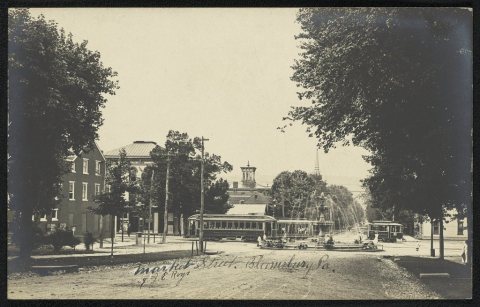 1905
 1905
 1905
 1905
 1905
 1905
 1907
 1907
 1907
 1907
 1907


![The site of tlie Town of Bloomsburg was owned by John Adam Oyer, and the town was laid out in 1802 by Ludwig Oyer, his agent, an<l Avas known for some years as Oyersburg. The original town ])lot Avas from West to Iron streets, and from First to Third. The old tannery was built by Daniel Snyder in 1…](https://images.townratings.com/story/15500/bk-265f73e587c40434-l.jpg)


