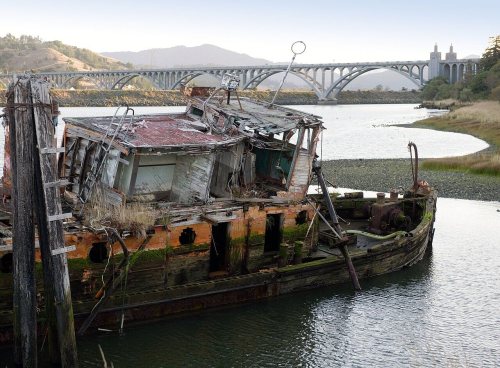
Most of Gold Beach was built recently: 8% of its homes predate 1940 and the median home dates from 1976. Its Register listings are the Hume, Mary D. and the Gold Beach Ranger Station. Below: 3 old photos and papers, maps from 1954 on, and the census since 1890.
Founding year: Wikidata. First post office: 1863.The full story ↓
History grade
What drives Gold Beach’s History grade
On its age, its old homes and the National Register, Gold Beach is more historic than 57% of U.S. towns. Its National Register listings hold the grade up; its age pulls it down.
B
HistoryA character grade: shown, never part of Gold Beach’s overall grade.
Oregon towns list more on the Register than most of the country (a typical Oregon town has 2.9 per 10,000 residents, the U.S. 2.4), so Gold Beach’s 40.6 sits above most of its state (89% of Oregon towns have fewer) while its 10 historic buildings outnumber those of 76% of U.S. towns.
NoteThe founding year comes from Wikidata alone; no second source gives 1853.
How sure. Graded on any two of the three inputs instead, the letter would range from C to B+. The pre-1940 share is a Census survey estimate (±4.7 points).
Founding year: Wikidata (other dates in Quick answers). Homes: Census ACS 2020–24. National Register: National Park Service, May 2026 list; each listing counted once (boundary changes and added documentation belong to their listing), and a historic district counts its contributing buildings. How TownRatings grades history →
What stands out about Gold Beach’s past
Read from the archive, the National Register and the record. The page puts what stands out first.
The early narrative of Gold Beach represents an intricate tapestry encompassing Native American civilizations and conflicts, Spanish explorers and European fur traders, ranchers, gold prospectors, loggers, fishermen, mill operatives, and townspeople.
The community was originally named Ellensburg in the 1850s, but later took the name Gold Beach after a beach near the mouth of the Rogue River where hundreds of placer mines extracted gold. An Ellensburg post office was established in 1853, changed to Ellensburg in 1877, and changed to Gold Beach in 1890.
Mailboats based in Gold Beach have been delivering mail upstream to Agness since 1895, one of only two rural mailboat routes remaining in the U.S.
Nothing in the archives for these yearsWeddings on Main Street, storms, parades, school pictures, the old store. If it’s in your family album, it belongs here.
Nothing in the archives for these yearsWeddings on Main Street, storms, parades, school pictures, the old store. If it’s in your family album, it belongs here.
In 1853, according to Wikidata. Gold Beach’s post office opened in 1863, and the census of 1890 counted 200 people here.
How does Gold Beach rank for history?
Gold Beach is more historic than 57% of U.S. towns. The History grade combines the town’s founding era, the share of homes built before 1940 and its National Register listings. It’s a character grade, so it isn’t part of the overall grade. How it works.
What is on the National Register in Gold Beach?
Two places: the Hume, Mary D. (listed 1979) and the Gold Beach Ranger Station (1986).
How old are the homes in Gold Beach?
8% of Gold Beach’s homes were built before 1940 (Census estimate, ±4.7 points), against a typical 5.3% for an Oregon town; the median home was built in 1976.
Founding dates: Wikidata, Wikipedia, the U.S. post office records of Blevins & Helbock (CC0) and the Census. Homes by year built: Census ACS 2020–24. National Register of Historic Places: National Park Service (list of May 22, 2026). Old photos, postcards and papers: Wikimedia Commons, the Library of Congress and other public archives, credited on each item’s page. Maps: U.S. Geological Survey historical topographic maps (via Esri) and Sanborn fire-insurance maps (Library of Congress). History text and census tables: Wikipedia (CC BY-SA 4.0). Places that used to be: USGS Geographic Names Information System (2021).
From Wikimedia Commons (4), the Library of Congress (1), Wikidata (1), the National Register of Historic Places (2), Wikipedia, Wikidata and Wikipedia for famous people, U.S. Geological Survey historical maps, U.S. Census counts (via Wikipedia), the US Post Offices dataset (Blevins & Helbock) and the USGS Geographic Names Information System. Archive images are copied here with their credits and licenses, shown on each photo’s page. Refreshed monthly.


 1972
 2009
 2004