Portsmouth dates to 1803, and 43% of its homes were built before 1940
More historic than 97% of U.S. towns · #26 of 993 in Ohio. What drives it
35 places in town are on the National Register, among them three historic districts with 105 buildings between them. Below: 4 old photos and papers, maps from 1957 on, and the census since 1820.
Founding year: Wikidata; Wikipedia’s history section gives the same year. First post office: 1808.The full story ↓
History grade
What drives Portsmouth’s History grade
On its age, its old homes and the National Register, Portsmouth is more historic than 97% of U.S. towns, #26 of 993 in Ohio. All 3 inputs are above most U.S. towns; its share of homes from before 1940 ranks highest and its age lowest.
A+
HistoryA character grade: shown, never part of Portsmouth’s overall grade.
Ohio towns list about as much on the Register as the country (a typical Ohio town has 2.9 per 10,000 residents, the U.S. 2.4), so Portsmouth’s 78.4 sits above most of its state (91% of Ohio towns have fewer) while its 139 historic buildings outnumber those of 91% of U.S. towns.
How sure. Graded on any two of the three inputs instead, the letter would range from A to A+. The pre-1940 share is a Census survey estimate (±3.7 points). Two sources give 1803.
Founding year: Wikidata (other dates in Quick answers). Homes: Census ACS 2020–24. National Register: National Park Service, May 2026 list; each listing counted once (boundary changes and added documentation belong to their listing), and a historic district counts its contributing buildings. How TownRatings grades history →
What stands out about Portsmouth’s past
Read from the archive, the National Register and the record. The page puts what stands out first.
The area was occupied by Native Americans as early as 100 BC, as indicated by the Portsmouth Earthworks, a ceremonial center built by the Ohio Hopewell culture between 100 and 500 AD.
According to early 20th-century historian Charles Augustus Hanna, a Shawnee village was founded at the site of modern-day Portsmouth in late 1758, following the abandonment of Lower Shawneetown.
European-Americans began to settle in the 1790s after the American Revolutionary War, and the small town of Alexandria was founded. Located at the confluence, Alexandria was flooded numerous times by the Ohio River and the Scioto River.
Passages that mention Portsmouth, cut from the printed page as they were published.
A history of Scioto County, Ohio,1903 · page 455Read the page →
Read the text
Portsmouth’s New .Charter. — Vol. 49, page 117, March 17, 1851. An amendment to the act incorporating the City of Portsmouth perpetuating all ordinances of the Town of Portsmouth not inconsistent with the act of incorporation.
Text read by machine from the scan; it may contain errors.
history of scioto county, ohio, together with a pioneer record of southern ohio1903 · page 455Read the page →
Read the text
Portsmouth’s New Charter.—Vol. 49, page 117, March 17, 1851. An amendment to the act incorporating the City of Portsmouth perpetuating all ordinances of the Town of Portsmouth not inconsistent with the act of incorporation. ; School House.—Vol. 69, page 265, April 25, 1872, authorized the Board of Education of Portsmouth to borrow, $20,000 to erect a school house. Bonds were to run four years.
Text read by machine from the scan; it may contain errors.
history of scioto county, ohio, together with a pioneer record of southern ohio1903 · page 1316Read the page →
A history of Scioto County, Ohio,1903 · page 704Read the page →
Read the text
David GharKy was one of the most interesting characters who ever took part in public affairs in Portsmouth. To begin with, he was one of the first nine City Fathers of Portsmouth, Ohio, and he continued to be a Councilman of the town of Portsmouth from March 15, 1815, until March, 1823. He was Town Treasurer of Portsmouth, Ohio, from March 15, 1815, until April 1, 1822, when he was removed by a unanimous vote for squandering the circulating medium of the
Text read by machine from the scan; it may contain errors.
Scans and text from the Internet Archive. Books published in 1930 or earlier, which are in the public domain.
Timeline
Portsmouth, 1803 to 1957
Woven from the archive, old maps, post office records, the National Register and the people born here.
Nothing in the archives for these yearsWeddings on Main Street, storms, parades, school pictures, the old store. If it’s in your family album, it belongs here.
In 1803, according to Wikidata and Wikipedia’s history of the town. Portsmouth’s post office opened in 1808, and the census of 1820 counted 527 people here.
How does Portsmouth rank for history?
Portsmouth is more historic than 97% of U.S. towns, #26 of 993 in Ohio. The History grade combines the town’s founding era, the share of homes built before 1940 and its National Register listings. It’s a character grade, so it isn’t part of the overall grade. How it works.
What is on the National Register in Portsmouth?
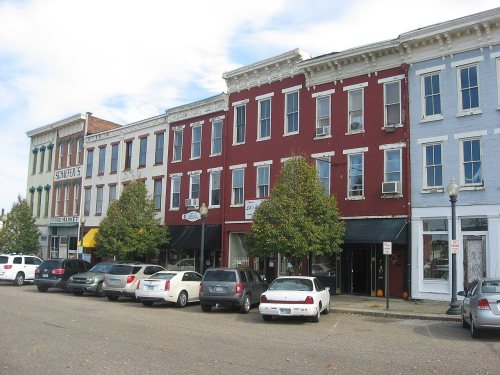
35 listings: 29 buildings, among them the Aaron Kinney House (listed 1973, the first), 3 historic districts, the Boneyfiddle Commercial Disrict, the Second Street Historic District and the Sixth Street Historic District, with 105 contributing buildings, 1 site, and 2 structures. 139 historic buildings in all.
How old are the homes in Portsmouth?
43% of Portsmouth’s homes were built before 1940 (Census estimate, ±3.7 points), against a typical 15% for an Ohio town; the median home was built in 1946.
Founding dates: Wikidata, Wikipedia, the U.S. post office records of Blevins & Helbock (CC0) and the Census. Homes by year built: Census ACS 2020–24. National Register of Historic Places: National Park Service (list of May 22, 2026). Old photos, postcards and papers: Wikimedia Commons, the Library of Congress and other public archives, credited on each item’s page. Maps: U.S. Geological Survey historical topographic maps (via Esri) and Sanborn fire-insurance maps (Library of Congress). History text and census tables: Wikipedia (CC BY-SA 4.0). Places that used to be: USGS Geographic Names Information System (2021).
From Wikimedia Commons (2), the Library of Congress (2), Wikidata (2), the National Register of Historic Places (35), Wikipedia, Wikidata and Wikipedia for famous people, U.S. Geological Survey historical maps, U.S. Census counts (via Wikipedia), the US Post Offices dataset (Blevins & Helbock), the USGS Geographic Names Information System and old county and town histories (Internet Archive). Archive images are copied here with their credits and licenses, shown on each photo’s page. Refreshed monthly.




 1866

