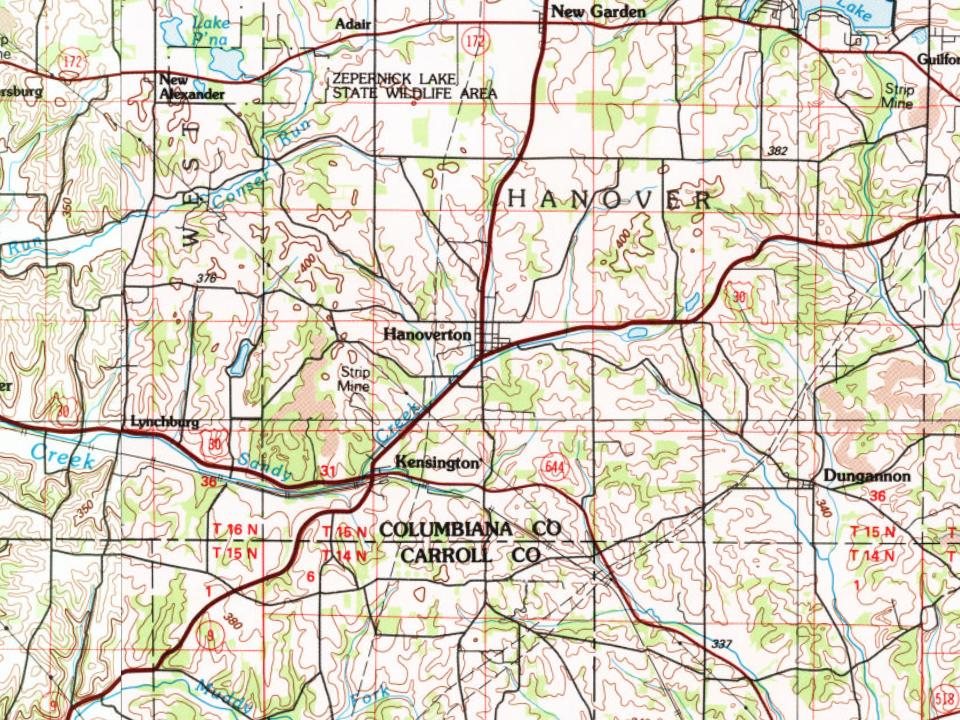
Hanoverton was laid out in 1813 by Quaker abolitionist James Craig and incorporated as a village in 1836. Hanoverton experienced growth in the 1830s by the building of the Sandy and Beaver Canal through the town, reaching a peak population in the late decade of around 2,000 inhabitants. Growth slowed into the 1840s; by the 1852 completion of the Cleveland and Pittsburgh Railroad the canal was no longer profitable and the town declined.
Passages that mention Hanoverton, cut from the printed page as they were published.
History of Columbiana county, Ohio1879 · page 166Read the page →
Read the text
David Grim & Co. have a steam grist-mill north of Hanoverton, with two run of buhrs. This mill was built by Burton Sinclair, upon the site of the mill put up by George Brown, one of the pioneers of Hanover. George Moore operates a saw-mill at Hanoverton, which he took in 1873 from William Sinclair. Mr. Moore cuts about three hundred thousand feet of lumber annually, besides doing considerable planing and turning-work.
Text read by machine from the scan; it may contain errors.
History of Columbiana county, Ohio1879 · page 159Read the page →
Read the text
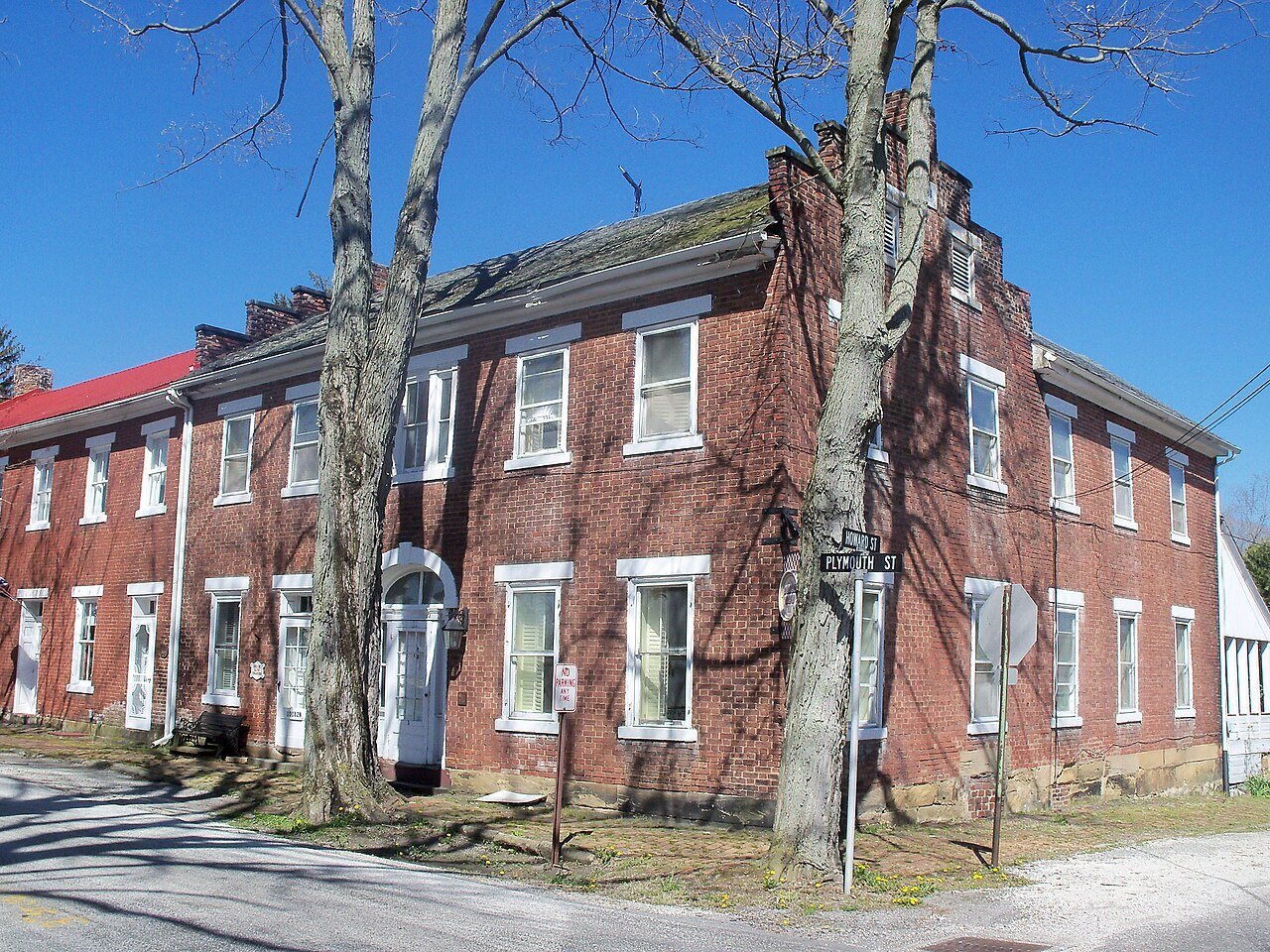
Hanover village (known as Hanoverton Post-office) was laid out in May, 1813, by James Craig, who, purchasing the northwest quarter of section 28 of Joseph Milner, platted a village, and called it Hanover. The village street was the one now called Plymouth Street, running north and south. Craig organized a stock company, or co-operative store, obtained an appointment as postmaster, built a sawand grist-mill, and gave the village a good start. The
Text read by machine from the scan; it may contain errors.
History of Hanover, Columbiana County, Ohio, 1804-19081908Read the page →
Read the text
A postoffice was established at Hanover about 1812, when James Craig was postmaster. At that time the name of the postoffice was Hanoverton, as there was already a Hanover in Ohio. After the failure of the company store which Craig managed, the postoffice was discontinued for a time. Then in 1832 Owen Williams was appointed postmaster. George Freace was the next postmaster, in 1837, and after him the office was held by the following persons: Henry Freace, J. R. Arter, William Hamilton, A. N. Kinear, George
Text read by machine from the scan; it may contain errors.
History of Columbiana County, Ohio1905 · page 282Read the page →
Read the text
The Disciples Church at Hanoverton traces its origin back to 1820, when the Christian Church was organized there. The first house of worship was a log cabin just south of Hanover village. In 1830 the congregation was reorganized as the Disciples Church. An addition to the church was built, and that house served until 1859, when a new building was
Text read by machine from the scan; it may contain errors.
Scans and text from the Internet Archive. Books published in 1930 or earlier, which are in the public domain.
Timeline
Hanoverton, 1813 to 1986
Woven from the archive, old maps, post office records, the National Register and the people born here.
Founding dates: Wikidata, Wikipedia, the U.S. post office records of Blevins & Helbock (CC0) and the Census. Homes by year built: Census ACS 2020–24. National Register of Historic Places: National Park Service (list of May 22, 2026). Old photos, postcards and papers: Wikimedia Commons, the Library of Congress and other public archives, credited on each item’s page. Maps: U.S. Geological Survey historical topographic maps (via Esri) and Sanborn fire-insurance maps (Library of Congress). History text and census tables: Wikipedia (CC BY-SA 4.0). Places that used to be: USGS Geographic Names Information System (2021). How TownRatings grades history →
From Wikimedia Commons (6), the National Register of Historic Places (1), Wikipedia, Wikidata and Wikipedia for famous people, U.S. Geological Survey historical maps, U.S. Census counts (via Wikipedia), the US Post Offices dataset (Blevins & Helbock), the USGS Geographic Names Information System, Sanborn fire insurance maps (Library of Congress) and old county and town histories (Internet Archive). Archive images are copied here with their credits and licenses, shown on each photo’s page. Refreshed monthly.


 2018
 2015
 2010
 2010
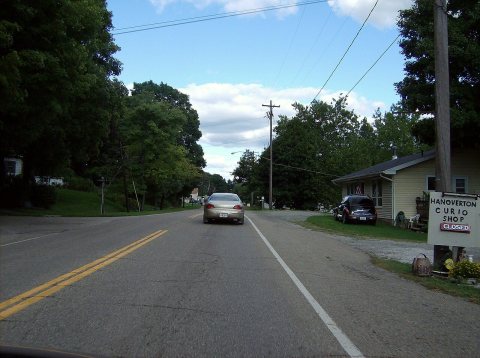 2007
 2004