East Cleveland’s post office opened in 1847, and 61% of its homes were built before 1940
More historic than 98% of U.S. towns · #19 of 993 in Ohio. What drives it
6 places in town are on the National Register, among them three historic districts with 101 buildings between them. Below: 12 old photos and papers, maps from 1901 on, and the census since 1880.
From East Cleveland’s archive · credits on each photo
Quick answers
How East Cleveland began
When was East Cleveland founded?
1847
The East Cleveland post office opened in 1847, the earliest record of the town by name. Wikidata gives 1895. Another post office, Collamer (1849), opened inside today’s city and later closed.
First census: 2,876 in 18802020 census: 13,792179 years
How historic is East Cleveland?
A+
More historic than 98% of U.S. towns, on its age, its old homes and the National Register.
Founding year: the first East Cleveland post office (Blevins & Helbock, CC0). Wikidata: 1895.The full story ↓
History grade
What drives East Cleveland’s History grade
On its age, its old homes and the National Register, East Cleveland is more historic than 98% of U.S. towns, #19 of 993 in Ohio. All 3 inputs are above most U.S. towns; its share of homes from before 1940 ranks highest and its age lowest.
A+
HistoryA character grade: shown, never part of East Cleveland’s overall grade.
Ohio towns list about as much on the Register as the country (a typical Ohio town has 2.9 per 10,000 residents, the U.S. 2.4), so East Cleveland’s 77.6 sits above most of its state (91% of Ohio towns have fewer) while its 105 historic buildings outnumber those of 90% of U.S. towns.
How sure. Graded on any two of the three inputs instead, the letter would range from A to A+. The pre-1940 share is a Census survey estimate (±3.4 points). The founding year is the first post office, not a stated founding date; Wikidata gives 1895.
Founding year: the first post office (other dates in Quick answers). Homes: Census ACS 2020–24. National Register: National Park Service, May 2026 list; each listing counted once (boundary changes and added documentation belong to their listing), and a historic district counts its contributing buildings. How TownRatings grades history →
What stands out about East Cleveland’s past
Read from the archive, the National Register and the record. The page puts what stands out first.
National Park Service, National Register of Historic Places. Photos from Wikimedia Commons, credited on each place’s page.
On the map
East Cleveland on the map, 1901 to 1994
Every edition of the U.S. Geological Survey’s map of East Cleveland. Tap a year, or press play to watch the town change.
1901Euclid sheet · 1:62,500
U.S. Geological Survey historical topographic maps (public domain), via Esri’s collection of the scans. The red ring marks the center of East Cleveland.
Historically East Cleveland was partially founded by Scottish immigrants, whose names can still be found in the city such as Shaw, McIlrath, and Eddy. East Cleveland incorporated as a village in 1895 and became a city in 1911. This charter included provisions for women's suffrage, which at the time was unheard of east of the Mississippi River. Before the charter passed, the city of Cleveland unsuccessfully attempted to annex the emerging municipality in 1910 and again in 1916.
Passages that mention East Cleveland, cut from the printed page as they were published.
History of Cuyahoga County, Ohio. With portraits and biographical sketches of its prominent men and pioneers1879 · page 443Read the page →
Read the text
The second actual settler in the present township of East Cleveland was Asa Dille, a brother of David Dille, of Euclid, who moved from Pennsylvania in March, 1804; putting up his cabin in the unbroken forest near th.e southwestern corner of the old township of Euclid. There he lived and died, raising a large family of children.
Text read by machine from the scan; it may contain errors.
History of Cuyahoga County, Ohio ..1879 · page 443Read the page →
Read the text
The second actual settler in the present township of East Cleveland was Asa Dille, a brother of David Dille, of Euclid, who moved from Pennsylvania in March, 1804; putting up his cabin in the unbroken forest near the southwestern corner of the old township of Euclid. There he lived and died, raising a large family of children.
Text read by machine from the scan; it may contain errors.
History of Cuyahoga County, Ohio ...1881 · page 447Read the page →
Read the text
For many years after the fornuition of the township, tlic interest regarding it principally centered in the village of East Cleveland, which grew rapidly into very extensive proportions, becoming an important suburb of the city. In 1852 the Cleveland, Painesville and Ashtabula railroad (since becoming a part of the Lake Shore and Michinan Southern), was opened from Clcvelaud to Erie, running through the lujrtiiern
Text read by machine from the scan; it may contain errors.
History of Cuyahoga County, Ohio. With portraits and biographical sketches of its prominent men and pioneers1879 · page 452Read the page →
Read the text
ing applied first to the survey-township and then to the civil township covering the same territory. The western and southwestern parts have since been taken off to form part of the township of East Cleveland; leaving Euclid an irregular ti-act, with an eastern boundary nearly nine miles long, a southern one less than three miles long, and a northwestern one (on the lake shore) about six miles long. This sketch is in-
Text read by machine from the scan; it may contain errors.
Scans and text from the Internet Archive. Books published in 1930 or earlier, which are in the public domain.
Timeline
East Cleveland, 1847 to 1971
Woven from the archive, old maps, post office records, the National Register and the people born here.
Nothing in the archives for these yearsWeddings on Main Street, storms, parades, school pictures, the old store. If it’s in your family album, it belongs here.
The East Cleveland post office opened in 1847, the earliest record of the town by name (U.S. post office records). Wikidata gives 1895.
How does East Cleveland rank for history?
East Cleveland is more historic than 98% of U.S. towns, #19 of 993 in Ohio. The History grade combines the town’s founding era, the share of homes built before 1940 and its National Register listings. It’s a character grade, so it isn’t part of the overall grade. How it works.
What is on the National Register in East Cleveland?
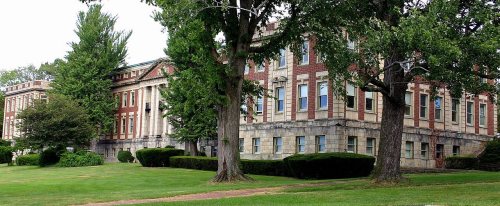
6 listings: 3 buildings and 3 historic districts, the Nela Park, the Forest Hill Historic District and the Forest Hill Park, with 101 contributing buildings. 105 historic buildings in all.
How old are the homes in East Cleveland?
61% of East Cleveland’s homes were built before 1940 (Census estimate, ±3.4 points), against a typical 15% for an Ohio town; the median home was built in 1938.
Founding dates: Wikidata, Wikipedia, the U.S. post office records of Blevins & Helbock (CC0) and the Census. Homes by year built: Census ACS 2020–24. National Register of Historic Places: National Park Service (list of May 22, 2026). Old photos, postcards and papers: Wikimedia Commons, the Library of Congress and other public archives, credited on each item’s page. Maps: U.S. Geological Survey historical topographic maps (via Esri) and Sanborn fire-insurance maps (Library of Congress). History text and census tables: Wikipedia (CC BY-SA 4.0). Places that used to be: USGS Geographic Names Information System (2021).
From Wikimedia Commons (12), the National Register of Historic Places (6), Wikipedia, Wikidata and Wikipedia for famous people, U.S. Geological Survey historical maps, U.S. Census counts (via Wikipedia), the US Post Offices dataset (Blevins & Helbock), the USGS Geographic Names Information System and old county and town histories (Internet Archive). Archive images are copied here with their credits and licenses, shown on each photo’s page. Refreshed monthly.




 1906
 1906
 1908
 1908
 1908
 1908
 1908
 1908
 1908
 1908
 1908

