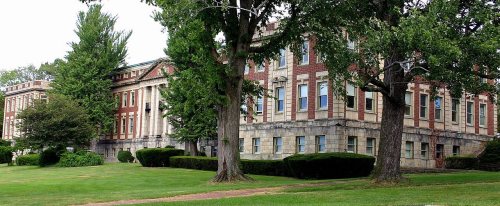
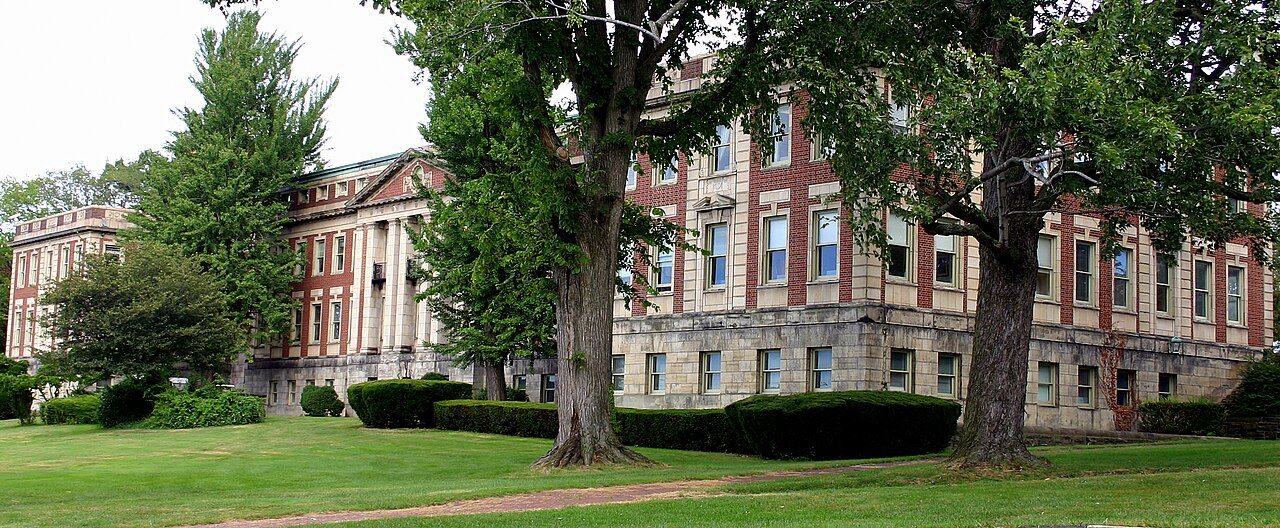
The weak point is health (D−): on CDC estimates, its residents' health ranks in the bottom 2% nationally. Walkability is its strong suit (A+): it is more walkable than 98% of U.S. towns. All told, that adds up to a D overall and a rank of 964th of 987 in Ohio. Set against the rest, it does better than nearly a tenth of U.S. towns. Safety is weaker too — it reports more crime per resident than 99% of U.S. towns, including 228 violent crimes reported to the FBI in 2025. It lags on incomes as well (D): the median household income is $22K, and 41% of residents live below the poverty line. Its National Register listings include Nela Park and First Church of Christ in Euclid. History is its standout character grade: an A+, better than 98% of U.S. towns, with 6 places on the National Register.
Figures: health, CDC PLACES · FBI crime data, 2025 · incomes, Census ACS, 2020–24 · National Register of Historic Places.
Census counts: 2,876 in 1880, a peak of 40,047 in 1950, 13,792 in 2020. The archive holds 12 old photos and papers going back to 1906 and 5 maps from 1901 on.
6 places on the National Register of Historic Places.
East Cleveland has a longer frost-free season than almost anywhere else in Ohio and is healthier than towns with similar incomes, but it reports violent crime at 6 times the Ohio rate.
At 0.9 years of the Cleveland metro’s $71K median household income, the typical home (about $67K) costs less against local pay than in any other Ohio town; that ratio is one input to its A− for cost of living. Values fell 4.2% in the past year while the Ohio typical home rose 3.2%.
For East Cleveland, the typical rent is $776 a month. East Cleveland: 64% of renter households spend 30% or more of their income on rent, where Ohio’s towns sit at 42% and U.S. towns at 48%. Also worth knowing: homes in the town are typically worth about $67,000, 73% below the Ohio typical home. A home in East Cleveland typically sold within 78 days of listing.
The East Cleveland City School District runs its public schools. The largest public high school is Shaw High School, with 420 students. Two of the 6 schools are below, and why each made the list.
20%of OH districts it outscoresC−School Grade
School
Level
Students
Letter
Apex AcademyLargest public elementary schoolGrades K–8
Against the 122 U.S. towns with household incomes like East Cleveland’s, it is less healthy than 64%, so its D− isn’t only a matter of income.
A fifth of East Cleveland adults report frequent physical distress. East Cleveland: 43% of adults feel lonely, above both Ohio’s towns (34%) and U.S. towns (33%). Two figures for adults in the town: 25% smoke cigarettes, 50% have obesity. Only one of the 993 Ohio towns we compare has a higher share of adults who had a checkup this year than East Cleveland.
1%healthier than U.S. townsD−Health Grade
East Cleveland
Ohio towns
U.S. towns
Fair or poor health (CDC PLACES)
38%
20%
19%
Smoke cigarettes (CDC PLACES)
25%
16%
14%
Obesity (CDC PLACES)
50%
38%
35%
Diabetes (CDC PLACES)
27%
13%
12%
32 measures vs. Ohio
5 better3 too close to call24 worse
What stands out
East Cleveland
OH
Fewer binge drinkers
11.1%
16.6%
Fewer adults who have had cancer
6.3%
8.7%
More adults facing a utility shut-off
27.5%
8.3%
Louis Stokes Cleveland VA Medical Center
2.2 mi away · emergency room
3 of 3
care shortages: primary care, dental, mental health
Violent crime runs at 17.1 per 1,000 residents, 6 times the Ohio rate; the Safety Grade counts each violent crime four times, so this weighs most on its D−.
No town among the 313 in Ohio we compare has a higher rate of reported violence than East Cleveland. The level of property crime locally is 29.3 per 1,000 residents.
Count the trails in 5 parks and preserves and they come to 1.7 miles. The biggest place to walk is Forest Hill Park, 182 acres with 1.3 miles of trail. East Cleveland’s trail network density is 0.6 miles per square mile.
Storm and flood damage is expected to run lower than in four fifths of U.S. communities. Federal disaster aid has reached households in East Cleveland after 4 declared disasters, most recently in 2012. Of the losses FEMA expects in the town, 63% come from inland flooding and 18% from cold waves. Since 1983, one flood insurance claim has been paid here.
Half the trips to work are shorter than 7 miles. Of the 992 Ohio towns we compare, none has a lower typical household income than East Cleveland. Most people who work leave East Cleveland to do it: just 4% work in town. Only 2 of the 993 Ohio towns we compare have a higher share of residents below the poverty line than East Cleveland.
4%work in town
East Cleveland
Ohio towns
U.S. towns
Below the poverty line
41%
9.1%
9.6%
Median household income
$22,000
$75,000
$80,000
Working residents who work in town
3.9%
6.9%
8%
Work from home
9.1%
9.7%
11%
Where working residents work
In East Cleveland4%
Cleveland34%
Euclid5%
Beachwood2%
Cleveland Heights2%
7 mi
median commute distance
1,896
jobs based in East Cleveland
A commuter town
jobs vs. working residents
A+
Walkability grade: more walkable than 98% of U.S. towns
The Cleveland weather station, 17 miles away, records that the frost-free season runs about 198 days, the highest of 2,573 Ohio places with climate records.
In July, afternoons reach 82°; in January, nights fall to 21°, and about 64 inches of snow falls in a winter.
East Cleveland is a city in Cuyahoga County, Ohio, United States. The population was 13,792 at the 2020 census, and was estimated to be 13,402 in 2024. It is a suburb lying east and south of Cleveland and west of Cleveland Heights.
East Cleveland grades D overall, better than 9% of U.S. towns and #964 of 987 in Ohio. It grades D− for health, D− for safety and C− for schools. Health is its weak spot, with a D−.
What is East Cleveland, OH known for?
17 notable people were born here, including Christine Chubbuck and Yvette Nicole Brown.



 7 mi
 6 mi
 9 mi
 2 mi


