Founding year: Wikipedia. First post office: 1820.The full story ↓
History grade
What drives Stafford’s History grade
On its age, its old homes and the National Register, Stafford is more historic than 90% of U.S. towns. All 3 inputs are above most U.S. towns; its share of homes from before 1940 ranks highest and its National Register listings lowest.
A
HistoryA character grade: shown, never part of Stafford’s overall grade.
New York towns list more on the Register than most of the country (a typical New York town has 12.3 per 10,000 residents, the U.S. 2.4), so Stafford’s 26.7 sits near the middle of its state (60% of New York towns have fewer) while its 6 historic buildings outnumber those of 72% of U.S. towns.
How sure. Graded on any two of the three inputs instead, the letter would range from A− to A. The pre-1940 share is a Census survey estimate (±7.7 points). Two sources give 1798.
Founding year: Wikipedia (other dates in Quick answers). Homes: Census ACS 2020–24. National Register: National Park Service, May 2026 list; each listing counted once (boundary changes and added documentation belong to their listing), and a historic district counts its contributing buildings. How TownRatings grades history →
What stands out about Stafford’s past
Read from the archive, the National Register and the record. The page puts what stands out first.
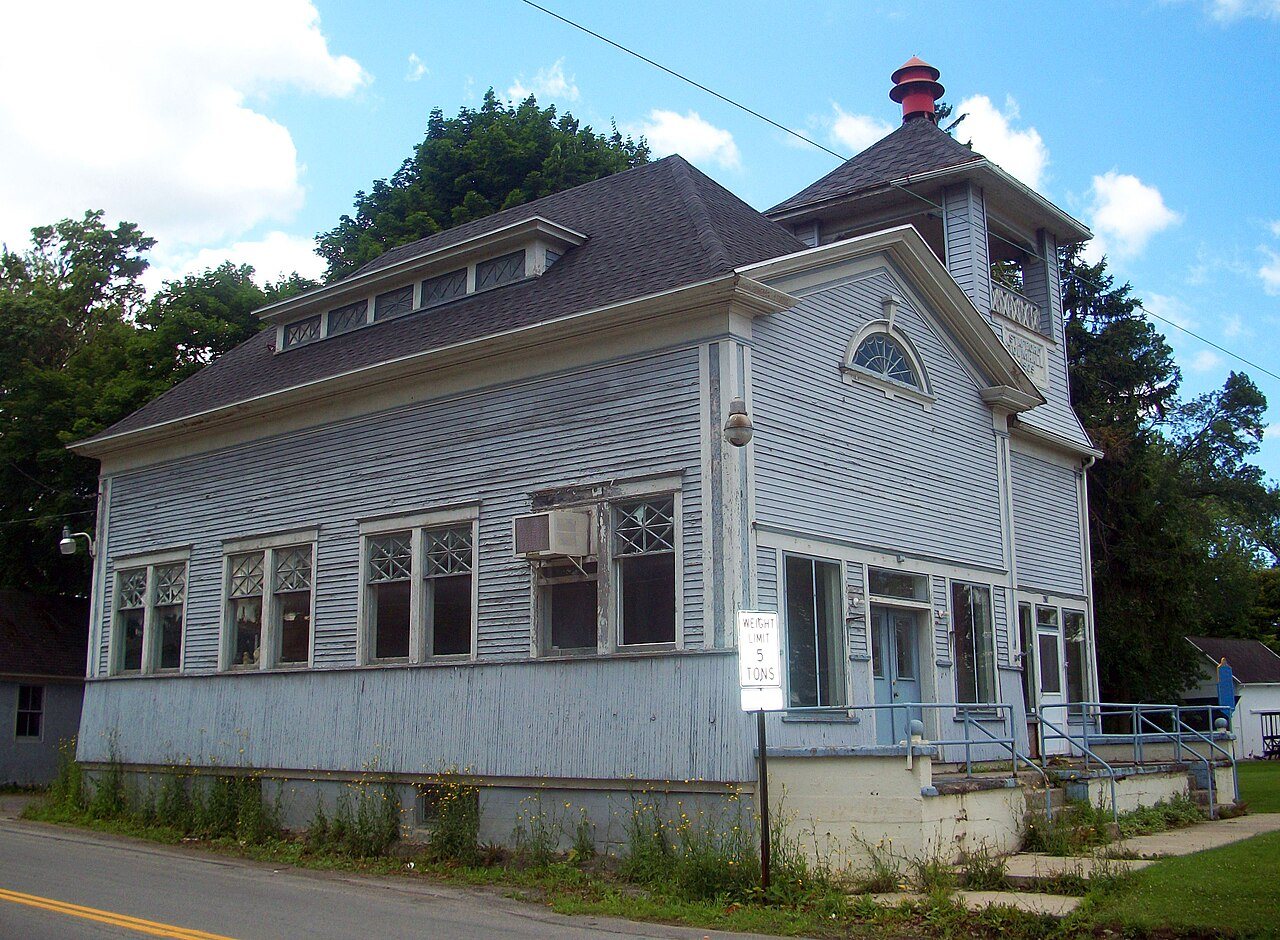
The town was first settled in 1798, one of the first of the towns in the Holland Purchase to be occupied. Stafford was formed in 1820 from parts of the towns of Batavia and Le Roy. Part of Stafford was taken to form the town of Pavilion in 1842. The historic core at the hamlet of Stafford was listed on the National Register of Historic Places as the Stafford Village Four Corners Historic District in 1985.
Passages that mention Stafford, cut from the printed page as they were published.
Foote family, comprising the genealogy and history of Nathaniel Foote, of Wethersfield, Conn., and his descendants1907 · page 84Read the page →
Read the text
"In May, 1773, he removed from Colchester to what was called Square Pond Settlement, being within the limits of East Winsor, and bounding on West Stafford, Ct. In May, 1778, he removed to Stafford, and in the year- 1779 he was by united application of the people appointed Justice of the Peace, which office he continued to hold until he removed from that state. He was frequently elected to represent the town of Stafford in the General Assembly of Connecticut, and was a delegate to the convention to consider the adoption of the Constitution of the United States.
Text read by machine from the scan; it may contain errors.
The history of the town and castle of Tamworth, in the counties of Stafford & Warwick1845 · page 444Read the page →
Read the text
three, the survivors should immediately elect four more new trustees, substantial inhabitants of the town of Tamworth or gentlemen of estate and condition in the counties of Stafford or Warwick. The expenses of the new deeds of trust, and all other charges incident to the charity should be paid out of the poors* levies whilst the building should serve as a Workhouse, and afterwards out of the rents and profits of the messuage.'
Text read by machine from the scan; it may contain errors.
The history of the town and castle of Tamworth, in the counties of Stafford & Warwick1845 · page 487Read the page →
Read the text
the baili& and commonalty took charge of that part belonging to the town:* for the Bridge has ever been, half in the jurisdiction of the borough, and half in that of the county of Stafford. Lady-bridge was originally a low and narrow structure, inferior, as Leland observes, to Bolebridge, which it resembled in a great measure, being very narrow, and provided with triangular recesses placed over the
Text read by machine from the scan; it may contain errors.
Scans and text from the Internet Archive. Books published in 1930 or earlier, which are in the public domain.
Timeline
Stafford, 1798 to 1990
Woven from the archive, old maps, post office records, the National Register and the people born here.
In 1798, according to Wikipedia’s history of the town. Stafford’s post office opened in 1820, and the census of 1820 counted 2,069 people here.
How does Stafford rank for history?
Stafford is more historic than 90% of U.S. towns. The History grade combines the town’s founding era, the share of homes built before 1940 and its National Register listings. It’s a character grade, so it isn’t part of the overall grade. How it works.
What is on the National Register in Stafford?
One place: the Stafford Village Four Corners Historic District (listed 1976).
How old are the homes in Stafford?
37% of Stafford’s homes were built before 1940 (Census estimate, ±7.7 points), against a typical 27% for a New York town; the median home was built in 1956.
Founding dates: Wikidata, Wikipedia, the U.S. post office records of Blevins & Helbock (CC0) and the Census. Homes by year built: Census ACS 2020–24. National Register of Historic Places: National Park Service (list of May 22, 2026). Old photos, postcards and papers: Wikimedia Commons, the Library of Congress and other public archives, credited on each item’s page. Maps: U.S. Geological Survey historical topographic maps (via Esri) and Sanborn fire-insurance maps (Library of Congress). History text and census tables: Wikipedia (CC BY-SA 4.0). Places that used to be: USGS Geographic Names Information System (2021).
From the National Register of Historic Places (1), Wikipedia, Wikidata and Wikipedia for famous people, U.S. Geological Survey historical maps, U.S. Census counts (via Wikipedia), the US Post Offices dataset (Blevins & Helbock), the USGS Geographic Names Information System and old county and town histories (Internet Archive). Archive images are copied here with their credits and licenses, shown on each photo’s page. Refreshed monthly.