Founding year: the first Patchogue post office (Blevins & Helbock, CC0).The full story ↓
History grade
What drives Patchogue’s History grade
On its age, its old homes and the National Register, Patchogue is more historic than 83% of U.S. towns, #373 of 758 in New York. All 3 inputs are above most U.S. towns; its share of homes from before 1940 ranks highest and its National Register listings lowest.
A−
HistoryA character grade: shown, never part of Patchogue’s overall grade.
New York towns list more on the Register than most of the country (a typical New York town has 12.3 per 10,000 residents, the U.S. 2.4), so Patchogue’s 5.6 sits near the middle of its state (37% of New York towns have fewer) while its 7 historic buildings outnumber those of 73% of U.S. towns.
How sure. Graded on any two of the three inputs instead, the letter would range from B+ to A. The pre-1940 share is a Census survey estimate (±5.6 points). The founding year is the first post office, not a stated founding date.
Founding year: the first post office (other dates in Quick answers). Homes: Census ACS 2020–24. National Register: National Park Service, May 2026 list; each listing counted once (boundary changes and added documentation belong to their listing), and a historic district counts its contributing buildings. How TownRatings grades history →
What stands out about Patchogue’s past
Read from the archive, the National Register and the record. The page puts what stands out first.
Fire insurance maps drew every building, what it was made of and what it was used for, so insurers could price the risk of fire. Pick a year, then a sheet.
Nothing in the archives for these yearsWeddings on Main Street, storms, parades, school pictures, the old store. If it’s in your family album, it belongs here.
In 1812, there were 75 inhabitants in what is now Patchogue. The community incorporated as a village in 1893, after the local residents voted in favor of declaring municipal home rule.
The Patchogue Former Manufactured Gas Plant (MGP) was operated from 1904 to 1926. The company was a small operation, converting coal and/or petroleum products to a flammable gas for use in lighting and industry. The company was sold to Long Island Lighting Company (LILCO).
The Patchogue Theatre opened in 1923. It was later renovated into a triplex, after which it was converted to a single movie theater. It closed in the late 1980s. In the mid-1990s the village acquired the theater, and completely refurbished the building; it now seats 1,166 people.
Passages that mention Patchogue, cut from the printed page as they were published.
...History of Suffolk county, New York1882 · page 19Read the page →
Read the text
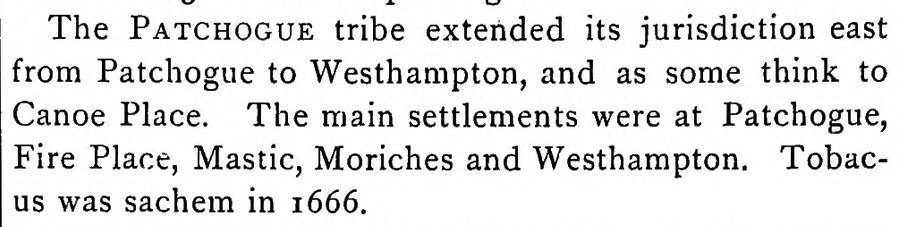
The Patchogue tribe extended its jurisdiction east from Patchogue to Westhampton, and as some think to Canoe Place. The main settlements were at Patchogue, Fire Place, Mastic, Moriches and Westhampton. Tobacus was sachem in 1666.
Text read by machine from the scan; it may contain errors.
The Methodist Episcopal Church at SayviUe was an offshoot from the society at Patchogue. About 1838 a class of some fifteen was formed, with Silas Hulse as leader. Services were held on alternate Sabbaths in a schoolhouse here by clergymen from Patchogue, till the year 1847, when the society had increased to about forty members. During this year a house of worship 25 by 40 feet in size was erected, at a cost of about f 1,000, and services
Text read by machine from the scan; it may contain errors.
Scans and text from the Internet Archive. Books published in 1930 or earlier, which are in the public domain.
Timeline
Patchogue, 1834 to 1976
Woven from the archive, old maps, post office records, the National Register and the people born here.
The Patchogue post office opened in 1802, the earliest record of the town by name (U.S. post office records).
How does Patchogue rank for history?
Patchogue is more historic than 83% of U.S. towns, #373 of 758 in New York. The History grade combines the town’s founding era, the share of homes built before 1940 and its National Register listings. It’s a character grade, so it isn’t part of the overall grade. How it works.
How old are the homes in Patchogue?
28% of Patchogue’s homes were built before 1940 (Census estimate, ±5.6 points), against a typical 27% for a New York town; the median home was built in 1964.
Founding dates: Wikidata, Wikipedia, the U.S. post office records of Blevins & Helbock (CC0) and the Census. Homes by year built: Census ACS 2020–24. National Register of Historic Places: National Park Service (list of May 22, 2026). Old photos, postcards and papers: Wikimedia Commons, the Library of Congress and other public archives, credited on each item’s page. Maps: U.S. Geological Survey historical topographic maps (via Esri) and Sanborn fire-insurance maps (Library of Congress). History text and census tables: Wikipedia (CC BY-SA 4.0). Places that used to be: USGS Geographic Names Information System (2021).
From Wikimedia Commons (12), Wikipedia, Wikidata and Wikipedia for famous people, U.S. Geological Survey historical maps, U.S. Census counts (via Wikipedia), Sanborn fire insurance maps (Library of Congress) and old county and town histories (Internet Archive). Archive images are copied here with their credits and licenses, shown on each photo’s page. Refreshed monthly.


 1834
 1850
 1850
 1873
 1873
 c. 1888
 1902
 1902
 1902
 1902
 1906
 1915