Founding year: Wikipedia. First post office: 1800.The full story ↓
History grade
What drives Owego’s History grade
On its age, its old homes and the National Register, Owego is among the most historic 1% of U.S. towns, #34 of 758 in New York. All 3 inputs are above most U.S. towns; its share of homes from before 1940 ranks highest and its age lowest.
A+
HistoryA character grade: shown, never part of Owego’s overall grade.
New York towns list more on the Register than most of the country (a typical New York town has 12.3 per 10,000 residents, the U.S. 2.4), so Owego’s 953 sits above most of its state (95% of New York towns have fewer) while its 373 historic buildings outnumber those of 96% of U.S. towns.
How sure. Graded on any two of the three inputs instead, the letter would range from A to A+. The pre-1940 share is a Census survey estimate (±5.9 points). Two sources give 1786.
Founding year: Wikipedia (other dates in Quick answers). Homes: Census ACS 2020–24. National Register: National Park Service, May 2026 list; each listing counted once (boundary changes and added documentation belong to their listing), and a historic district counts its contributing buildings. How TownRatings grades history →
What stands out about Owego’s past
Read from the archive, the National Register and the record. The page puts what stands out first.
Lost a third of its people between 1880 and 1920, then more than doubled.
21 censuses, 1820–2020.
U.S. Census Bureau decennial counts, from the census table on Owego’s Wikipedia page.
Every building
Owego, building by building, 1888–1915
Fire insurance maps drew every building, what it was made of and what it was used for, so insurers could price the risk of fire. Pick a year, then a sheet.
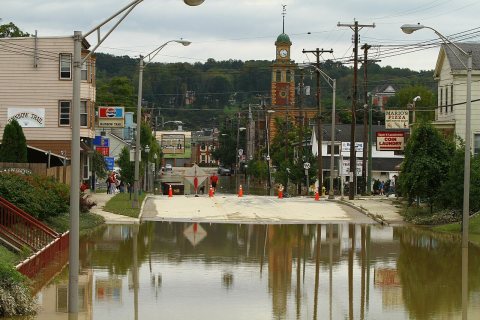
The town was first settled around 1786. The original town of Owego was created at the time Tioga County was formed in 1791. This original town was reduced by formation of later towns in the county. The town's name is a derivative of the Iroquois word "ahwaga", which means "where the valley widens". This name came from the vast floods that run into the valley when the winter snows melt, which caused several deaths a year.
The current town of Owego was formed as the town of Tioga in 1800 from the town of Union (now in Broome County).
Confusion over the location of the village of Owego caused the legislature to have the towns of Owego and Tioga switch names in 1813 so that Owego village was within the same-named town.
perfect than at any time in its history, was established by an act of the legislature, passed April 23, 1864, which with the amendments of 1865, declared that all school districts and parts of school districts lying within the corporate limits of the village of Owego, he consolidated and incorporated into one school district, to he called the “ Union School District of the Village of Owego.” Further, the act provided that the schools he designated the “ Union Schools of the Village of Owego,” and for their control and gov-
Text read by machine from the scan; it may contain errors.
Again, in 1849, the New York and Lake Erie railroad was completed to Owego village, and general rejoicing prevailed throughout the town. Still better, property was increased in value all along the line of the road, and the little hamlets of Apalachin and Campville and also the village of Owego, at once felt the impulse of increased importance and worth. The old Ithaca and Owego road, organized April 9, 1828, as a company, was a benefit in its way and day, but the proposed Owego and Cortland railroad com-
Text read by machine from the scan; it may contain errors.
Scans and text from the Internet Archive. Books published in 1930 or earlier, which are in the public domain.
Timeline
Owego, 1786 to 1990
Woven from the archive, old maps, post office records, the National Register and the people born here.
Nothing in the archives for these yearsWeddings on Main Street, storms, parades, school pictures, the old store. If it’s in your family album, it belongs here.
In 1786, according to Wikipedia’s history of the town. Owego’s post office opened in 1800, and the census of 1820 counted 1,741 people here.
How does Owego rank for history?
Owego is among the most historic 1% of U.S. towns, #34 of 758 in New York. The History grade combines the town’s founding era, the share of homes built before 1940 and its National Register listings. It’s a character grade, so it isn’t part of the overall grade. How it works.
How old are the homes in Owego?
62% of Owego’s homes were built before 1940 (Census estimate, ±5.9 points), against a typical 27% for a New York town; the median home was built in 1938.
Founding dates: Wikidata, Wikipedia, the U.S. post office records of Blevins & Helbock (CC0) and the Census. Homes by year built: Census ACS 2020–24. National Register of Historic Places: National Park Service (list of May 22, 2026). Old photos, postcards and papers: Wikimedia Commons, the Library of Congress and other public archives, credited on each item’s page. Maps: U.S. Geological Survey historical topographic maps (via Esri) and Sanborn fire-insurance maps (Library of Congress). History text and census tables: Wikipedia (CC BY-SA 4.0). Places that used to be: USGS Geographic Names Information System (2021).
From Wikimedia Commons (12), Wikipedia, Wikidata and Wikipedia for famous people, U.S. Geological Survey historical maps, U.S. Census counts (via Wikipedia), Sanborn fire insurance maps (Library of Congress) and old county and town histories (Internet Archive). Archive images are copied here with their credits and licenses, shown on each photo’s page. Refreshed monthly.


 2012
 2011
 2011
 2009
 2009
 2009
 2009
 2009
 2009
 2007


