The Genoa post office opened in 1817, the earliest record of the town by name. Five smaller post offices, East Genoa (1828), Five Corners (1828) and Nine Corners (1847), opened inside today’s town and later closed.
First census: 3,353 in 18002020 census: 1,815209 years
How historic is Genoa?
A−
More historic than 83% of U.S. towns, on its age, its old homes and the National Register.
Founding year: the first Genoa post office (Blevins & Helbock, CC0).The full story ↓
History grade
What drives Genoa’s History grade
On its age, its old homes and the National Register, Genoa is more historic than 83% of U.S. towns. Its share of homes from before 1940 holds the grade up; its National Register listings pull it down.
A−
HistoryA character grade: shown, never part of Genoa’s overall grade.
New York towns list more on the Register than most of the country (a typical New York town has 12.3 per 10,000 residents, the U.S. 2.4), so Genoa’s 6.1 sits near the middle of its state (38% of New York towns have fewer) while its 1 listings outnumber those of 51% of U.S. towns.
How sure. Graded on any two of the three inputs instead, the letter would range from B to A. The pre-1940 share is a Census survey estimate (±6.3 points). The founding year is the first post office, not a stated founding date.
Founding year: the first post office (other dates in Quick answers). Homes: Census ACS 2020–24. National Register: National Park Service, May 2026 list; each listing counted once (boundary changes and added documentation belong to their listing), and a historic district counts its contributing buildings. How TownRatings grades history →
What stands out about Genoa’s past
Read from the archive, the National Register and the record. The page puts what stands out first.
The Sullivan Expedition moved through the area in 1779 destroying native villages and stores. Genoa became part of the Central New York Military Tract. The first settlers arrived in 1791.
The town was created as Milton in 1789 while still part of Onondaga County. The name was changed to Genoa in 1808. The name was later adopted for use in Genoa, Illinois by early settler Thomas Madison, a Revolutionary War soldier who was inspired by the town in New York.
The town was reduced to form the town of Locke in 1802. Genoa was reduced again in 1817 to form the town of Lansing in Tompkins County.
Passages that mention Genoa, cut from the printed page as they were published.
History of Cayuga County, New York1908 · page 578Read the page →
Read the text
of that town and the town of Locke, to which he subsequently moved. He followed farming for some years; indeed he has been interested in farming all his life, and owns a fine farm in the town of Genoa. His first business, aside from farming, was the produce business in which he engaged for some years and then became proprietor of a hotel at Genoa. He next conducted the Empire House in Auburn, and then the Avery House. After conducting this hotel for three years he sold out, only to buy it back after a
Text read by machine from the scan; it may contain errors.
History of Cayuga County, New York1879 · page 172Read the page →
Read the text
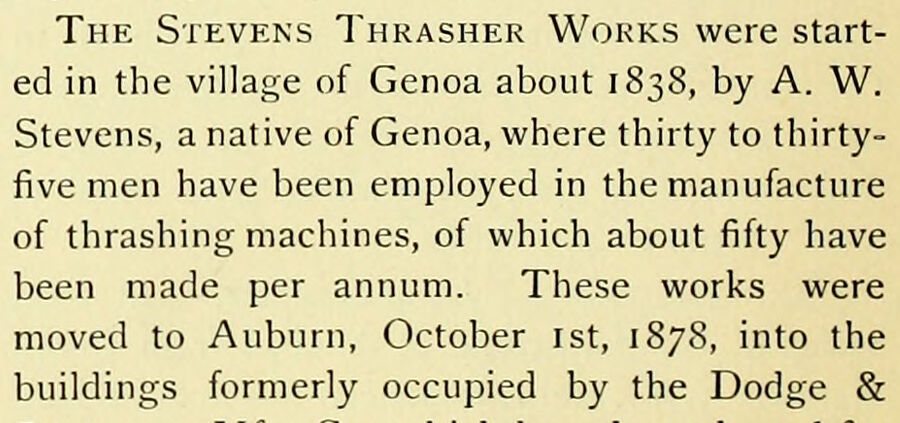
The Stevens Thrasher Works were started in the village of Genoa about 1838, by A. W. Stevens, a native of Genoa, where thirty to thirtyfive men have been employed in the manufacture of thrashing machines, of which about fifty have been made per annum. These works were moved to Auburn, October ist, 1878, into the buildings formerly occupied by the Dodge &
Text read by machine from the scan; it may contain errors.
History of Cayuga County, New York1908 · page 557Read the page →
Read the text
Dr. Dudley has served as supervisor of the town of Genoa since 1898, and was chairman of the Board of Supervisors of Cayuga County in 1901. In 1906 he was elected Assemblyman from Cayuga County by a plurality of 3,796.
Text read by machine from the scan; it may contain errors.
History of Cayuga County, New York1879 · page 499Read the page →
Read the text
The First Universallst SocrETVoF Genoa. A preliminary meeting of Universalists and others of Genoa was held at the house of Wm. Miner, June 1 2th, 1829, for the purpose of building a meeting-house, which it was resolved should be free to all other denominations, when not occupied by the Universalists. It was attended by Wm. Miner, Alfred Avery, Edwin Avery, Samuel
Text read by machine from the scan; it may contain errors.
Scans and text from the Internet Archive. Books published in 1930 or earlier, which are in the public domain.
Timeline
Genoa, 1807 to 1904
Woven from the archive, old maps, post office records, the National Register and the people born here.
Nothing in the archives for these yearsWeddings on Main Street, storms, parades, school pictures, the old store. If it’s in your family album, it belongs here.
The Genoa post office opened in 1817, the earliest record of the town by name (U.S. post office records).
How does Genoa rank for history?
Genoa is more historic than 83% of U.S. towns. The History grade combines the town’s founding era, the share of homes built before 1940 and its National Register listings. It’s a character grade, so it isn’t part of the overall grade. How it works.
What is on the National Register in Genoa?
One place: the East Genoa Methodist Episcopal Church (listed 2002).
How old are the homes in Genoa?
38% of Genoa’s homes were built before 1940 (Census estimate, ±6.3 points), against a typical 27% for a New York town; the median home was built in 1966.
Founding dates: Wikidata, Wikipedia, the U.S. post office records of Blevins & Helbock (CC0) and the Census. Homes by year built: Census ACS 2020–24. National Register of Historic Places: National Park Service (list of May 22, 2026). Old photos, postcards and papers: Wikimedia Commons, the Library of Congress and other public archives, credited on each item’s page. Maps: U.S. Geological Survey historical topographic maps (via Esri) and Sanborn fire-insurance maps (Library of Congress). History text and census tables: Wikipedia (CC BY-SA 4.0). Places that used to be: USGS Geographic Names Information System (2021).
From Wikimedia Commons (5), the National Register of Historic Places (1), Wikipedia, Wikidata and Wikipedia for famous people, U.S. Geological Survey historical maps, U.S. Census counts (via Wikipedia), the US Post Offices dataset (Blevins & Helbock), the USGS Geographic Names Information System and old county and town histories (Internet Archive). Archive images are copied here with their credits and licenses, shown on each photo’s page. Refreshed monthly.




 1904
 Date?
 Date?
 2005
