Founding year: Wikipedia. First post office: 1813.The full story ↓
History grade
What drives Augusta’s History grade
On its age, its old homes and the National Register, Augusta is more historic than 84% of U.S. towns. Its share of homes from before 1940 holds the grade up; its National Register listings pull it down.
A−
HistoryA character grade: shown, never part of Augusta’s overall grade.
New York towns list more on the Register than most of the country (a typical New York town has 12.3 per 10,000 residents, the U.S. 2.4), so Augusta’s 5.4 sits near the middle of its state (36% of New York towns have fewer) while its 1 listings outnumber those of 51% of U.S. towns.
How sure. Graded on any two of the three inputs instead, the letter would range from B to A. The pre-1940 share is a Census survey estimate (±5.7 points). Two sources give 1793.
Founding year: Wikipedia (other dates in Quick answers). Homes: Census ACS 2020–24. National Register: National Park Service, May 2026 list; each listing counted once (boundary changes and added documentation belong to their listing), and a historic district counts its contributing buildings. How TownRatings grades history →
What stands out about Augusta’s past
Read from the archive, the National Register and the record. The page puts what stands out first.
Augusta was settled in 1793 by a man named Gunn, whose son, Peter Smith Gunn, was the first child born in the town.
Gunn was followed by Benjamin Warren, David Morton, and John Alden. On August 17, 1793, Ichabod Stafford, and Joseph and Abraham Forbes arrived bringing the population to 23. Other settlers arriving in 1794 and 1795 were Isaac and Benjamin Allen, Amos Parker, a Revolutionary War veteran, James Cassety, Frances O'Toole, Ozias Hart, Abel Prior, Thomas Spafford, Ezra Saxton, Abiel Lindsley, and J. Reynolds.
1796 brought Abraham and Alexander Holmes, Oliver Bartholomew, Deacon Philip Pond, William Martin, Stephen Crosby, Archibald and John Manchester, Robert Worden, and John Goodhue.
Passages that mention Augusta, cut from the printed page as they were published.
History of Augusta County, Virginia1882 · page 176Read the page →
Read the text
The first mention in the Statute Book of West Augusta occurs in an Act of the General Assembly, passed October, 1776, for ascertaining the boundary between the County of Augusta and the District of West Augusta. The preamble to this Act is in these words : Whereas, it is expedient to ascertam the boundary between the County of Augusta and the District of West Augusta: Be it, therefore, enacted, That the boundary between the said district and county shall be as follows : Beginning on the Alleghany mountains, between the heads of the Potomac, Cheat
Text read by machine from the scan; it may contain errors.
History of Augusta County, Virginia1882 · page 102Read the page →
Read the text
On May 23d, 1774, the House of Burgesses received a petition from sundry inhabitants of the county and parish of Augusta, representing that " the parish is upwards of ninety miles long and near eighty miles wide, and that there are between three and four thousand tithables in it, and but one church ; therefore, praying it may be divided." No action seems to have been taken on this subject by the House.
Text read by machine from the scan; it may contain errors.
Scans and text from the Internet Archive. Books published in 1930 or earlier, which are in the public domain.
Timeline
Augusta, 1793 to 1943
Woven from the archive, old maps, post office records, the National Register and the people born here.
In 1793, according to Wikipedia’s history of the town. Augusta’s post office opened in 1813, and the census of 1800 counted 1,598 people here.
How does Augusta rank for history?
Augusta is more historic than 84% of U.S. towns. The History grade combines the town’s founding era, the share of homes built before 1940 and its National Register listings. It’s a character grade, so it isn’t part of the overall grade. How it works.
What is on the National Register in Augusta?
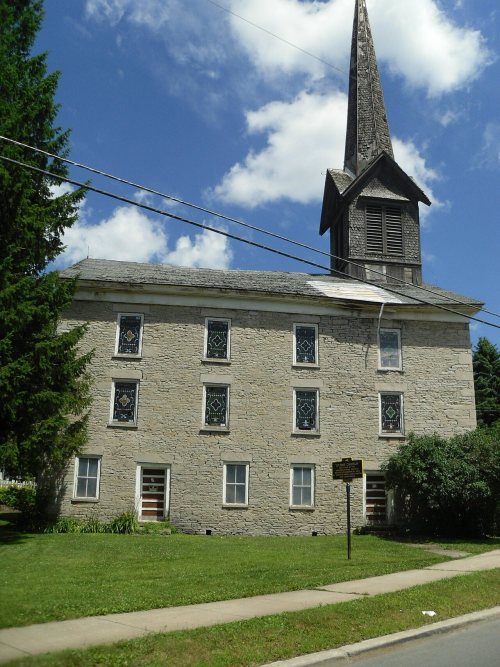
One place: the First Congregational Free Church (listed 1979).
How old are the homes in Augusta?
42% of Augusta’s homes were built before 1940 (Census estimate, ±5.7 points), against a typical 27% for a New York town; the median home was built in 1966.
Founding dates: Wikidata, Wikipedia, the U.S. post office records of Blevins & Helbock (CC0) and the Census. Homes by year built: Census ACS 2020–24. National Register of Historic Places: National Park Service (list of May 22, 2026). Old photos, postcards and papers: Wikimedia Commons, the Library of Congress and other public archives, credited on each item’s page. Maps: U.S. Geological Survey historical topographic maps (via Esri) and Sanborn fire-insurance maps (Library of Congress). History text and census tables: Wikipedia (CC BY-SA 4.0). Places that used to be: USGS Geographic Names Information System (2021).
From the National Register of Historic Places (1), Wikipedia, Wikidata and Wikipedia for famous people, U.S. Geological Survey historical maps, U.S. Census counts (via Wikipedia), the US Post Offices dataset (Blevins & Helbock), the USGS Geographic Names Information System and old county and town histories (Internet Archive). Archive images are copied here with their credits and licenses, shown on each photo’s page. Refreshed monthly.