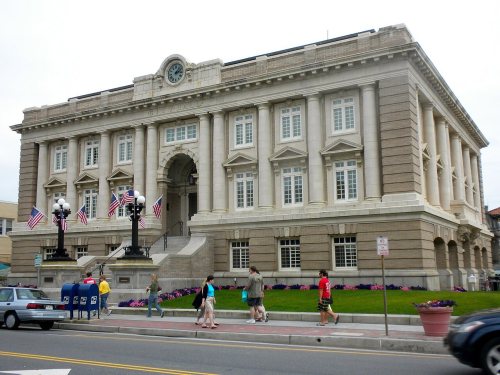
Overall, Ocean City earns a B, better than 58% of U.S. towns. That places it 250th of 466 in New Jersey. Its strongest subject is walkability (A+): it is easier to get around on foot or by transit than 97% of U.S. towns. It also does well on health — it is healthier than 86% of U.S. towns. The trade-off is cost of living — the typical home is worth about $1.1 million, 13.8 years of the Atlantic City metro’s $82K median household income. Hazard risk is weaker too: FEMA rates its natural-hazard risk higher than 92% of U.S. communities, with inland flooding at the top. Just over a third of residents are 65 or older locally, against 18% in New Jersey’s towns and 18% across U.S. towns. The town has 6 places on the National Register of Historic Places, among them Ocean City Tenth Street Station and Ocean City 34th Street Station.
Figures: health, CDC PLACES · home values, Zillow · incomes, Census ACS, 2020–24 · FEMA National Risk Index · National Register of Historic Places.
Ocean City 34th Street Station · National Register of Historic Places
Ocean City’s story
145 years in pictures
Census counts: 452 in 1890, a peak of 15,512 in 1990, 11,229 in 2020. The archive holds 24 old photos and papers going back to 1885 and 6 maps from 1890 on.
6 places on the National Register of Historic Places.
Its grades run from A+ for walkability (better than 97% of comparable towns) to D− for cost of living (better than 2%), so the B overall blends very different results.
Ocean City has a longer frost-free season than almost anywhere else in New Jersey, but it carries more natural-hazard risk than most of New Jersey (mostly inland flooding) and has homes that cost more against local pay than most of New Jersey.
At 13.8 years of the Atlantic City metro’s $82K median household income, the typical home (about $1.14M) costs more against local pay than in 97% of New Jersey towns; that ratio is one input to that grade.
A home in Ocean City typically sold within 83 days of listing. Values rose 11% in the 12 months to September 2026. Its midpoint rent stands at $1,683 a month.
Three of its 4 schools are below, each with the reason it’s listed. The largest public high school is Ocean City High School, with 1,106 students. The public schools here belong to the Ocean City School District.
FEMA rates its natural-hazard risk higher than 98% of New Jersey towns, with expected losses of about $2,194 per resident a year; that rating is what its D− for hazard risk is built on. 7,807 flood insurance claims have been filed here, and 559 properties have flooded more than once.
Households in Ocean City have drawn federal disaster aid in 7 declared disasters, most recently in 2020. Expected losses in Ocean City break down as 42% from inland flooding and 41% from coastal flooding. Also worth knowing: the national flood insurance program has paid 7,807 claims here since 1978.
Within New Jersey it is less healthy than 51% of the 468 graded towns: New Jersey sets a high bar. Its A for health tops all 3 graded neighbors; Upper Township (B+) comes closest.
Among 468 New Jersey towns, just 3 have a lower share of adults who sleep under 7 hours than Ocean City. In Ocean City, 13% of adults report frequent mental distress. CDC measures, 32 in all: Ocean City beats New Jersey on 16 and trails on 7.
The Atlantic City Intl Ap weather station, 13 miles away, records that the frost-free season runs about 190 days, the highest of 941 New Jersey places with climate records.
Ocean City has about as many jobs (4,113) as working residents, but only 783 people both live and work here.
For half of commuters, work is under 14 miles away. The top destinations are Somers Point (5%), Egg Harbor Township (5%) and Atlantic City (4%). The median household income in the town is $102,000.
22%work in town
Ocean City
New Jersey towns
U.S. towns
Working residents who work in town
22%
6.3%
8%
Work from home
19%
16%
11%
Median household income
$102,000
$113,000
$80,000
Average trip to work
27 minutes
30 minutes
25 minutes
Where working residents work
In Ocean City22%
Somers Point5%
Egg Harbor Township5%
Atlantic City4%
Middle Township4%
14 mi
median commute distance
4,113
jobs based in Ocean City
Balanced
jobs vs. working residents
A+
Walkability grade: more walkable than 97% of U.S. towns
Ocean City’s rate of thefts and burglaries is 17.7 per 1,000 residents. Most reported incidents are property crimes, mainly thefts. 6 violent crimes were reported in 2025.
The trail network density for Ocean City comes to 0.3 miles per square mile. In 5 parks and preserves, walkers have 2.9 miles of trail. The biggest park or preserve is Corson's Inlet State Park, at 155 acres.
#315for trails in NJ
Ocean City
New Jersey towns
U.S. towns
Miles of trail per square mile
0.3 miles per square mile
0.7
0.4
Conserved land
9%
11%
4.3%
9%
conserved · 660 of 7,355 acres
2.9 mi
of trails · 0.3 per sq mi
Biggest places to walk
Trails
Acres
1. Corson's Inlet State Park
0.8 mi
155
2. Cape May Coastal Wetlands Wildlife Management Area
Ocean City is a city in Cape May County, in the U.S. state of New Jersey. It is the principal city of the Ocean City metropolitan statistical area, which encompasses all of Cape May County, and is part of the Philadelphia metropolitan area. It is part of the South Jersey region of the state. As of the 2020 United States census, the city's population was 11,229, a decrease of 472 (−4.0%) from the 2010 census count of 11,701, which in turn reflected a decline of 3,677 (−23.9%) from the 15,378 counted in the 2000 census. In summer months, with an influx of tourists and second homeowners, there are estimated to be 115,000 to 130,000 within the city's borders. Ocean City originated as a borough …
Ocean City and Upper Township report no FBI crime data of their own. Strathmere and Longport aren’t graded (fewer than 1,000 residents, or not enough data). Compare Ocean City with a neighbor →
Questions about Ocean City
Short answers, built from the data on this page.
Is Ocean City, NJ a good place to live?
For most people who can afford it, yes. Ocean City grades B overall, better than 58% of U.S. towns and #250 of 466 in New Jersey. It grades A for health and B+ for schools. Cost of living is its weak spot, with a D−.
Is Ocean City, NJ expensive?
Yes. Cost of living, which also weighs rents, property taxes and how many households pay 30% or more of their income for housing, grades D−.
What is Ocean City, NJ known for?
Ocean City was settled in 1881 and has 6 places on the National Register of Historic Places. 10 notable people were born here, including Keith Andes and Gay Talese.


 6 mi
 11 mi
 in town
 12 mi