Founding year: Wikidata. First post office: 1836.The full story ↓
History grade
What drives Milford’s History grade
On its age, its old homes and the National Register, Milford is more historic than 91% of U.S. towns, #54 of 701 in Michigan. All 3 inputs are above most U.S. towns; its National Register listings ranks highest and its share of homes from before 1940 lowest.
A
HistoryA character grade: shown, never part of Milford’s overall grade.
Few Michigan towns list much on the Register (a typical Michigan town has 0.0 per 10,000 residents, the U.S. 2.4), so Milford’s 396 sits above most of its state (98% of Michigan towns have fewer) while its 257 historic buildings outnumber those of 95% of U.S. towns.
How sure. Graded on any two of the three inputs instead, the letter would range from A− to A+. The pre-1940 share is a Census survey estimate (±4.8 points). Two sources give 1832.
Founding year: Wikidata (other dates in Quick answers). Homes: Census ACS 2020–24. National Register: National Park Service, May 2026 list; each listing counted once (boundary changes and added documentation belong to their listing), and a historic district counts its contributing buildings. How TownRatings grades history →
What stands out about Milford’s past
Read from the archive, the National Register and the record. The page puts what stands out first.
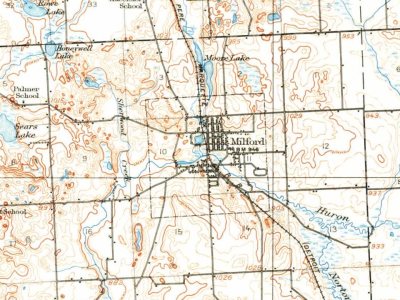
Every edition of the U.S. Geological Survey’s map of Milford. Tap a year, or press play to watch the town change.
1909Milford sheet · 1:62,500
U.S. Geological Survey historical topographic maps (public domain), via Esri’s collection of the scans. The red ring marks the center of Milford.
Every building
Milford, building by building, 1895–1910
Fire insurance maps drew every building, what it was made of and what it was used for, so insurers could price the risk of fire. Pick a year, then a sheet.
The village of Milford began with the building of a sawmill by Elizur and Stanley Ruggles in 1832. Early county records indicate that the mill was erected in the "Township" at that time, and that formal organization would occur in 1834. That same year, the first gristmill was erected by Luman Fuller. In 1835, the first post office was established with Aaron Phelps as postmaster.
The Lower Mill Pond was created in 1836 to provide waterpower for the various types of mills and factories. The Upper Mill Pond followed in 1845. In 1911, the Hubbell Pond was created by a dam built on the Huron River to generate electricity. The village was incorporated in 1869.
Passages that mention Milford, cut from the printed page as they were published.
History of Oakland County, Michigan1912 · page 447Read the page →
Read the text
The most prosperous period in the history of Milford was during the years 1850-1856. In the latter year the Detroit & Milwaukee Railroad was completed and, in a large measure, drew away the trade of the village to other points. From that time, also, it commenced to decline as an industrial center. It was not until 187 1 that the P'lint & Pere Marquette Railroad was built to the village, after which there was a period of revival, but nothing of a permanent nature. For about twenty years previous to 1900 the village virtually held its own at a popula-
Text read by machine from the scan; it may contain errors.
History of Oakland County, Michigan1912 · page 240Read the page →
Read the text
Pere AJarquette Railroad. Its branch from Detroit to Lirand Rapids runs along the southwest corner of Lyon township, with South Lyon as a station, while the branch from Toledo to Ludington traverses Xovi, Commerce (extreme southwest corner), Milford, ilighland. Rose and Holly townships. The latter branch embraces as stations, Novi, Wixom, Milford, Highland, Clyde, Rose Center and Holly, and furnishes the county with thirty-two miles of railway.
Text read by machine from the scan; it may contain errors.
Scans and text from the Internet Archive. Books published in 1930 or earlier, which are in the public domain.
Timeline
Milford, 1832 to 1971
Woven from the archive, old maps, post office records, the National Register and the people born here.
In 1832, according to Wikidata. Milford’s post office opened in 1836, and the census of 1880 counted 1,251 people here.
How does Milford rank for history?
Milford is more historic than 91% of U.S. towns, #54 of 701 in Michigan. The History grade combines the town’s founding era, the share of homes built before 1940 and its National Register listings. It’s a character grade, so it isn’t part of the overall grade. How it works.
How old are the homes in Milford?
17% of Milford’s homes were built before 1940 (Census estimate, ±4.8 points), against a typical 12% for a Michigan town; the median home was built in 1973.
Founding dates: Wikidata, Wikipedia, the U.S. post office records of Blevins & Helbock (CC0) and the Census. Homes by year built: Census ACS 2020–24. National Register of Historic Places: National Park Service (list of May 22, 2026). Old photos, postcards and papers: Wikimedia Commons, the Library of Congress and other public archives, credited on each item’s page. Maps: U.S. Geological Survey historical topographic maps (via Esri) and Sanborn fire-insurance maps (Library of Congress). History text and census tables: Wikipedia (CC BY-SA 4.0). Places that used to be: USGS Geographic Names Information System (2021).
From Wikimedia Commons (6), Wikidata (3), Wikipedia, Wikidata and Wikipedia for famous people, U.S. Geological Survey historical maps, U.S. Census counts (via Wikipedia), Sanborn fire insurance maps (Library of Congress) and old county and town histories (Internet Archive). Archive images are copied here with their credits and licenses, shown on each photo’s page. Refreshed monthly.


 2016
 2016
 2014
 2013
 2011
 2010