Grand Rapids dates to 1826, and 38% of its homes were built before 1940
More historic than 97% of U.S. towns · #15 of 701 in Michigan. What drives it
47 places in town are on the National Register, among them six historic districts with 699 buildings between them. Below: 10 old photos and papers, maps from 1888 on, and the census since 1850.
Founding year: Wikidata. First post office: 1831.The full story ↓
History grade
What drives Grand Rapids’ History grade
On its age, its old homes and the National Register, Grand Rapids is more historic than 97% of U.S. towns, #15 of 701 in Michigan. All 3 inputs are above most U.S. towns; its National Register listings ranks highest and its age lowest.
A+
HistoryA character grade: shown, never part of Grand Rapids’ overall grade.
Among the 400 U.S. cities of 100,000 or more, Grand Rapids ranks #32 on History.
Few Michigan towns list much on the Register (a typical Michigan town has 0.0 per 10,000 residents, the U.S. 2.4), so Grand Rapids’ 38.7 sits above most of its state (89% of Michigan towns have fewer) while its 768 historic buildings outnumber those of 98% of U.S. towns.
How sure. Graded on any two of the three inputs instead, the letter would range from A to A+. The pre-1940 share (±1.4 points) is firm at this size. Two sources give 1826.
Founding year: Wikidata (other dates in Quick answers). Homes: Census ACS 2020–24. National Register: National Park Service, May 2026 list; each listing counted once (boundary changes and added documentation belong to their listing), and a historic district counts its contributing buildings. How TownRatings grades history →
What stands out about Grand Rapids’ past
Read from the archive, the National Register and the record. The page puts what stands out first.
Passages that mention Grand Rapids, cut from the printed page as they were published.
History of the city of Grand Rapids, Michigan ... (With an appendix--History of Lowell, Michigan)1891 · page 530Read the page →
Read the text
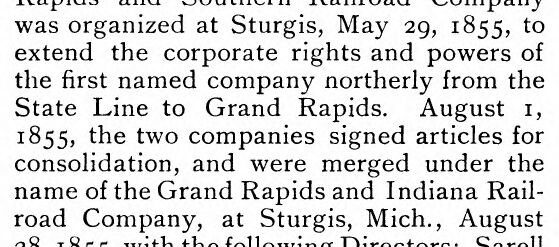
was organized at Sturgis, May 29, 1855, to extend the corporate rights and powers of the first named company northerly from the State Line to Grand Rapids. August i, 1855, the two companies signed articles for consolidation, and were merged under the name of the Grand Rapids and Indiana Railroad Company, at Sturgis, Mich., August
Text read by machine from the scan; it may contain errors.
History of the City of Grand Rapids, Michigan ...1891 · page 85Read the page →
Read the text
The municipal history of Grand Rapids properly begins in the two townships of Kent (afterward Grand Rapids) and Walker, from which the city was taken. The first town election in Kent was held April 4, 1834, as directed by the organizing act of the Legislative Council, at the house of Joel Guild, where now stands the National City
Text read by machine from the scan; it may contain errors.
History of the City of Grand Rapids, Michigan ...1891 · page 530Read the page →
Read the text
was organized at Sturgis, May 29, 1855, to extend the corporate rights and powers of the first named company northerly from the State Line to Grand Rapids. August i, 1855, the two companies signed articles for consolidation, and were merged under the name of the Grand Rapids and Indiana Railroad Company, at Sturgis, Mich., August
Text read by machine from the scan; it may contain errors.
History of the city of Grand Rapids, Michigan ... (With an appendix--History of Lowell, Michigan)1891 · page 536Read the page →
Read the text
The Grand Haven Railroad Company was organized February 16, i86g, as the Michigan Lake Shore Railroad Company. The Grand Rapids, Newaygo and Lake Shore Railroad Company was organized September II, 1869, and opened to White Cloud September 24, 1875. The company use the Union Depot in connection with the Grand
Text read by machine from the scan; it may contain errors.
Scans and text from the Internet Archive. Books published in 1930 or earlier, which are in the public domain.
Timeline
Grand Rapids, 1826 to 1992
Woven from the archive, old maps, post office records, the National Register and the people born here.
Nothing in the archives for these yearsWeddings on Main Street, storms, parades, school pictures, the old store. If it’s in your family album, it belongs here.
Every edition of the U.S. Geological Survey’s map of Grand Rapids. Tap a year, or press play to watch the town change.
1914Grand Rapids sheet · 1:62,500
U.S. Geological Survey historical topographic maps (public domain), via Esri’s collection of the scans. The red ring marks the center of Grand Rapids.
Every building
Grand Rapids, building by building, 1888–1913
Fire insurance maps drew every building, what it was made of and what it was used for, so insurers could price the risk of fire. Pick a year, then a sheet.
Lost post offices, places now gone and burying grounds
Grand Rapids had its own post office from 1831 to 1836. Three other post offices opened and closed inside today’s town.
Grand Rapids
1831–1836
Kent
1836–1844
Grand Rapids
1844–today
Oakdale Park
1888–1894
Soldiers Home
1892–1900
18301930today
Gone or out of use
Soldiers Home Post Officepost office
18cemeteries and burying grounds inside Grand Rapids
AchimBloodFairplainsFulton StreetGarfield ParkGrand Rapids Home For VeteransGreenwoodHoly CrossMaple GroveMount CalvaryOakgroveOakhillRest LawnSaint AndrewsSaints Peter and Paul's Lithuanian CatholicWashington ParkWhiteWoodlawn Cemetery East
US Post Offices dataset (Blevins & Helbock, CC0). Places and cemeteries from the USGS Geographic Names Information System (2021).
Help out
Finish Grand Rapids’s story
Most archives stop around 1920. The photos from after that are in family albums, not libraries.
Decades since 1900 with photos
00s10s20s30s40s50s60s70s80s90s
1 of 10 decades. The empty ones are waiting for someone’s album.
In 1826, according to Wikidata. Grand Rapids’ post office opened in 1831, and the census of 1850 counted 2,686 people here.
How does Grand Rapids rank for history?
Grand Rapids is more historic than 97% of U.S. towns, #15 of 701 in Michigan. The History grade combines the town’s founding era, the share of homes built before 1940 and its National Register listings. It’s a character grade, so it isn’t part of the overall grade. How it works.
What is on the National Register in Grand Rapids?
47 listings: 37 buildings, among them the Abram W. Pike House (listed 1970, the first), 6 historic districts with 699 contributing buildings, 3 structures, and 1 object. 768 historic buildings in all.
How old are the homes in Grand Rapids?
38% of Grand Rapids’ homes were built before 1940 (Census estimate, ±1.4 points), against a typical 12% for a Michigan town; the median home was built in 1953.
Founding dates: Wikidata, Wikipedia, the U.S. post office records of Blevins & Helbock (CC0) and the Census. Homes by year built: Census ACS 2020–24. National Register of Historic Places: National Park Service (list of May 22, 2026). Old photos, postcards and papers: Wikimedia Commons, the Library of Congress and other public archives, credited on each item’s page. Maps: U.S. Geological Survey historical topographic maps (via Esri) and Sanborn fire-insurance maps (Library of Congress). History text and census tables: Wikipedia (CC BY-SA 4.0). Places that used to be: USGS Geographic Names Information System (2021).
From Wikimedia Commons (4), the Library of Congress (6), Wikidata (8), the National Register of Historic Places (47), Wikipedia, Wikidata and Wikipedia for famous people, U.S. Geological Survey historical maps, U.S. Census counts (via Wikipedia), the US Post Offices dataset (Blevins & Helbock), the USGS Geographic Names Information System, Sanborn fire insurance maps (Library of Congress) and old county and town histories (Internet Archive). Archive images are copied here with their credits and licenses, shown on each photo’s page. Refreshed monthly.










 1899
 1900
 1900
 1900
 1900
 1900