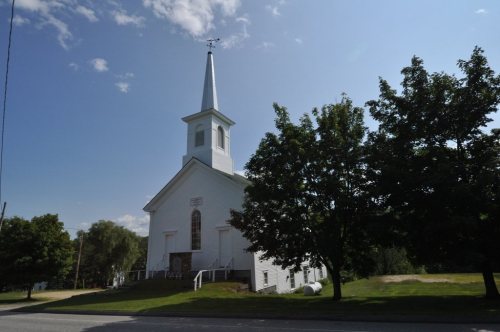
Its Register listings are the First Universalist Society of West Sumner and the Dudley's Corner School House. Below: 2 old photos and papers, maps from 1911 on, and the census since 1800.
Founding year: Wikidata; Wikipedia’s history section gives the same year. First post office: 1811.The full story ↓
History grade
What drives Sumner’s History grade
On its age, its old homes and the National Register, Sumner is more historic than 82% of U.S. towns. All 3 inputs are above most U.S. towns; its age ranks highest and its National Register listings lowest.
A−
HistoryA character grade: shown, never part of Sumner’s overall grade.
Maine towns list more on the Register than most of the country (a typical Maine town has 15.9 per 10,000 residents, the U.S. 2.4), so Sumner’s 23.7 sits near the middle of its state (63% of Maine towns have fewer) while its 2 listings outnumber those of 60% of U.S. towns.
How sure. Graded on any two of the three inputs instead, the letter would still be A−. The pre-1940 share is a Census survey estimate (±10.0 points). Two sources give 1798.
Founding year: Wikidata (other dates in Quick answers). Homes: Census ACS 2020–24. National Register: National Park Service, May 2026 list; each listing counted once (boundary changes and added documentation belong to their listing), and a historic district counts its contributing buildings. How TownRatings grades history →
What stands out about Sumner’s past
Read from the archive, the National Register and the record. The page puts what stands out first.
Originally called West Butterfield Plantation, it was first settled in 1783 by Noah Bosworth from Plympton, Massachusetts. Most of the early settlers were Revolutionary soldiers from Plymouth County, Massachusetts. The town was incorporated by the General Court on June 13, 1798, and named for Increase Sumner, who was then the governor of Massachusetts.
Text read by machine from the scan; it may contain errors.
A history of Buckfield, Oxford County, Maine, from the earliest explorations to the close of the year 19001915 · page 369Read the page →
Read the text
from Buckfield to Paris. The part set off included five lots of land in the first and second ranges, west division, and all the road leading from America Thayer's dwelling house northerly to the line of the town of Sumner. It was provided that they should take with them one-thirtieth part of the paupers of the town and that six ratable polls and $2700 be taken from the state valuation of Buckfield and added to Paris. The parties set off were to pay all taxes assessed upon them in Buckfield and their proportion (1-30) of the debt of the town. Provision was made, in
Text read by machine from the scan; it may contain errors.
A history of Buckfield, Oxford County, Maine, from the earliest explorations to the close of the year 19001915 · page 37Read the page →
Read the text
tain. Elias Taylor, elsewhere mentioned, had heard it said that he had been left, while an infant, at the door of a well-to-do family, which had brought him up as one of their own. Many of his descendants at one period lived in the town of Sumner. John Irish, Jr., from Gorham, came to Bucktown about 1780, and settled on South Hill on Lot 6, adjoining Peter White's lot on the south. It was afterwards known as the Henry Hutchinson place. He died in 1805. His estate was appraised at £1400 —
Text read by machine from the scan; it may contain errors.
The history of Waterford, Oxford County, Maine, comprising Historical address, by Henry P. Warren1879 · page 58Read the page →
Read the text
the meeting-house on the Flat, where Mr. Porter now lives j to this the north part of the town would 1 Bisbee-town includes the north-east part of Waterford. It was settled about 1825 by the Blsbees, who came from Sumner, Me.
Text read by machine from the scan; it may contain errors.
Scans and text from the Internet Archive. Books published in 1930 or earlier, which are in the public domain.
Timeline
Sumner, 1798 to 1966
Woven from the archive, old maps, post office records, the National Register and the people born here.
Nothing in the archives for these yearsWeddings on Main Street, storms, parades, school pictures, the old store. If it’s in your family album, it belongs here.
In 1798, according to Wikidata and Wikipedia’s history of the town. Sumner’s post office opened in 1811, and the census of 1800 counted 330 people here.
How does Sumner rank for history?
Sumner is more historic than 82% of U.S. towns. The History grade combines the town’s founding era, the share of homes built before 1940 and its National Register listings. It’s a character grade, so it isn’t part of the overall grade. How it works.
What is on the National Register in Sumner?
Two places: the First Universalist Society of West Sumner (listed 2002) and the Dudley's Corner School House (2002).
How old are the homes in Sumner?
22% of Sumner’s homes were built before 1940 (Census estimate, ±10.0 points), against a typical 19% for a Maine town; the median home was built in 1977.
Founding dates: Wikidata, Wikipedia, the U.S. post office records of Blevins & Helbock (CC0) and the Census. Homes by year built: Census ACS 2020–24. National Register of Historic Places: National Park Service (list of May 22, 2026). Old photos, postcards and papers: Wikimedia Commons, the Library of Congress and other public archives, credited on each item’s page. Maps: U.S. Geological Survey historical topographic maps (via Esri) and Sanborn fire-insurance maps (Library of Congress). History text and census tables: Wikipedia (CC BY-SA 4.0). Places that used to be: USGS Geographic Names Information System (2021).
From Wikimedia Commons (12), the National Register of Historic Places (2), Wikipedia, Wikidata and Wikipedia for famous people, U.S. Geological Survey historical maps, U.S. Census counts (via Wikipedia), the US Post Offices dataset (Blevins & Helbock), the USGS Geographic Names Information System and old county and town histories (Internet Archive). Archive images are copied here with their credits and licenses, shown on each photo’s page. Refreshed monthly.




 1914
 2012
 2012
 2012
 2010
 2010
 2010
 2010
 2010
 2010
 2010