More historic than 41% of U.S. towns · #133 of 143 in Maine. What drives it
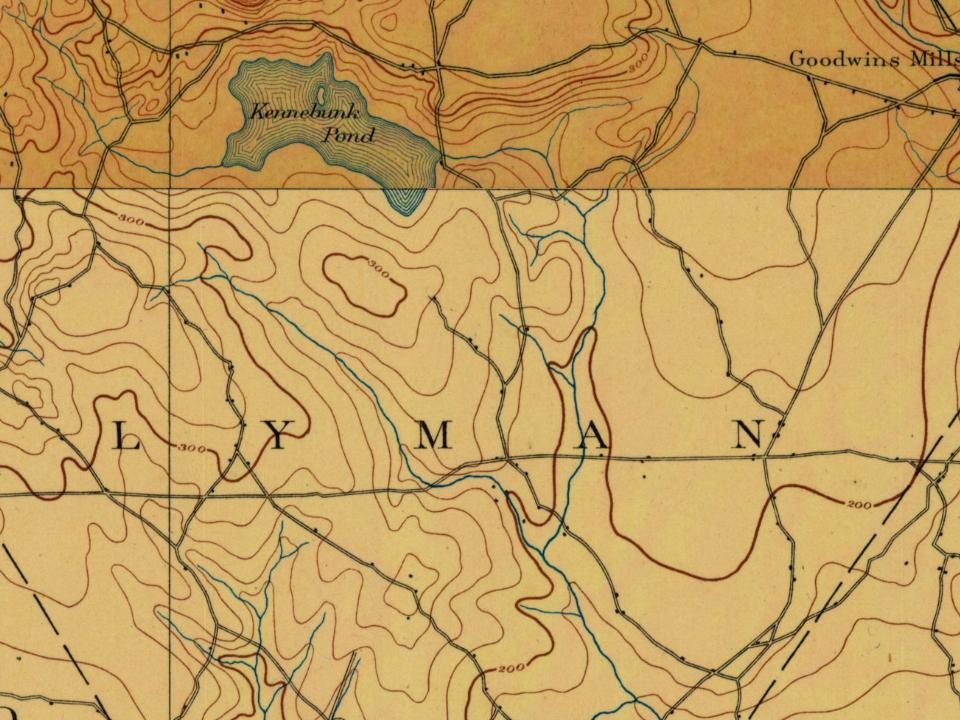
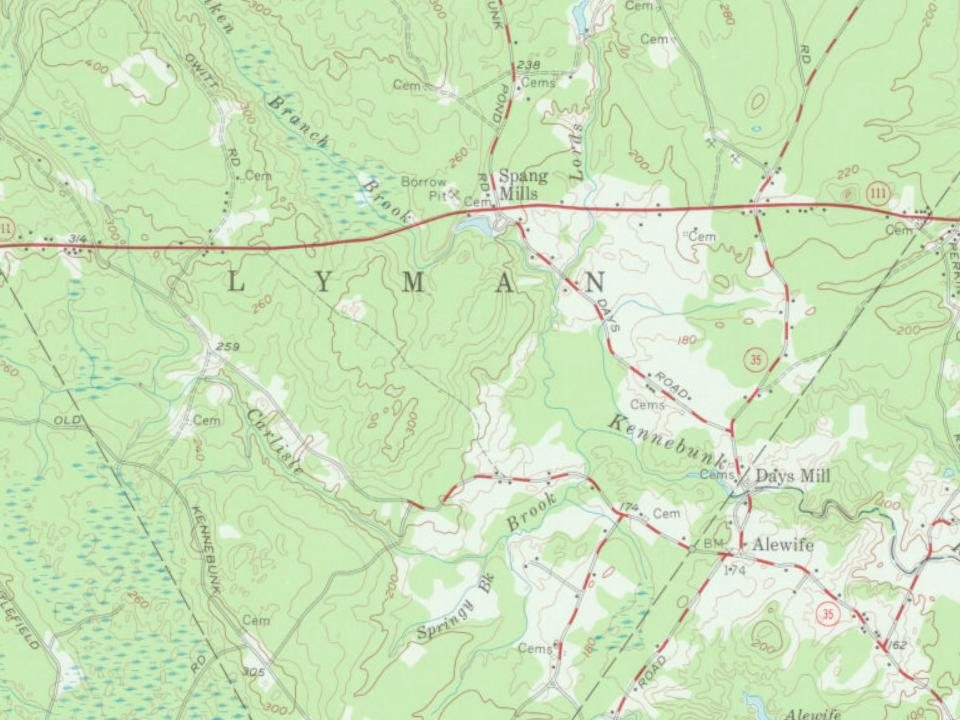
Most of Lyman was built recently: 8% of its homes predate 1940 and the median home dates from 1979. Below: 2 old photos and papers, maps from 1891 on, and the census since 1790.
The Lyman post office opened in 1818, the earliest record of the town by name. Another post office, Goodwin's Mills (1839), opened inside today’s town and later closed.
First census: 765 in 17902020 census: 4,525208 years
How historic is Lyman?
C+
More historic than 41% of U.S. towns, on its age, its old homes and the National Register.
Founding year: the first Lyman post office (Blevins & Helbock, CC0).The full story ↓
History grade
What drives Lyman’s History grade
On its age, its old homes and the National Register, Lyman is more historic than 41% of U.S. towns, #133 of 143 in Maine. Its age holds the grade up; its National Register listings pull it down.
C+
HistoryA character grade: shown, never part of Lyman’s overall grade.
Maine towns list more on the Register than most of the country (a typical Maine town has 15.9 per 10,000 residents, the U.S. 2.4), so Lyman’s 0.0 sits below most of its state (10% of Maine towns have fewer) while its 0 listings outnumber those of 23% of U.S. towns.
How sure. Graded on any two of the three inputs instead, the letter would range from C− to B. The pre-1940 share is a Census survey estimate (±5.2 points). The founding year is the first post office, not a stated founding date.
Founding year: the first post office (other dates in Quick answers). Homes: Census ACS 2020–24. National Register: National Park Service, May 2026 list; each listing counted once (boundary changes and added documentation belong to their listing), and a historic district counts its contributing buildings. How TownRatings grades history →
What stands out about Lyman’s past
Read from the archive, the National Register and the record. The page puts what stands out first.
In 1660, John Sanders, John Bush and Peter Turbat purchased from the Abenaki sachem Sosowen and his son Fluellin what is now the township of Lyman. First called Swanfield, it was settled in 1767. While the original settlers are not known for certain, early records and deeds mention the following: William and Jacob Waterhouse (of Kennebunk), Love Roberts, Alexander Grant, Thomas Lord, Jacob Rhoades, Benjamin and Mark Goodwin (brothers who built one of the first mills at Goodwin's Mills), John Low (who served as town moderator and treasurer), John Burbank, Joseph Witten, James and William Brock, Mark Ricker, Robert Cousens, Valentine Hill, and Gershom Downs.
Passages that mention Lyman, cut from the printed page as they were published.
History of York County, Maine. With illustrations and biographical sketches of its prominent men and pioneers1880 · page 357Read the page →
Read the text
fined by the General Court, as follows : "Whereas, By act passed April 20, 1780, incorporating the Plantation of Coxhall into a town, the boundaries thereof are vague and uncertain, be it enacted that the town of Lyman, formerly Coxhall, shall hereafter be bounded as follows : Beginning at the westerly side of Mousam River, at a pitch pine stump on the edge of the bank of said river, and on the head line of the town of Wells ; from thence to run on the head line of Aurundel six miles to the west line of the town
Text read by machine from the scan; it may contain errors.
History of York County, Maine. With illustrations and biographical sketches of its prominent men and pioneers1880Read the page →
Read the text
The town of Sanford contains an area of 17,920 acres, 16,000 of which are improved. It was incorporated in 1768 with 27,000 acres, and extended as far east as the western line of Lyman and to the Saco River. That part of the town remaining in 1794 to the east of Hayes Brook, was incorporated, February 4th of that year, under the name of Alfred, as a district, but was represented in town affairs until it became a separate town in 1808. Sanford is
Text read by machine from the scan; it may contain errors.
Scans and text from the Internet Archive. Books published in 1930 or earlier, which are in the public domain.
Timeline
Lyman, 1818 to 2020
Woven from the archive, old maps, post office records, the National Register and the people born here.
The Lyman post office opened in 1818, the earliest record of the town by name (U.S. post office records).
How does Lyman rank for history?
Lyman is more historic than 41% of U.S. towns, #133 of 143 in Maine. The History grade combines the town’s founding era, the share of homes built before 1940 and its National Register listings. It’s a character grade, so it isn’t part of the overall grade. How it works.
How old are the homes in Lyman?
8% of Lyman’s homes were built before 1940 (Census estimate, ±5.2 points), against a typical 19% for a Maine town; the median home was built in 1979.
Founding dates: Wikidata, Wikipedia, the U.S. post office records of Blevins & Helbock (CC0) and the Census. Homes by year built: Census ACS 2020–24. National Register of Historic Places: National Park Service (list of May 22, 2026). Old photos, postcards and papers: Wikimedia Commons, the Library of Congress and other public archives, credited on each item’s page. Maps: U.S. Geological Survey historical topographic maps (via Esri) and Sanborn fire-insurance maps (Library of Congress). History text and census tables: Wikipedia (CC BY-SA 4.0). Places that used to be: USGS Geographic Names Information System (2021).
From Wikimedia Commons (2), Wikipedia, Wikidata and Wikipedia for famous people, U.S. Geological Survey historical maps, U.S. Census counts (via Wikipedia), the US Post Offices dataset (Blevins & Helbock), the USGS Geographic Names Information System and old county and town histories (Internet Archive). Archive images are copied here with their credits and licenses, shown on each photo’s page. Refreshed monthly.




 Date?
 Date?