Fitchburg dates to 1730, and 43% of its homes were built before 1940
More historic than 95% of U.S. towns · #81 of 283 in Massachusetts. What drives it
10 places in town are on the National Register, among them four historic districts with 48 buildings between them. Below: 10 old photos and papers, maps from 1887 on, and the census since 1790.
Founding year: Wikidata; Wikipedia’s history section gives the same year. First post office: 1811.The full story ↓
History grade
What drives Fitchburg’s History grade
On its age, its old homes and the National Register, Fitchburg is more historic than 95% of U.S. towns, #81 of 283 in Massachusetts. All 3 inputs are above most U.S. towns; its age ranks highest and its National Register listings lowest.
A+
HistoryA character grade: shown, never part of Fitchburg’s overall grade.
Massachusetts towns list more on the Register than most of the country (a typical Massachusetts town has 46.0 per 10,000 residents, the U.S. 2.4), so Fitchburg’s 15.1 sits below most of its state (32% of Massachusetts towns have fewer) while its 63 historic buildings outnumber those of 86% of U.S. towns.
How sure. Graded on any two of the three inputs instead, the letter would range from A− to A+. The pre-1940 share (±2.7 points) is firm at this size. Two sources give 1730.
Founding year: Wikidata (other dates in Quick answers). Homes: Census ACS 2020–24. National Register: National Park Service, May 2026 list; each listing counted once (boundary changes and added documentation belong to their listing), and a historic district counts its contributing buildings. How TownRatings grades history →
What stands out about Fitchburg’s past
Read from the archive, the National Register and the record. The page puts what stands out first.
Fitchburg was first settled in by Europeans in 1730 as part of Lunenburg, and was officially set apart from that town and incorporated in 1764. The area was previously occupied by the Nipmuc tribe. It is named for John Fitch, one of the committee that procured the act of incorporation. In July 1748 Fitch and his family, living in this isolated spot, were abducted to Canada by Native Americans, but returned the next year.
Passages that mention Fitchburg, cut from the printed page as they were published.
History of the town of Fitchburg, Massachusetts1865 · page 112Read the page →
Read the text
This was a sore discomfiture to the east, and so they considered it. They caused another town meeting to be called immediately " To see if the town will comply with a request of a number of the inhabitants of the town of Fitchburg, to grant that they, together witli their respective estates and interests, may be set off from Fitchburg and annexed to Lunenburg." This shows that the people of the east were determined never to travel over the hills to the place where the new meeting house was to be erected.
Text read by machine from the scan; it may contain errors.
History of the town of Fitchburg, Massachusetts1865 · page 51Read the page →
Read the text
After the events ahove detailed, and previous to the incorporation of the town of Fitchburg, several families moved into the westerly part of Lunenburg, wdiose names will be given when I speak of those living in Fitchburg when it was erected into a separate town. Capt. Samuel Hunt came into this town (from Worcester, as I have been told) and built a part of the house now occupied by James L. Haynes. In the year 1761, he commenced keeping tavern there. This was the first public house
Text read by machine from the scan; it may contain errors.
History of the town of Fitchburg, Massachusetts1836 · page 46Read the page →
Read the text
After the events above detailed, and previous to tljo incorporation of the town of Fitchburg, several families moved into the westerly part of Lunenburg, whose names will bo given \vhen I speak of tliose living in Fitchburg when it was ertrcted into a separate town. Capt. Samuel Hunt came into 'his town (from Worcester, as I have been told) and built a part of th.j house now occupied by James L. Haynes. In the year 1701 he connnenccd keeping tavern there. This Vv'as the lirsl pub-
Text read by machine from the scan; it may contain errors.
History of the town of Fitchburg, Massachusetts1836 · page 92Read the page →
Read the text
in the warrant for a town meeting — "To see if the town would take into consideration the request of Jacob Upton and others, to see if the town will set off the inhabitants of the north-westerly part of Fitchburg, with their lands and privileges, free and clear from said Fitchburg, to join the extreme part of Westminster, with the northeasterly part of Ashburnham, to be incorporated into a town, to have town privileges, as other towns." If this request had been granted, the people of the
Text read by machine from the scan; it may contain errors.
Scans and text from the Internet Archive. Books published in 1930 or earlier, which are in the public domain.
Timeline
Fitchburg, 1730 to 1980
Woven from the archive, old maps, post office records, the National Register and the people born here.
Nothing in the archives for these yearsWeddings on Main Street, storms, parades, school pictures, the old store. If it’s in your family album, it belongs here.
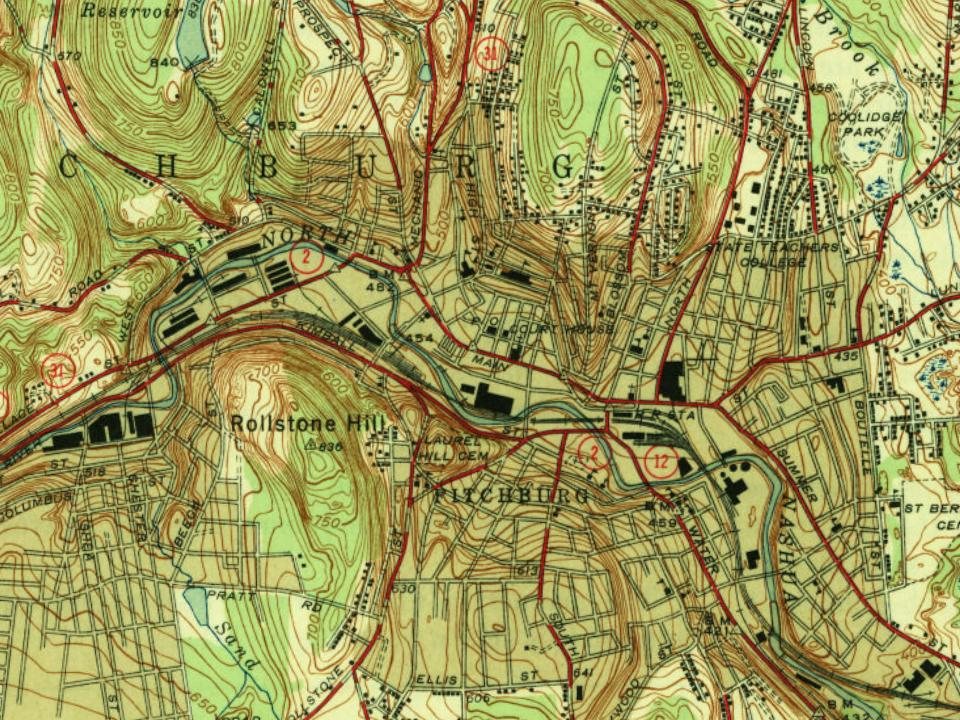
Fire insurance maps drew every building, what it was made of and what it was used for, so insurers could price the risk of fire. Pick a year, then a sheet.
In 1730, according to Wikidata and Wikipedia’s history of the town. Fitchburg’s post office opened in 1811, and the first U.S. census counted 1,151 people here in 1790.
How does Fitchburg rank for history?
Fitchburg is more historic than 95% of U.S. towns, #81 of 283 in Massachusetts. The History grade combines the town’s founding era, the share of homes built before 1940 and its National Register listings. It’s a character grade, so it isn’t part of the overall grade. How it works.
What is on the National Register in Fitchburg?
10 listings: 6 buildings, among them the Fay Club (listed 1978, the first), and 4 historic districts with 48 contributing buildings. 63 historic buildings in all.
How old are the homes in Fitchburg?
43% of Fitchburg’s homes were built before 1940 (Census estimate, ±2.7 points), against a typical 21% for a Massachusetts town; the median home was built in 1950.
Founding dates: Wikidata, Wikipedia, the U.S. post office records of Blevins & Helbock (CC0) and the Census. Homes by year built: Census ACS 2020–24. National Register of Historic Places: National Park Service (list of May 22, 2026). Old photos, postcards and papers: Wikimedia Commons, the Library of Congress and other public archives, credited on each item’s page. Maps: U.S. Geological Survey historical topographic maps (via Esri) and Sanborn fire-insurance maps (Library of Congress). History text and census tables: Wikipedia (CC BY-SA 4.0). Places that used to be: USGS Geographic Names Information System (2021).
From Wikimedia Commons (9), the Library of Congress (1), Wikidata (2), the National Register of Historic Places (10), Wikipedia, Wikidata and Wikipedia for famous people, U.S. Geological Survey historical maps, U.S. Census counts (via Wikipedia), the US Post Offices dataset (Blevins & Helbock), the USGS Geographic Names Information System, Sanborn fire insurance maps (Library of Congress) and old county and town histories (Internet Archive). Archive images are copied here with their credits and licenses, shown on each photo’s page. Refreshed monthly.








 1897
 1898
 1898
 1898
 1898
 1901–1907
 c. 1905


