Warsaw’s post office opened in 1837, and 21% of its homes were built before 1940
More historic than 88% of U.S. towns · #165 of 593 in Indiana. What drives it
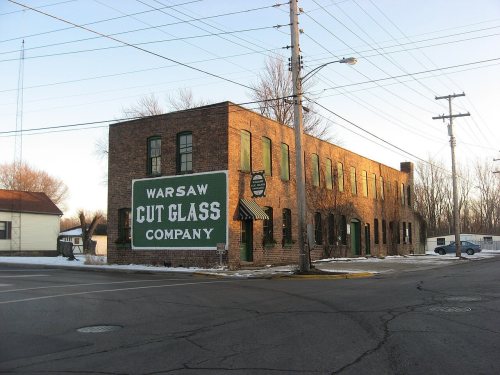
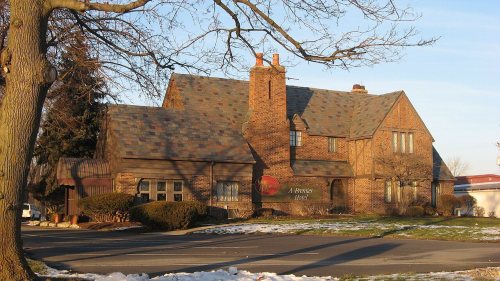
6 places in town are on the National Register, among them a historic district with 50 buildings. Below: 2 old photos and papers, maps from 1886 on, and the census since 1850.
Founding year: the first Warsaw post office (Blevins & Helbock, CC0).The full story ↓
History grade
What drives Warsaw’s History grade
On its age, its old homes and the National Register, Warsaw is more historic than 88% of U.S. towns, #165 of 593 in Indiana. All 3 inputs are above most U.S. towns; its National Register listings ranks highest and its share of homes from before 1940 lowest.
A
HistoryA character grade: shown, never part of Warsaw’s overall grade.
Indiana towns list more on the Register than most of the country (a typical Indiana town has 7.9 per 10,000 residents, the U.S. 2.4), so Warsaw’s 40.6 sits above most of its state (73% of Indiana towns have fewer) while its 68 historic buildings outnumber those of 87% of U.S. towns.
How sure. Graded on any two of the three inputs instead, the letter would range from A− to A. The pre-1940 share is a Census survey estimate (±3.7 points). The founding year is the first post office, not a stated founding date.
Founding year: the first post office (other dates in Quick answers). Homes: Census ACS 2020–24. National Register: National Park Service, May 2026 list; each listing counted once (boundary changes and added documentation belong to their listing), and a historic district counts its contributing buildings. How TownRatings grades history →
What stands out about Warsaw’s past
Read from the archive, the National Register and the record. The page puts what stands out first.
National Park Service, National Register of Historic Places. Photos from Wikimedia Commons, credited on each place’s page.
Every building
Warsaw, building by building, 1886–1917
Fire insurance maps drew every building, what it was made of and what it was used for, so insurers could price the risk of fire. Pick a year, then a sheet.
Early Warsaw saw traders, trappers, and merchants supplying manufactured goods to area farmers. Because of the central location in the lake region, tourists soon began visiting Warsaw and eventually made permanent residences in the city, with industry soon following.
In March 1854, Warsaw became a town, and the initial census on February 2, 1854, showed a total of 752 residents in the town limits. The Pennsylvania Railroad (then known as the Pittsburgh, Fort Wayne, and Chicago Railroad) reached Warsaw in November 1854. The Big Four Railroad (Cleveland, Cincinnati, Chicago, and St Louis) arrived in Warsaw in August 1870.
Passages that mention Warsaw, cut from the printed page as they were published.
History of the centennial celebration1903 · page 56Read the page →
Read the text
In 1828 the church was incorporated under the name of the “Baptist Church and Society in Warsaw.” The meeting for incorporation was held June 9, 1828, and the certificate was filed in the office of the county clerk at Batavia on July 7, 1828, The first trustees, elected at the meeting for incorporation, were David Fargo, Samuel Salisbury and Seth Higgins.
Text read by machine from the scan; it may contain errors.
History of the town of Warsaw, New York, from its first settlement to the present time1869Read the page →
Read the text
Hannah Stearns, John Brown, Wm. Brown, Miriam Brown, Levi Rice, Hannah Rice, Jeremiah Truesdell, Elijah Hammond, Rhoda Reed, Joanna Beardsley. A Baptist church having been formed in Middlebury, then a part of Warsaw, this church was called the “Second Baptist Church of Warsaw.” After the town of Middlebury had been formed into a separate town, this church was called the “ First Baptist
Text read by machine from the scan; it may contain errors.
History of the centennial celebration1903 · page 47Read the page →
Read the text
July 14, 1808 “The First Congregational Church of Warsaw” was organized with ten members, and thus as a denomination we go back to the beginning of church organization in this region, for this was the first church organized upon the Holland Purchase. Five years later this “little flock in the wilderness” became incorporated under the name of the “Warsaw Union Society” and continued so for nearly two decades, “ walking in the
Text read by machine from the scan; it may contain errors.
History of the town of Warsaw, New York, from its first settlement to the present time1869Read the page →
Read the text
lias given the name of Crystal Brook to the stream that flows from it. Gathering in volume from tlie runnels of the meadows and the water-courses of the hollows, it enters the town of Warsaw, and there receiving a tributaiy from the west, bends sharply towards the east. In the earlier days of the towm, when the forests were denser than at present, it industriously toiled here for the neighborhood in turning the wheels of saw-mills.
Text read by machine from the scan; it may contain errors.
Scans and text from the Internet Archive. Books published in 1930 or earlier, which are in the public domain.
Timeline
Warsaw, 1837 to 1957
Woven from the archive, old maps, post office records, the National Register and the people born here.
Nothing in the archives for these yearsWeddings on Main Street, storms, parades, school pictures, the old store. If it’s in your family album, it belongs here.
The Warsaw post office opened in 1837, the earliest record of the town by name (U.S. post office records).
How does Warsaw rank for history?
Warsaw is more historic than 88% of U.S. towns, #165 of 593 in Indiana. The History grade combines the town’s founding era, the share of homes built before 1940 and its National Register listings. It’s a character grade, so it isn’t part of the overall grade. How it works.
What is on the National Register in Warsaw?
6 listings: 5 buildings, among them the Kosciusko County Jail (listed 1978, the first), and 1 historic district, the Warsaw Courthouse Square Historic District, with 50 contributing buildings. 68 historic buildings in all.
How old are the homes in Warsaw?
21% of Warsaw’s homes were built before 1940 (Census estimate, ±3.7 points), against a typical 14% for an Indiana town; the median home was built in 1979.
Founding dates: Wikidata, Wikipedia, the U.S. post office records of Blevins & Helbock (CC0) and the Census. Homes by year built: Census ACS 2020–24. National Register of Historic Places: National Park Service (list of May 22, 2026). Old photos, postcards and papers: Wikimedia Commons, the Library of Congress and other public archives, credited on each item’s page. Maps: U.S. Geological Survey historical topographic maps (via Esri) and Sanborn fire-insurance maps (Library of Congress). History text and census tables: Wikipedia (CC BY-SA 4.0). Places that used to be: USGS Geographic Names Information System (2021).
From Wikimedia Commons (16), the Library of Congress (1), Wikidata (1), the National Register of Historic Places (6), Wikipedia, Wikidata and Wikipedia for famous people, U.S. Geological Survey historical maps, U.S. Census counts (via Wikipedia), the US Post Offices dataset (Blevins & Helbock), the USGS Geographic Names Information System, Sanborn fire insurance maps (Library of Congress) and old county and town histories (Internet Archive). Archive images are copied here with their credits and licenses, shown on each photo’s page. Refreshed monthly.






 2013
 2013
 2013
 2013
 2013
 2012
 2012
 2012
 2011
 2010
 2007
 2005
 2005
 2005
 2005

