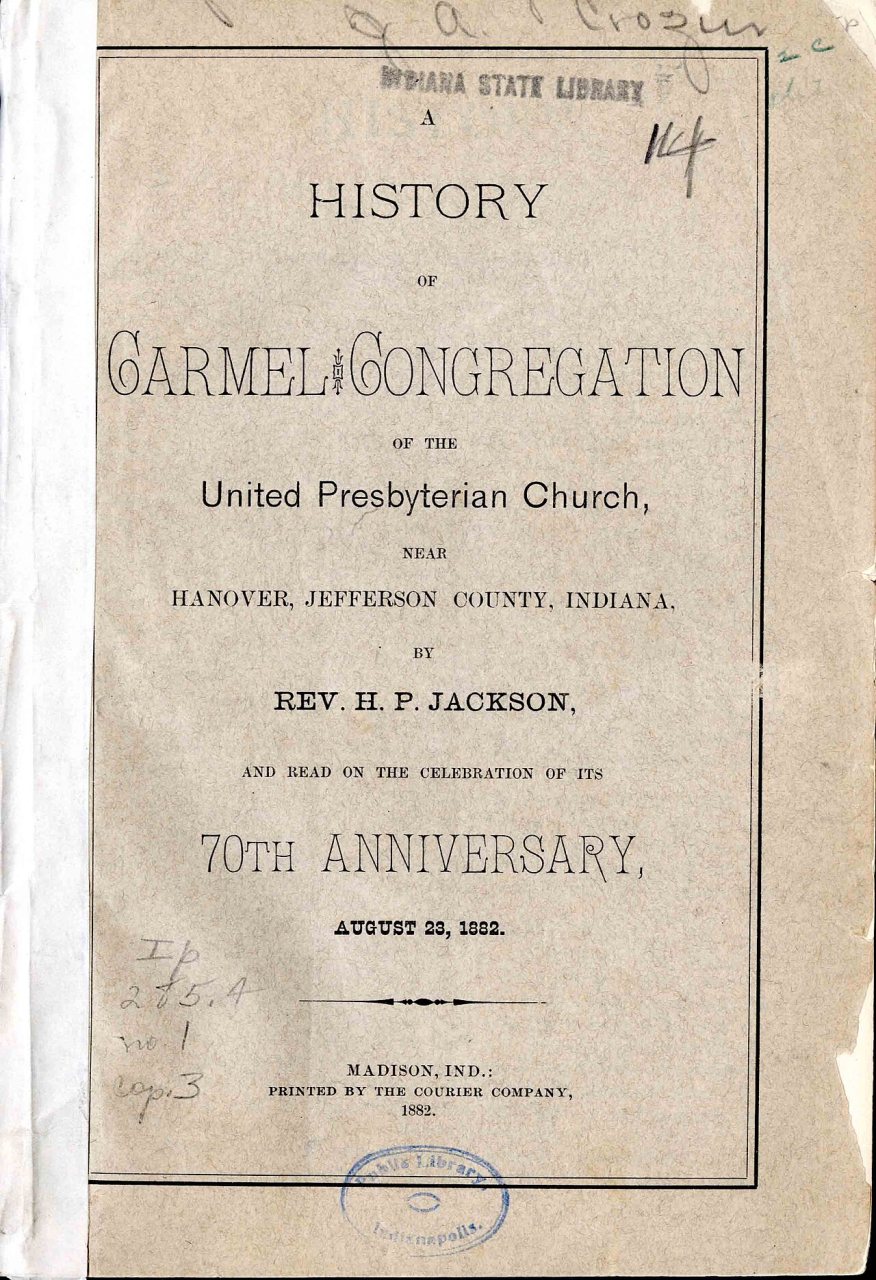
Hanover’s post office opened in 1860, and 3 of its places are on the National Register
More historic than 53% of U.S. towns · #363 of 593 in Indiana. What drives it
Most of Hanover was built recently: 7% of its homes predate 1940 and the median home dates from 1972. 3 places in town are on the National Register, among them a historic district with 20 buildings. Below: 6 old photos and papers, maps from 1939 on, and the census since 1870.
Founding year: the first Hanover post office (Blevins & Helbock, CC0).The full story ↓
History grade
What drives Hanover’s History grade
On its age, its old homes and the National Register, Hanover is more historic than 53% of U.S. towns, #363 of 593 in Indiana. Its National Register listings hold the grade up; its age pulls it down.
B−
HistoryA character grade: shown, never part of Hanover’s overall grade.
Indiana towns list more on the Register than most of the country (a typical Indiana town has 7.9 per 10,000 residents, the U.S. 2.4), so Hanover’s 61.9 sits above most of its state (77% of Indiana towns have fewer) while its 22 historic buildings outnumber those of 80% of U.S. towns.
How sure. Graded on any two of the three inputs instead, the letter would range from C to B. The pre-1940 share is a Census survey estimate (±3.3 points). The founding year is the first post office, not a stated founding date.
Founding year: the first post office (other dates in Quick answers). Homes: Census ACS 2020–24. National Register: National Park Service, May 2026 list; each listing counted once (boundary changes and added documentation belong to their listing), and a historic district counts its contributing buildings. How TownRatings grades history →
What stands out about Hanover’s past
Read from the archive, the National Register and the record. The page puts what stands out first.
During the late eighteenth century, the area today known as the state of Indiana was a part of the Northwest Territory in the new United States. This large area west of the Appalachians and north of the Ohio River had been ceded by Great Britain after the Revolutionary War. It consisted of the area later organized as the states of Ohio, Indiana, Michigan, Illinois, Wisconsin, and parts of Minnesota. At that time, there were few European settlements on the northern bank of the Ohio River, although French colonists had settled in the west Illinois Country along the Mississippi River. Kentucky, which developed on the southern banks of the Ohio, was originally considered part of Virginia. In 1792 it was granted statehood after becoming more densely settled by European Americans. Prior to the early nineteenth-century European-American settlement of the Hanover area, its predominant inhabita…
Passages that mention Hanover, cut from the printed page as they were published.
A history of the town of Hanover, N.H.1928 · page 290Read the page →
Read the text
Stockbridge Association A society unique to Hanover is the Stockbridge Association, a boys’ club founded December 31, 1894, and named in honor of Miss Theodosia Stockbridge. In 1855 Miss Stockbridge had begun to gather about her weekly in the red brick schoolhouse 1 The five were Mr. and Mrs. J. L. Bridgman, Mr. and Mrs. T. W. Praddex, H. F. Hoyt, Jr., the new members were Mr. and Mrs. E. R. Kellogg, Mr.
Text read by machine from the scan; it may contain errors.
A history of the town of Hanover, N.H.1928 · page 93Read the page →
Read the text
THE checkered and turbulent history of the church at Hanover Center, as far as the departure of Dr. Eden Burroughs in 1809, may be found in Chapter IV of Chase’s History of Dartmouth College and the Town of Hanover.
Text read by machine from the scan; it may contain errors.
The act incorporating the town of Hanover was approved by the Governor, February 14, 1843. The warrant for the first meeting was issued by Reuben B. Foster, Esq., to Gardiner G. Hoyt. The meeting was held at the school house near Howe's mills, on the twenty-second day of March, 1843. Reuben B. Foster was chosen moderator, Gardiner G. Hoyt, clerk, Spencer Drake, Adam Willis, and Phineas H. Howe, selectmen, and Eli Howe, . treasurer. An, adjourned meeting was held April third, when Joel Howe was
Text read by machine from the scan; it may contain errors.
Scans and text from the Internet Archive. Books published in 1930 or earlier, which are in the public domain.
Timeline
Hanover, 1814 to 1980
Woven from the archive, old maps, post office records, the National Register and the people born here.
Nothing in the archives for these yearsWeddings on Main Street, storms, parades, school pictures, the old store. If it’s in your family album, it belongs here.
Nothing in the archives for these yearsWeddings on Main Street, storms, parades, school pictures, the old store. If it’s in your family album, it belongs here.
The Hanover post office opened in 1860, the earliest record of the town by name (U.S. post office records).
How does Hanover rank for history?
Hanover is more historic than 53% of U.S. towns, #363 of 593 in Indiana. The History grade combines the town’s founding era, the share of homes built before 1940 and its National Register listings. It’s a character grade, so it isn’t part of the overall grade. How it works.
What is on the National Register in Hanover?
Three places: the Crowe-Garritt House (listed 1980), the St. Stephen's African Methodist Episcopal Church (2000) and the Hanover College Historic District (2024).
How old are the homes in Hanover?
7% of Hanover’s homes were built before 1940 (Census estimate, ±3.3 points), against a typical 14% for an Indiana town; the median home was built in 1972.
Founding dates: Wikidata, Wikipedia, the U.S. post office records of Blevins & Helbock (CC0) and the Census. Homes by year built: Census ACS 2020–24. National Register of Historic Places: National Park Service (list of May 22, 2026). Old photos, postcards and papers: Wikimedia Commons, the Library of Congress and other public archives, credited on each item’s page. Maps: U.S. Geological Survey historical topographic maps (via Esri) and Sanborn fire-insurance maps (Library of Congress). History text and census tables: Wikipedia (CC BY-SA 4.0). Places that used to be: USGS Geographic Names Information System (2021).
From Wikimedia Commons (11), Wikidata (1), the National Register of Historic Places (3), Wikipedia, Wikidata and Wikipedia for famous people, U.S. Geological Survey historical maps, U.S. Census counts (via Wikipedia), the US Post Offices dataset (Blevins & Helbock), the USGS Geographic Names Information System and old county and town histories (Internet Archive). Archive images are copied here with their credits and licenses, shown on each photo’s page. Refreshed monthly.




 1978
 1978
 1978
 1978
 2012
 2012
 2009
 2009
 2009