Goshen dates to 1831, and 18% of its homes were built before 1940
More historic than 91% of U.S. towns · #137 of 593 in Indiana. What drives it
7 places in town are on the National Register, among them a historic district with 751 buildings. Below: 22 old photos and papers, maps from 1886 on, and the census since 1850.
Founding year: Wikipedia. First post office: 1832.The full story ↓
History grade
What drives Goshen’s History grade
On its age, its old homes and the National Register, Goshen is more historic than 91% of U.S. towns, #137 of 593 in Indiana. All 3 inputs are above most U.S. towns; its National Register listings ranks highest and its share of homes from before 1940 lowest.
A
HistoryA character grade: shown, never part of Goshen’s overall grade.
Indiana towns list more on the Register than most of the country (a typical Indiana town has 7.9 per 10,000 residents, the U.S. 2.4), so Goshen’s 221 sits above most of its state (89% of Indiana towns have fewer) while its 760 historic buildings outnumber those of 98% of U.S. towns.
How sure. Graded on any two of the three inputs instead, the letter would range from A− to A. The pre-1940 share (±2.8 points) is firm at this size. Two sources give 1831.
Founding year: Wikipedia (other dates in Quick answers). Homes: Census ACS 2020–24. National Register: National Park Service, May 2026 list; each listing counted once (boundary changes and added documentation belong to their listing), and a historic district counts its contributing buildings. How TownRatings grades history →
What stands out about Goshen’s past
Read from the archive, the National Register and the record. The page puts what stands out first.
Nothing in the archives for these yearsWeddings on Main Street, storms, parades, school pictures, the old store. If it’s in your family album, it belongs here.
Before the arrival of white colonists, the land that is today Goshen, Indiana, had been populated by Native Americans, specifically the Miami people, the Peoria people, and Potawatomi peoples, for thousands of years. In 1830, the US Congress passed the Indian Removal Act, requiring all indigenous people to relocate west of the Mississippi River.
Passages that mention Goshen, cut from the printed page as they were published.
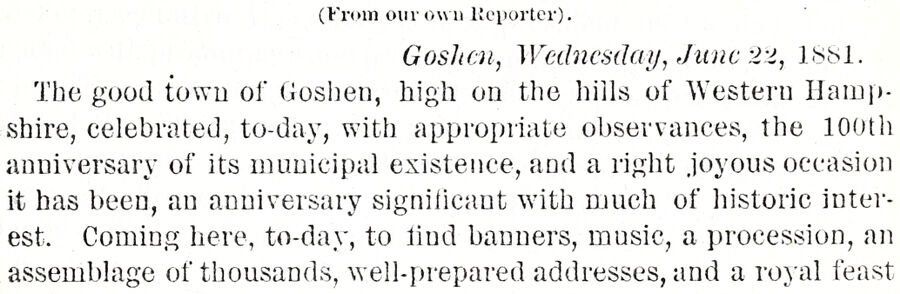
Centennial anniversary of the incorporation of the town of Goshen, Mass., June 22, 1881. Including addresses, poems, letters, and other matters relating to the occasion. Pub. by request1881Read the page →
Read the text
(From our ow n Reporter)* Goshen, Wednesday, June 2-1, 1881. The good town of Goshen, high on the hills of Western Hampshire, celebrated, to-day, with appropriate observances, the 100th anniversary of its municipal existence, and a right joyous occasion it has been, an anniversary significant with much of historic interest. Coming here, to-day, to liud banners, music, a procession, an assemblage of thousands, well-prepared addresses, and a royal feast
Text read by machine from the scan; it may contain errors.
Centennial anniversary of the incorporation of the town of Goshen, Mass., June 22, 1881. Including addresses, poems, letters, and other matters relating to the occasion. Pub. by request1881Read the page →
Read the text
.-. . . Your very kind invitation to all persons interested in your beautiful town, either by residence, marriage, descent or otherwise, to participate in the celebration of the one hundredth anniversary of her incorporation, is received. 1 am u otherwise " interested in Goshen, mainly through my respect and esteem for your chairman, and I regret that 1 shall be unable to witness your festivities. May the success of your celebration be unrivalled, and may the town of Goshen enter, under the happiest auspices, upon her second century.
Text read by machine from the scan; it may contain errors.
A standard history of Elkhart County, Indiana1916 · page 166Read the page →
Read the text
After the war Captain Wells, an old railroad man, and Joseph H. Defrees organized a new railroad company for the purpose of pushing a railroad north and south through Goshen. It was known as the Goshen, Warsaw and Wabash Railroad and was put in operation in 1870. The line, as originally planned, would have run through Middlebury to White Pigeon, skirting the southern part of the county and crossing the Baltimore and Ohio and the Wabash railroads. This line is now a part of the Big Four system
Text read by machine from the scan; it may contain errors.
A standard history of Elkhart County, Indiana1916 · page 403Read the page →
Read the text
to the railroad company to establish a station where the woodshed stood, and as a result a side track and platform afforded the shippers from the south an outlet for their products without the necessity of going to Bristol or Goshen. Thenceforward, until the railroad was built to Middlebury, Vistula was practically the railroad station for her southern neighbor. About 1845 the depot was moved to its present location, and William Bilhngs took charge as the first station agent in its new location. As Middlebury Station
Text read by machine from the scan; it may contain errors.
Scans and text from the Internet Archive. Books published in 1930 or earlier, which are in the public domain.
Timeline
Goshen, 1831 to 1983
Woven from the archive, old maps, post office records, the National Register and the people born here.
Every edition of the U.S. Geological Survey’s map of Goshen. Tap a year, or press play to watch the town change.
1959Goshen sheet · 1:24,000
U.S. Geological Survey historical topographic maps (public domain), via Esri’s collection of the scans. The red ring marks the center of Goshen.
Every building
Goshen, building by building, 1886–1917
Fire insurance maps drew every building, what it was made of and what it was used for, so insurers could price the risk of fire. Pick a year, then a sheet.
In 1831, according to Wikipedia’s history of the town. Goshen’s post office opened in 1832, and the census of 1850 counted 780 people here.
How does Goshen rank for history?
Goshen is more historic than 91% of U.S. towns, #137 of 593 in Indiana. The History grade combines the town’s founding era, the share of homes built before 1940 and its National Register listings. It’s a character grade, so it isn’t part of the overall grade. How it works.
What is on the National Register in Goshen?
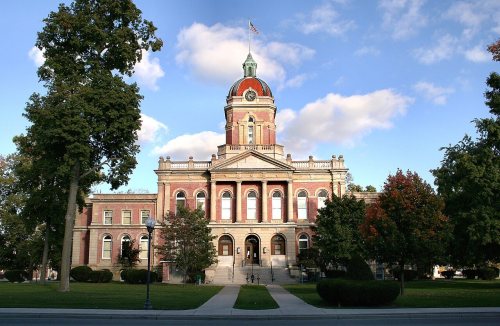
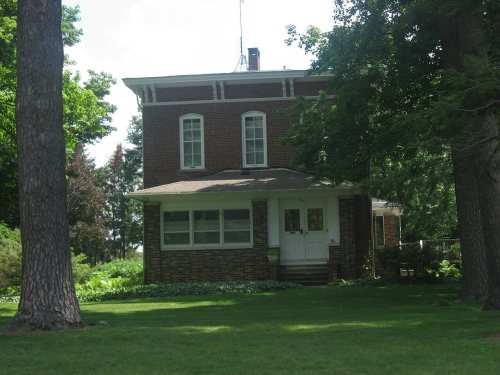
7 listings: 5 buildings, among them the Elkhart County Courthouse (listed 1980, the first), 1 historic district, the Goshen Historic Distriict, with 751 contributing buildings, and 1 structure. 760 historic buildings in all.
How old are the homes in Goshen?
18% of Goshen’s homes were built before 1940 (Census estimate, ±2.8 points), against a typical 14% for an Indiana town; the median home was built in 1980.
Founding dates: Wikidata, Wikipedia, the U.S. post office records of Blevins & Helbock (CC0) and the Census. Homes by year built: Census ACS 2020–24. National Register of Historic Places: National Park Service (list of May 22, 2026). Old photos, postcards and papers: Wikimedia Commons, the Library of Congress and other public archives, credited on each item’s page. Maps: U.S. Geological Survey historical topographic maps (via Esri) and Sanborn fire-insurance maps (Library of Congress). History text and census tables: Wikipedia (CC BY-SA 4.0). Places that used to be: USGS Geographic Names Information System (2021).
From Wikimedia Commons (1), the Library of Congress (21), Wikidata (1), the National Register of Historic Places (7), Wikipedia, Wikidata and Wikipedia for famous people, U.S. Geological Survey historical maps, U.S. Census counts (via Wikipedia), the US Post Offices dataset (Blevins & Helbock), the USGS Geographic Names Information System, Sanborn fire insurance maps (Library of Congress) and old county and town histories (Internet Archive). Archive images are copied here with their credits and licenses, shown on each photo’s page. Refreshed monthly.





 1908
 1908
 1909
 1909
 1909
 1909
 1909
 1911
 1911
 1911
 1911
 1911
 1911
 1911
 1911
 1911
 1911
 1911
 1911
 1911
 1911
 1911