Columbia City dates to 1839, and 21% of its homes were built before 1940
More historic than 92% of U.S. towns · #122 of 593 in Indiana. What drives it
4 places in town are on the National Register, among them a historic district with 197 buildings. Below: 4 old photos and papers, maps from 1886 on, and the census since 1860.
Founding year: Wikidata; Wikipedia’s history section gives the same year. First post office: 1854.The full story ↓
History grade
What drives Columbia City’s History grade
On its age, its old homes and the National Register, Columbia City is more historic than 92% of U.S. towns, #122 of 593 in Indiana. All 3 inputs are above most U.S. towns; its National Register listings ranks highest and its share of homes from before 1940 lowest.
A
HistoryA character grade: shown, never part of Columbia City’s overall grade.
Indiana towns list more on the Register than most of the country (a typical Indiana town has 7.9 per 10,000 residents, the U.S. 2.4), so Columbia City’s 202 sits above most of its state (88% of Indiana towns have fewer) while its 200 historic buildings outnumber those of 93% of U.S. towns.
How sure. Graded on any two of the three inputs instead, the letter would range from A− to A. The pre-1940 share is a Census survey estimate (±3.8 points). Two sources give 1839.
Founding year: Wikidata (other dates in Quick answers). Homes: Census ACS 2020–24. National Register: National Park Service, May 2026 list; each listing counted once (boundary changes and added documentation belong to their listing), and a historic district counts its contributing buildings. How TownRatings grades history →
What stands out about Columbia City’s past
Read from the archive, the National Register and the record. The page puts what stands out first.
Fire insurance maps drew every building, what it was made of and what it was used for, so insurers could price the risk of fire. Pick a year, then a sheet.
The first European ancestry settlers arrived in 1837 as a result of the end of the Black Hawk War and the Erie Canal. They were from New England - "Yankee" Settlers, descendants of the English Puritans who settled New England in the colonial era. They were primarily members of the Congregational Church though due to the Second Great Awakening many of them had converted to Methodism and some had become Baptists before coming to what is now Columbia City.
Passages that mention Columbia City, cut from the printed page as they were published.
History of Whitley County, Indiana1907 · page 345Read the page →
Read the text
About 1840 Thomas Washburn and some of the early business men of Columbia City petitioned the legislature to build a state road from Columbia City to Raccoon Village, as that was the nearest point to reach the canal in going from Columbia City to Fort Wayne and other eastern points, and in shipping goods to stock their stores.
Text read by machine from the scan; it may contain errors.
History of Whitley County, Indiana1907 · page 667Read the page →
Read the text
he and his brother rented the old homestead, which they successfully operated for three years. He then bought a small farm near Columbia City and during the time of his residence there worked in a saw mill, having been employed by the Peabody Saw Mill Company for a period of five years.
Text read by machine from the scan; it may contain errors.
Scans and text from the Internet Archive. Books published in 1930 or earlier, which are in the public domain.
Timeline
Columbia City, 1839 to 1979
Woven from the archive, old maps, post office records, the National Register and the people born here.
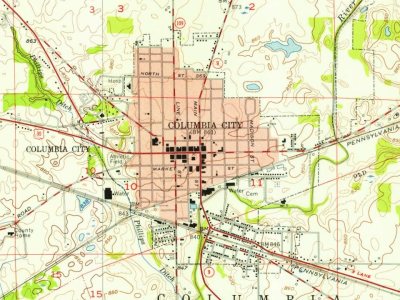
Every edition of the U.S. Geological Survey’s map of Columbia City. Tap a year, or press play to watch the town change.
1955Columbia City sheet · 1:24,000
U.S. Geological Survey historical topographic maps (public domain), via Esri’s collection of the scans. The red ring marks the center of Columbia City.
Then & now
Stand where they stood
No then-and-now pairs yet. Take a photo from the same spot as an old one and they appear here side by side.
Retake this viewColumbia-city-downtown
Find the spot, match the angle, and add your photo. It becomes the first then-and-now pair on Columbia City’s page.
In 1839, according to Wikidata and Wikipedia’s history of the town. Columbia City’s post office opened in 1854, and the census of 1860 counted 887 people here.
How does Columbia City rank for history?
Columbia City is more historic than 92% of U.S. towns, #122 of 593 in Indiana. The History grade combines the town’s founding era, the share of homes built before 1940 and its National Register listings. It’s a character grade, so it isn’t part of the overall grade. How it works.
What is on the National Register in Columbia City?
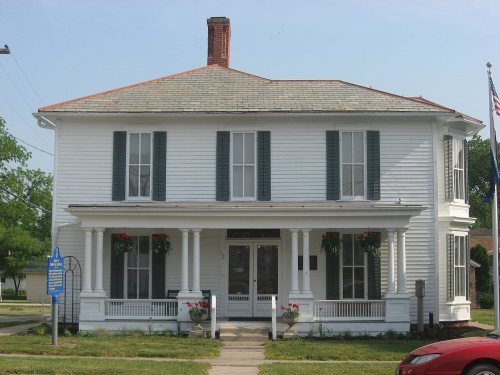
4 listings: 3 buildings, among them the Whitley County Courthouse (listed 1979, the first), and 1 historic district, the Columbia City Historic District, with 197 contributing buildings. 200 historic buildings in all.
How old are the homes in Columbia City?
21% of Columbia City’s homes were built before 1940 (Census estimate, ±3.8 points), against a typical 14% for an Indiana town; the median home was built in 1985.
Founding dates: Wikidata, Wikipedia, the U.S. post office records of Blevins & Helbock (CC0) and the Census. Homes by year built: Census ACS 2020–24. National Register of Historic Places: National Park Service (list of May 22, 2026). Old photos, postcards and papers: Wikimedia Commons, the Library of Congress and other public archives, credited on each item’s page. Maps: U.S. Geological Survey historical topographic maps (via Esri) and Sanborn fire-insurance maps (Library of Congress). History text and census tables: Wikipedia (CC BY-SA 4.0). Places that used to be: USGS Geographic Names Information System (2021).
From Wikimedia Commons (23), Wikidata (2), the National Register of Historic Places (4), Wikipedia, Wikidata and Wikipedia for famous people, U.S. Geological Survey historical maps, U.S. Census counts (via Wikipedia), the US Post Offices dataset (Blevins & Helbock), the USGS Geographic Names Information System, Sanborn fire insurance maps (Library of Congress) and old county and town histories (Internet Archive). Archive images are copied here with their credits and licenses, shown on each photo’s page. Refreshed monthly.





 Date?
 Date?
 Date?
 Date?
 2013
 2013
 2013
 2013
 2013
 2013
 2013
 2013
 2013
 2013
 2013
 2013
 2013
 2013
 2013
 2012
 2012
 2012
 2007


