Woodstock’s post office opened in 1852, and 15% of its homes were built before 1940
More historic than 70% of U.S. towns · #264 of 768 in Illinois. What drives it
3 places in town are on the National Register, among them a historic district with 70 buildings. Below: 5 old photos and papers, maps from 1885 on, and the census since 1860.
Founding year: the first Woodstock post office (Blevins & Helbock, CC0).The full story ↓
History grade
What drives Woodstock’s History grade
On its age, its old homes and the National Register, Woodstock is more historic than 70% of U.S. towns, #264 of 768 in Illinois. Its National Register listings hold the grade up; its age pulls it down.
B+
HistoryA character grade: shown, never part of Woodstock’s overall grade.
Few Illinois towns list much on the Register (a typical Illinois town has 0.5 per 10,000 residents, the U.S. 2.4), so Woodstock’s 27.5 sits above most of its state (88% of Illinois towns have fewer) while its 72 historic buildings outnumber those of 87% of U.S. towns.
How sure. Graded on any two of the three inputs instead, the letter would range from C+ to A−. The pre-1940 share (±2.5 points) is firm at this size. The founding year is the first post office, not a stated founding date.
Founding year: the first post office (other dates in Quick answers). Homes: Census ACS 2020–24. National Register: National Park Service, May 2026 list; each listing counted once (boundary changes and added documentation belong to their listing), and a historic district counts its contributing buildings. How TownRatings grades history →
What stands out about Woodstock’s past
Read from the archive, the National Register and the record. The page puts what stands out first.
National Park Service, National Register of Historic Places. Photos from Wikimedia Commons, credited on each place’s page.
Every building
Woodstock, building by building, 1885–1922
Fire insurance maps drew every building, what it was made of and what it was used for, so insurers could price the risk of fire. Pick a year, then a sheet.
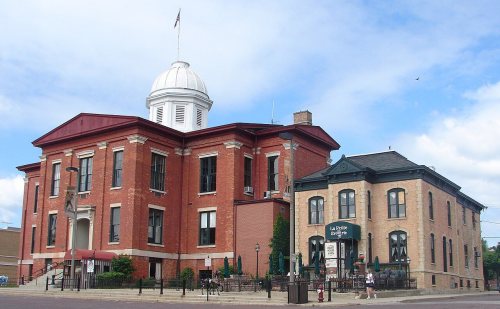
Woodstock was originally known as Centerville because of its location at the geographic center of McHenry County. It was chosen as the county seat on September 4, 1843. Early settler Alvin Judd developed a plat for the town, which incorporated a two-acre public square, near which a 2-story frame courthouse and jail were constructed the following year by George C. Dean and Daniel Blair.
In 1856 these people secured a church in which to worship and it served the congregation many yens, h was purchased by the American P byterians in Woodstock, taken aparl and hauled to Queen Ann Prairie, ami there buill into a church edifice. In 1878 the Dame of the church was changed to Queen Ann Church of Woodstock. Services were held there until 1881, when they buill a bouse of worship on Chemung street, Woodstock. This was a frame structure and seated 250 pers It stood "ii the presenl site of i trace Evangelical church, near the < Oliver
Text read by machine from the scan; it may contain errors.
In Woodstock the first school was taught in I84C, by David Richardson, who paid $2.00 a month for the privilege of holding school in the old courthouse. The next year, 1846, the first school building in Woodstock was erected on the same site still used for school purposes. In 18(i() this house was deemed too small, and it was sold and a new building provided in 1867. A new building was erected in 1906 at a cost of
Text read by machine from the scan; it may contain errors.
Scans and text from the Internet Archive. Books published in 1930 or earlier, which are in the public domain.
Timeline
Woodstock, 1852 to 1997
Woven from the archive, old maps, post office records, the National Register and the people born here.
Nothing in the archives for these yearsWeddings on Main Street, storms, parades, school pictures, the old store. If it’s in your family album, it belongs here.
The Woodstock post office opened in 1852, the earliest record of the town by name (U.S. post office records).
How does Woodstock rank for history?
Woodstock is more historic than 70% of U.S. towns, #264 of 768 in Illinois. The History grade combines the town’s founding era, the share of homes built before 1940 and its National Register listings. It’s a character grade, so it isn’t part of the overall grade. How it works.
What is on the National Register in Woodstock?
Three places: the Woodstock Opera House (listed 1974), the Old McHenry County Courthouse (1974) and the Woodstock Square Historic District (1982).
How old are the homes in Woodstock?
15% of Woodstock’s homes were built before 1940 (Census estimate, ±2.5 points), against a typical 11% for an Illinois town; the median home was built in 1989.
Founding dates: Wikidata, Wikipedia, the U.S. post office records of Blevins & Helbock (CC0) and the Census. Homes by year built: Census ACS 2020–24. National Register of Historic Places: National Park Service (list of May 22, 2026). Old photos, postcards and papers: Wikimedia Commons, the Library of Congress and other public archives, credited on each item’s page. Maps: U.S. Geological Survey historical topographic maps (via Esri) and Sanborn fire-insurance maps (Library of Congress). History text and census tables: Wikipedia (CC BY-SA 4.0). Places that used to be: USGS Geographic Names Information System (2021).
From Wikimedia Commons (15), the Library of Congress (3), the National Register of Historic Places (3), Wikipedia, Wikidata and Wikipedia for famous people, U.S. Geological Survey historical maps, U.S. Census counts (via Wikipedia), the US Post Offices dataset (Blevins & Helbock), the USGS Geographic Names Information System, Sanborn fire insurance maps (Library of Congress) and old county and town histories (Internet Archive). Archive images are copied here with their credits and licenses, shown on each photo’s page. Refreshed monthly.




 1917
 1941
 1942
 2016
 2016
 2016
 2013
 2013
 2012
 2012
 2012
 2012
 2012
 2011
 2007
 2005


