Sterling dates to 1838, and 25% of its homes were built before 1940
More historic than 84% of U.S. towns · #139 of 768 in Illinois. What drives it
Its Register listings are the First Congregational Church of Sterling and the Sterling Masonic Temple. Below: 6 old photos and papers, maps from 1884 on, and the census since 1860.
Founding year: Wikidata. First post office: 1843.The full story ↓
History grade
What drives Sterling’s History grade
On its age, its old homes and the National Register, Sterling is more historic than 84% of U.S. towns, #139 of 768 in Illinois. All 3 inputs are above most U.S. towns; its share of homes from before 1940 ranks highest and its National Register listings lowest.
A−
HistoryA character grade: shown, never part of Sterling’s overall grade.
Few Illinois towns list much on the Register (a typical Illinois town has 0.5 per 10,000 residents, the U.S. 2.4), so Sterling’s 1.4 sits near the middle of its state (64% of Illinois towns have fewer) while its 2 listings outnumber those of 60% of U.S. towns.
How sure. Graded on any two of the three inputs instead, the letter would still be A−. The pre-1940 share is a Census survey estimate (±3.9 points). Two sources give 1838.
Founding year: Wikidata (other dates in Quick answers). Homes: Census ACS 2020–24. National Register: National Park Service, May 2026 list; each listing counted once (boundary changes and added documentation belong to their listing), and a historic district counts its contributing buildings. How TownRatings grades history →
What stands out about Sterling’s past
Read from the archive, the National Register and the record. The page puts what stands out first.
Fire insurance maps drew every building, what it was made of and what it was used for, so insurers could price the risk of fire. Pick a year, then a sheet.
In 1834, Hezekiah Brink built the first cabin in what was to become Harrisburg. Two years later, William Kirkpatrick settled downstream in an area that became Chatham. In 1838, Harrisburg and Chatham merged to become the Town of Sterling in an effort to become the county seat. The name Sterling was chosen to honor Major James Sterling, who distinguished himself in the area during the Blackhawk War in 1832. On February 16, 1857, Sterling was incorporated as a city by state law.
Passages that mention Sterling, cut from the printed page as they were published.
1877 history of whiteside county illinois1877 · page 424Read the page →
Read the text
The charter was amended by an act of the General Assembly in 1869, and the city has been working under the amended charter sinee that time. Under this charter the corporate limits of the city are described to be “all that district embraced in the platted town of Sterling, including the several additions thereto, as now platted and recorded in the office of the Recorder of Whiteside county; also all that part of the Southwest quarter of section twenty-two, in said town, which lies north of Rock river, and all that part of the said town of Sterling lying between the said platted town and the central line of Roek river,
Text read by machine from the scan; it may contain errors.
History of Whiteside county, Illinois, from its first settlement to the present time1877 · page 424Read the page →
Read the text
The charter was amended by an act of the General Assembly in 1869, and the city has been working under the amended charter since that time. XJnder this charter. the corporate limits of the city are described to be "all that district embraced in the platted town of Sterling, including the several additions thereto, as now platted and recorded in the office of the Recorder of Whiteside county; also all that part of the Southwest quarter of section twenty-two, in said town, which lies north of Rock river, and all that part of the said town of Sterling lying between the said platted town and the central line of Rock river,
Text read by machine from the scan; it may contain errors.
History of Whiteside County, Illinois from its earliest settlement to 19081908 · page 30Read the page →
Read the text
section provided that the legal voters of the county should meet at their respective places of holding elections on the first Tuesday of April, 1849, and proceed to vote on the permanent location of the seat of justice, either at Lyndon or at Sterling, and the place receiving the majority, should thereafter be the seat of justice. The election was duly held April 3, 1849, with the following result: For Sterling 519 votes; for Lyndon 451; majority for Sterling 68. So Lyndon withdrew her claim, and Sterling remained the county seat until 1857. But she was not to remain in undisturbed pos-
Text read by machine from the scan; it may contain errors.
1877 history of whiteside county illinois1877 · page 513Read the page →
Read the text
The Town of Sterling: Responded to by Nelson Mason as follows: “I came to the town of Sterling in the fal] of 1836, in company with John D. Barnett. I found John Chapman and Wright Murphy living in the cabin now on the farm of. Capt. Woodburn. Here I spent my first night on Rock river. The first thing that attracted my attention as T left the cabin door in the morning, was a prairie wolf. We stood looking at cach other a short time and parted, each taking his own path. The next attraction was on the bank of the river, at the rapids; there were the remains of the wigwams of the Indian, and great
Text read by machine from the scan; it may contain errors.
Scans and text from the Internet Archive. Books published in 1930 or earlier, which are in the public domain.
By decade
Sterling, decade by decade
2 decades in the archive, from the 1860s to the 1900s. Scroll each row; tap a photo for its story.
Nothing in the archives for these yearsWeddings on Main Street, storms, parades, school pictures, the old store. If it’s in your family album, it belongs here.
In 1838, according to Wikidata. Sterling’s post office opened in 1843, and the census of 1860 counted 2,428 people here.
How does Sterling rank for history?
Sterling is more historic than 84% of U.S. towns, #139 of 768 in Illinois. The History grade combines the town’s founding era, the share of homes built before 1940 and its National Register listings. It’s a character grade, so it isn’t part of the overall grade. How it works.
What is on the National Register in Sterling?
Two places: the First Congregational Church of Sterling (listed 1995) and the Sterling Masonic Temple (1996).
How old are the homes in Sterling?
25% of Sterling’s homes were built before 1940 (Census estimate, ±3.9 points), against a typical 11% for an Illinois town; the median home was built in 1957.
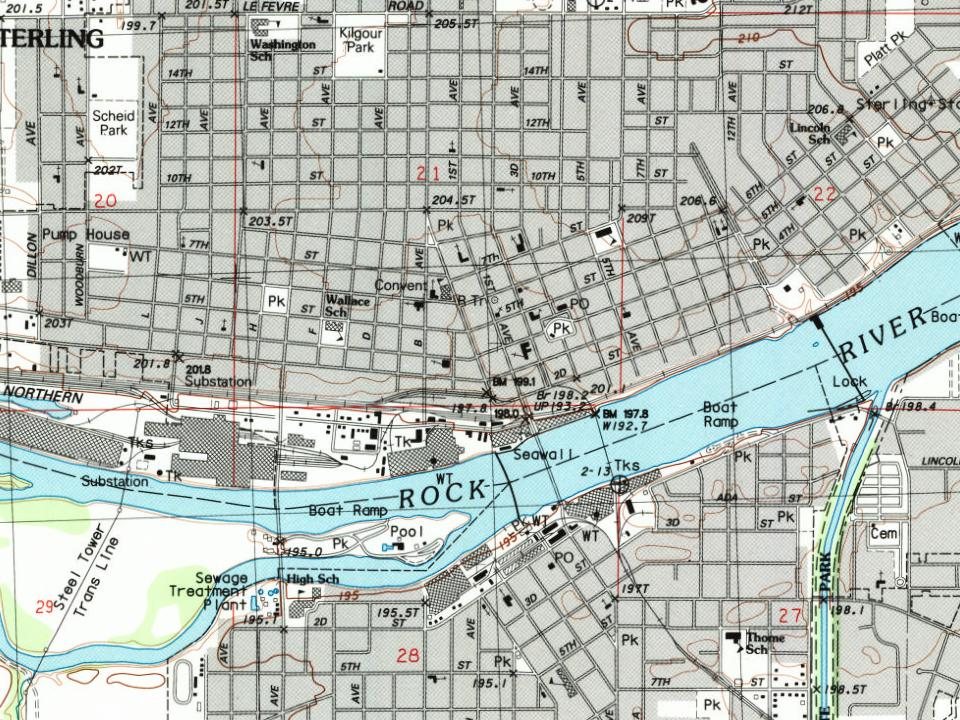
Founding dates: Wikidata, Wikipedia, the U.S. post office records of Blevins & Helbock (CC0) and the Census. Homes by year built: Census ACS 2020–24. National Register of Historic Places: National Park Service (list of May 22, 2026). Old photos, postcards and papers: Wikimedia Commons, the Library of Congress and other public archives, credited on each item’s page. Maps: U.S. Geological Survey historical topographic maps (via Esri) and Sanborn fire-insurance maps (Library of Congress). History text and census tables: Wikipedia (CC BY-SA 4.0). Places that used to be: USGS Geographic Names Information System (2021).
From Wikimedia Commons (6), the National Register of Historic Places (2), Wikipedia, Wikidata and Wikipedia for famous people, U.S. Geological Survey historical maps, U.S. Census counts (via Wikipedia), the US Post Offices dataset (Blevins & Helbock), the USGS Geographic Names Information System, Sanborn fire insurance maps (Library of Congress) and old county and town histories (Internet Archive). Archive images are copied here with their credits and licenses, shown on each photo’s page. Refreshed monthly.


![The Town of Sterling: Responded to by Nelson Mason as follows: “I came to the town of Sterling in the fal] of 1836, in company with John D. Barnett. I found John Chapman and Wright Murphy living in the cabin now on the farm of. Capt. Woodburn. Here I spent my first night on Rock river. The first th…](https://images.townratings.com/story/4276/bk-f24967929d608a4c-l.jpg)
 1907
 1907
 1907
 1907