Guest, Sign inJoin

Post to Springfield

We’ll email a one-tap link to publish your post. No password, and nothing is public until you click it.
Already a member? Sign in
AHistory
History · Springfield

Springfield dates to 1821, and 18% of its homes were built before 1940

More historic than 88% of U.S. towns · #102 of 768 in Illinois. What drives it

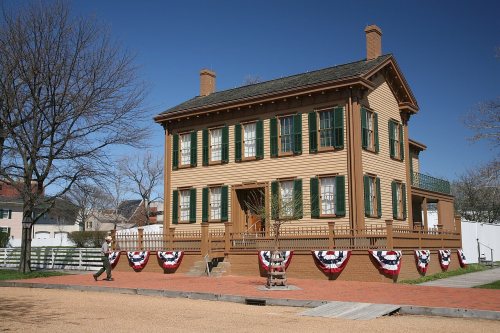
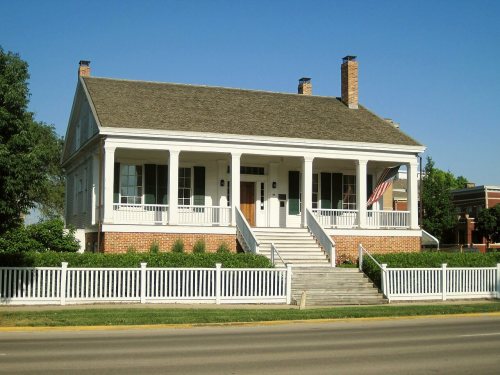
44 places in town are on the National Register, among them 5 National Historic Landmarks and four historic districts with 32 buildings between them. Below: 3 old photos and papers, maps from 1884 on, and the census since 1840.

1821founded
44on the National Register
18%homes built before 1940
3old photos & papers
41famous people
From Springfield’s archive · credits on each photo
Quick answers

How Springfield began

When was Springfield founded?

1821

Springfield dates its founding to 1821 (Wikidata). The census first counted it in 1840.

First census: 2,579 in 18402020 census: 114,394205 years

How historic is Springfield?

A

More historic than 88% of U.S. towns, on its age, its old homes and the National Register.

What drives the grade ↓
Founding year: Wikidata. First post office: 1822.The full story ↓
History grade

What drives Springfield’s History grade

On its age, its old homes and the National Register, Springfield is more historic than 88% of U.S. towns, #102 of 768 in Illinois. All 3 inputs are above most U.S. towns; its National Register listings ranks highest and its share of homes from before 1940 lowest.

A
HistoryA character grade: shown, never part of Springfield’s overall grade.
All U.S. towns we grade (21,289)Ahead of 88%
NewerOlder
Illinois towns of 2,500+ (768)Ahead of 87%

Among the 400 U.S. cities of 100,000 or more, Springfield ranks #82 on History.

Few Illinois towns list much on the Register (a typical Illinois town has 0.5 per 10,000 residents, the U.S. 2.4), so Springfield’s 7.0 sits above most of its state (79% of Illinois towns have fewer) while its 79 historic buildings outnumber those of 88% of U.S. towns.

How sure. Graded on any two of the three inputs instead, the letter would range from A− to A. The pre-1940 share (±0.9 points) is firm at this size. Two sources give 1821.

Founding year: Wikidata (other dates in Quick answers). Homes: Census ACS 2020–24. National Register: National Park Service, May 2026 list; each listing counted once (boundary changes and added documentation belong to their listing), and a historic district counts its contributing buildings. How TownRatings grades history →

What stands out about Springfield’s past

Read from the archive, the National Register and the record. The page puts what stands out first.

★ What stands out · On the National Register

44 historic places in Springfield

The country’s official list of buildings and places worth saving. 5 are National Historic Landmarks, the highest tier. Boundary changes and added documentation are counted with their listing.

places listed
44
National Historic Landmarks
5
Lincoln Tomb
historic buildings protected
79
each building in a district counts
first listed
1966
Lincoln Tomb
All 44 listings
Central Springfield Historic DistrictDistrict · listed 1978Union StationBuilding · listed 1978George M. Brinkerhoff HouseBuilding · listed 1978John L. Lewis HouseBuilding · listed 1979Howard K. Weber HouseBuilding · listed 1979Christ Episcopal ChurchBuilding · listed 1980Clarkson W. Freeman HouseBuilding · listed 1980Virgil Hickox HouseBuilding · listed 1982H. P. Boult HouseBuilding · listed 1982Bressmer-Baker HouseBuilding · listed 1982St. Nicholas HotelBuilding · listed 1983Gov. Richard Yates HouseBuilding · listed 1984Maid-Rite Sandwich ShopBuilding · listed 1984Hickox ApartmentsBuilding · listed 1984Price/Wheeler HouseBuilding · listed 1985Gottschalk, Fred, Grocery StoreBuilding · listed 1985Illinois Department of Mines and Minerals-Springfield Mine Rescue StationBuilding · listed 1985Illinois State CapitolBuilding · listed 1985Cong. James M. Graham HouseBuilding · listed 1989Rippon-Kinsella HouseBuilding · listed 1992Lincoln, Abraham, Memorial GardenSite · listed 1992Oak Ridge CemeteryDistrict · listed 1995Miller, Bell, ApartmentsBuilding · listed 1995Lincoln Colored HomeBuilding · listed 1998US ARMY Aircraft P-51D-25NA 44-73287Structure · listed 1999Fisher Building-Latham BlockBuilding · listed 2000John F. Bretz House and WarehouseBuilding · listed 2000Taylor ApartmentsBuilding · listed 2004Town House, TheBuilding · listed 2005Jennings Ford Automobile DealershipBuilding · listed 2006Hugh M. Garvey HouseBuilding · listed 2009Heimberger HouseBuilding · listed 2014Great Western Railroad DepotBuilding · listed 2014Strawbridge-Shepherd HouseBuilding · listed 2015Dr. Charles Compton HouseBuilding · listed 2017Washington ParkDistrict · listed 1992

National Park Service, National Register of Historic Places. Photos from Wikimedia Commons, credited on each place’s page.

Places that used to be

Lost post offices, old corners, places now gone and burying grounds

Springfield’s post office has been open since 1828. Six other post offices opened and closed inside today’s town.

Sangamon Courthouse
1822–1828
Sangamon
1824–1839
Sugar Creek
1827–1839
Springfield
1828–today
Ridgeley
1876–1878
Ridgely
1878–1902
Sugar Creek
1887–1888
18201920today
Hamlets and corners on the map
Arlington HeightsCodyColemanCotton HillDevereux HeightsEast SpringfieldHawthorne PlaceJessRidgelyShale BluffSouthlawnTorontoWest Grand Place
Gone or out of use
Cottage Hill SchoolschoolDoctors HospitalhospitalIles SchoolschoolReservoir ParkparkRickard SchoolschoolSouthtown TheatrebuildingUrsuline Academyschool
5cemeteries and burying grounds inside Springfield
BridgesDavid BrunkJonesLincoln TombOak Ridge

US Post Offices dataset (Blevins & Helbock, CC0). Places and cemeteries from the USGS Geographic Names Information System (2021).

Help out

Start Springfield’s collection

The first neighbors to add old photos shape how Springfield’s history is told.

Decades since 1900 with photos
00s10s20s30s40s50s60s70s80s90s
0 of 10 decades. The empty ones are waiting for someone’s album.
The story

How Springfield came to be

From Wikipedia’s history of Springfield.

Read it all →

Settlers originally named this community "Calhoun", after Senator John C. Calhoun of South Carolina, expressing their cultural ties. The land that Springfield now occupies was visited first by trappers and fur traders who came to the Sangamon River in 1818.

Text from Wikipedia, licensed CC BY-SA 4.0.

From the old history books

What they wrote about Springfield, 1909–1923

Passages that mention Springfield, cut from the printed page as they were published.

It is not only a great but unexpected honor to address you today. I am very proud to be asked, and very happy to address the citizens of this city of Springfield, where the mind of the great man whose memory we delight to honor today, took its definite shape.
Lincoln centennial1909Read the page →
Read the text

It is not only a great but unexpected honor to address you today. I am very proud to be asked, and very happy to address the citizens of this city of Springfield, where the mind of the great man whose memory we delight to honor today, took its definite shape.

Text read by machine from the scan; it may contain errors.
Four outstanding advantages which command attention point to the desirability of Springfield as a home and business center: Springfield has the lowest priced coal in the United States, due to the fact that it lies in the heart of Illinois' great coal fields, eliminating transportation costs. It has…
Historical guide and other points of interest of Springfield, Illinois1923Read the page →
Read the text

Four outstanding advantages which command attention point to the desirability of Springfield as a home and business center: Springfield has the lowest priced coal in the United States, due to the fact that it lies in the heart of Illinois' great coal fields, eliminating transportation costs. It has the lowest power and electric rates in the United

Text read by machine from the scan; it may contain errors.

Scans and text from the Internet Archive. Books published in 1930 or earlier, which are in the public domain.

Timeline

Springfield, 1821 to 1960

Woven from the archive, old maps, post office records, the National Register and the people born here.

  1. 19th century
  2. 1821
    FoundingSpringfield is established
  3. 1822Post officeThe Sangamon Courthouse post office opens
  4. 1824Post officeThe Sangamon post office opens
  5. 1827Post officeThe Sugar Creek post office opens
  6. 1828Post officeThe Sangamon Courthouse post office closes
  7. 1837BuiltOld State Capitol is built
  8. 1839Post officeThe Sangamon post office closes
  9. 1839Post officeThe Sugar Creek post office closes
  10. 1843Born hereRobert Todd Lincoln is born here
  11. 1855BuiltExecutive Mansion is built
  12. 1861In the archiveAbraham Lincoln Springfield departure February 1861
  13. 1868BuiltIllinois State Capitol is built
  14. 1874BuiltLincoln Tomb is built
  15. 1879Born hereVachel Lindsay is born here
  16. 1891Born hereSeth Barnes Nicholson is born here
  17. 20th century
  18. 1907On the mapFirst mapped by the U.S. Geological Survey
  19. 1960LandmarkLincoln Tomb named a National Historic Landmark
  20. 1960LandmarkLincoln Home National Historic Site named a National Historic Landmark
By decade

Springfield, decade by decade

One decade in the archive so far: the 1860s. Scroll each row; tap a photo for its story.

On the map

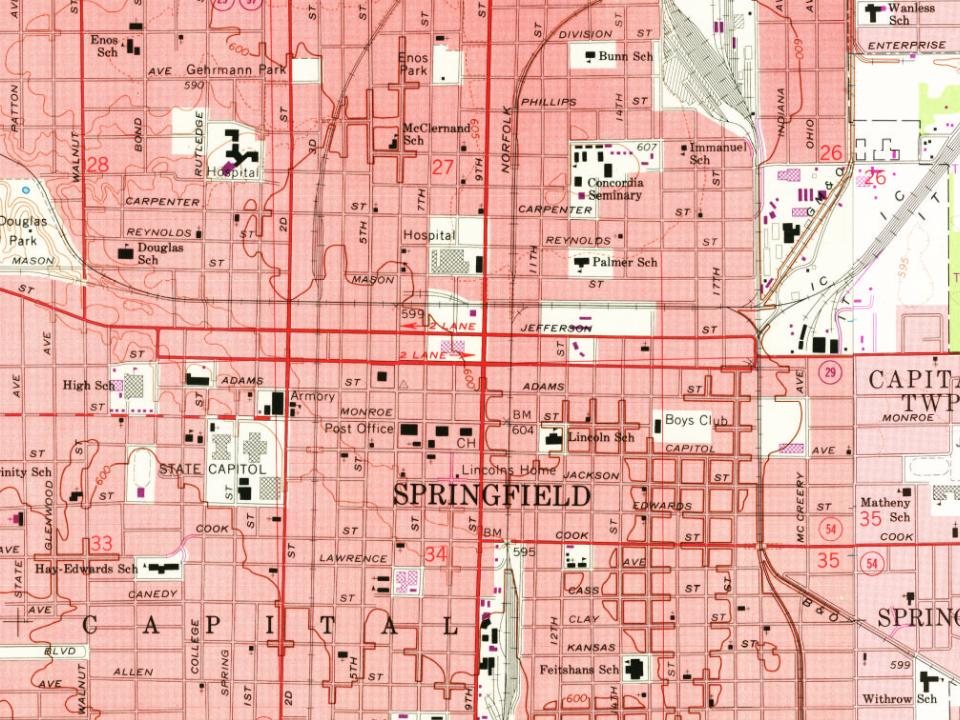
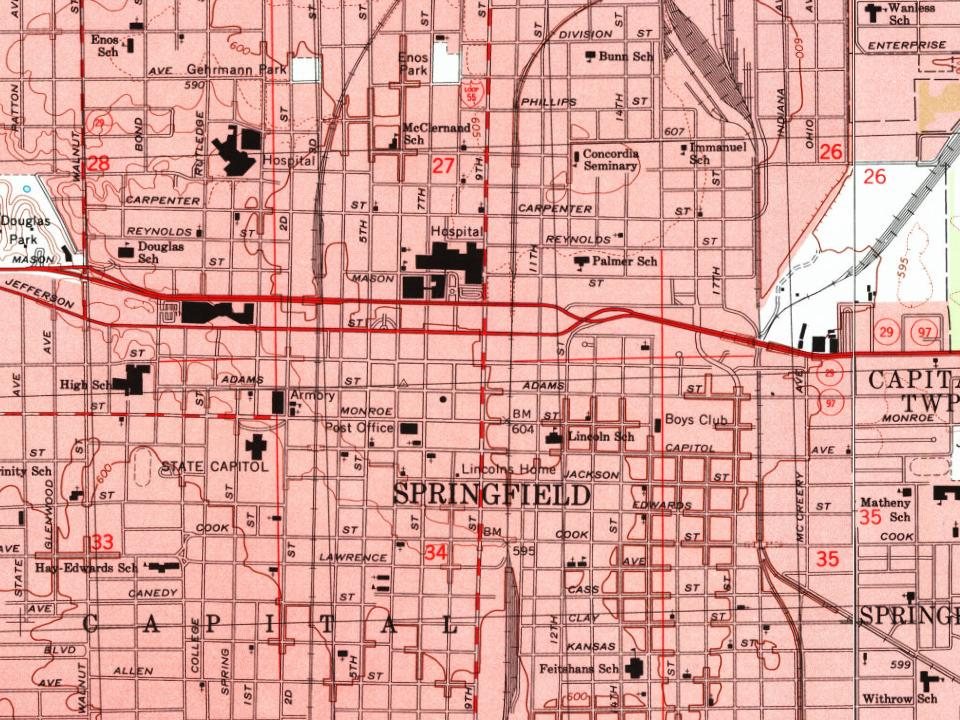
Springfield on the map, 1907 to 1998

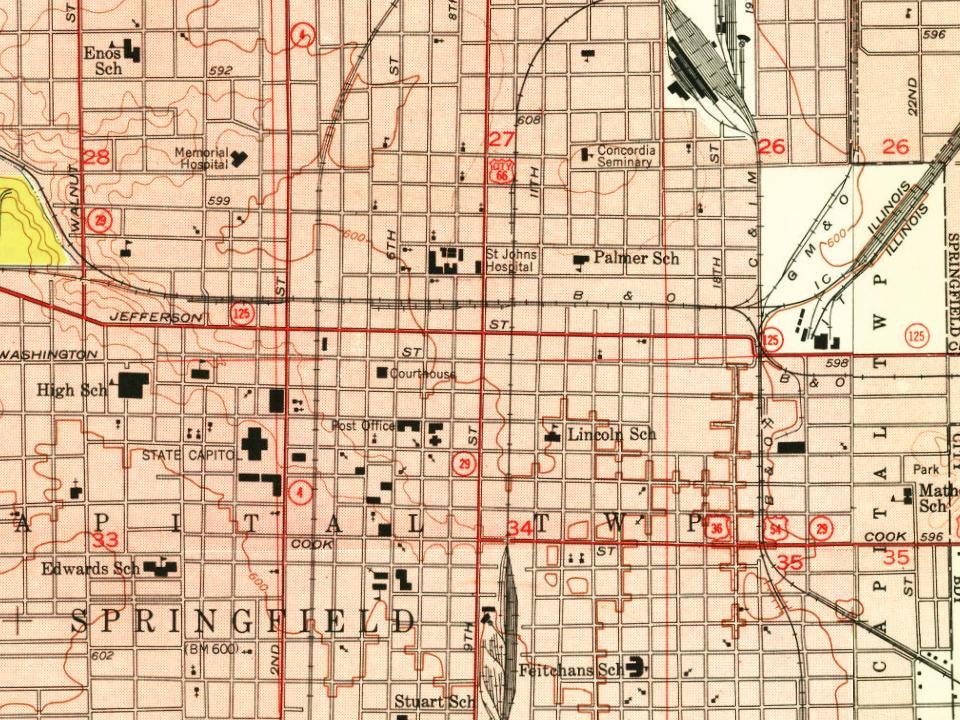
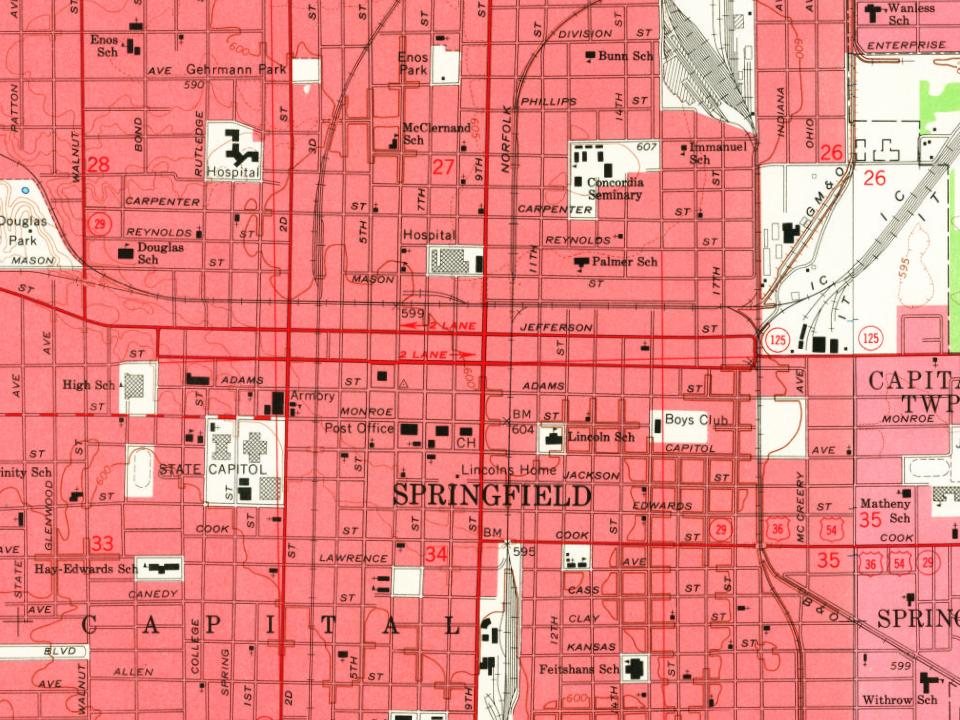
Every edition of the U.S. Geological Survey’s map of Springfield. Tap a year, or press play to watch the town change.

Springfield on the 1907 USGS mapSpringfield on the 1930 USGS mapSpringfield on the 1940 USGS mapSpringfield on the 1950 USGS mapSpringfield on the 1965 USGS mapSpringfield on the 1971 USGS mapSpringfield on the 1998 USGS map1907Springfield sheet · 1:62,500

U.S. Geological Survey historical topographic maps (public domain), via Esri’s collection of the scans. The red ring marks the center of Springfield.

Every building

Springfield, building by building, 1884–1917

Fire insurance maps drew every building, what it was made of and what it was used for, so insurers could price the risk of fire. Pick a year, then a sheet.

Springfield fire insurance map, 1884, sheet 21884Sheet 2 of 15
Edition
BrickWoodStone

Sanborn Map Company, via the Library of Congress. Editions published in 1930 or earlier, which are in the public domain.

Then & now

Stand where they stood

No then-and-now pairs yet. Take a photo from the same spot as an old one and they appear here side by side.

Abraham Lincoln Springfield departure February 1861
Retake this viewAbraham Lincoln Springfield departure February 1861, 1861

Find the spot, match the angle, and add your photo. It becomes the first then-and-now pair on Springfield’s page.

Retake this view · +15
People over time

Springfield, census by census

020,00040,00060,00080,000100,000120,0001850190019502000Peak: 116,250

Between 2,579 and 116,250 people in every census since 1840.

19 censuses, 1840–2020.

U.S. Census Bureau decennial counts, from the census table on Springfield’s Wikipedia page.

Famous people

41 famous people were born in Springfield

Writers, athletes, leaders and more, ranked by how widely they’re known.

See all →
Stories next door

History across the town line

Each neighbor’s History grade, on the same three inputs.

Questions about Springfield’s history

What year was Springfield founded?

In 1821, according to Wikidata. Springfield’s post office opened in 1822, and the census of 1840 counted 2,579 people here.

How does Springfield rank for history?

Springfield is more historic than 88% of U.S. towns, #102 of 768 in Illinois. The History grade combines the town’s founding era, the share of homes built before 1940 and its National Register listings. It’s a character grade, so it isn’t part of the overall grade. How it works.

What is on the National Register in Springfield?

44 listings, 5 of them National Historic Landmarks: 37 buildings, 4 historic districts with 32 contributing buildings, 1 site, and 2 structures. 79 historic buildings in all.

How old are the homes in Springfield?

18% of Springfield’s homes were built before 1940 (Census estimate), against a typical 11% for an Illinois town; the median home was built in 1972.

Memory lane

What the archives can’t tell you, neighbors can.

Town Square →
Start a conversation
Sources

Where this page comes from

Founding dates: Wikidata, Wikipedia, the U.S. post office records of Blevins & Helbock (CC0) and the Census. Homes by year built: Census ACS 2020–24. National Register of Historic Places: National Park Service (list of May 22, 2026). Old photos, postcards and papers: Wikimedia Commons, the Library of Congress and other public archives, credited on each item’s page. Maps: U.S. Geological Survey historical topographic maps (via Esri) and Sanborn fire-insurance maps (Library of Congress). History text and census tables: Wikipedia (CC BY-SA 4.0). Places that used to be: USGS Geographic Names Information System (2021).

From Wikimedia Commons (1), the Library of Congress (2), Wikidata (3), the National Register of Historic Places (44), Wikipedia, Wikidata and Wikipedia for famous people, U.S. Geological Survey historical maps, U.S. Census counts (via Wikipedia), the US Post Offices dataset (Blevins & Helbock), the USGS Geographic Names Information System, Sanborn fire insurance maps (Library of Congress) and old county and town histories (Internet Archive). Archive images are copied here with their credits and licenses, shown on each photo’s page. Refreshed monthly.