More historic than 16% of U.S. towns · #677 of 768 in Illinois. What drives it
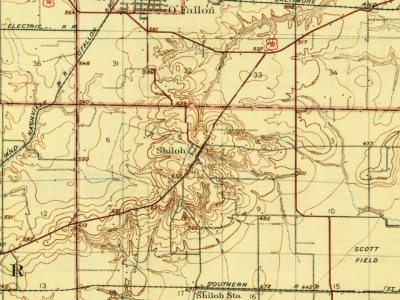
Most of Shiloh was built recently: 1% of its homes predate 1940 and the median home dates from 2000. Below: 6 old photos and papers, maps from 1907 on, and the census since 1870.
Founding year: the first Shiloh post office (Blevins & Helbock, CC0).The full story ↓
History grade
What drives Shiloh’s History grade
On its age, its old homes and the National Register, Shiloh is more historic than 16% of U.S. towns, #677 of 768 in Illinois. Its age holds the grade up; its share of homes from before 1940 pulls it down.
C−
HistoryA character grade: shown, never part of Shiloh’s overall grade.
Few Illinois towns list much on the Register (a typical Illinois town has 0.5 per 10,000 residents, the U.S. 2.4), so Shiloh’s 0.0 sits below most of its state (28% of Illinois towns have fewer) while its 0 listings outnumber those of 23% of U.S. towns.
How sure. Graded on any two of the three inputs instead, the letter would range from D to C−. The pre-1940 share (±1.0 points) is firm at this size. The founding year is the first post office, not a stated founding date.
Founding year: the first post office (other dates in Quick answers). Homes: Census ACS 2020–24. National Register: National Park Service, May 2026 list; each listing counted once (boundary changes and added documentation belong to their listing), and a historic district counts its contributing buildings. How TownRatings grades history →
What stands out about Shiloh’s past
Read from the archive, the National Register and the record. The page puts what stands out first.
A site known as "Three Springs" for its geological characteristics hosted an 11-day revival camp meeting in April 1807, which was the first in St. Clair County and possibly the second in Illinois Country, which was then part of Indiana Territory. It was organized by the Rev. William McKendree, Presiding Elder of the Western Conference and 4th Bishop of the Methodist Episcopal Church.
Passages that mention Shiloh, cut from the printed page as they were published.
Centennial, McKendree college, with St. Clair County history1928Read the page →
Read the text
The village of Shiloh did not have its origin until 184^, when the first house was built by Edwin Pierce. A store and the post office were estabhshed the same year. A little later other houses were built, a blacksmith shop was established, and in 1847 a steam sawmill was erected by Edwin Pierce, Philip Scott, and Charles Alexander. The village was laid out by Martin Stites and James Atkins. Most of the village still lies on a single street which has several stores and shops to
Text read by machine from the scan; it may contain errors.
History of St. Clair County, Illinois. With illustrations ... and biographical sketches of some of its prominent men and pioneers1881Read the page →
Read the text
The first school-house was erected of logs on the place now owned by H. A. Piercs, just opposite the present Cherry Grove schoolhouse, at a very early date. There was also an early school-house on the present site of the village of Shiloh. Rev. Clark, a Baptist minister, was an early teacher. A post-office was established at Clierry Grovs as early as 1318, and Daniel Wilbanks was the first postmaster. This office was kept at several places in the settlement, and at Rock Spring, and in 1845 it was permanently located
Text read by machine from the scan; it may contain errors.
History of St. Clair County, Illinois. With illustrations ... and biographical sketches of some of its prominent men and pioneers1881 · page 173Read the page →
Read the text
Shiloh is a sacred place to thousands of souls. Many who are in heaven doubtless look back with joy to old Shiloh, where they were born the second time. And many who are now living, and are scattered throughout the great West, many of whom have grown old and gray in the service of the Lord, can look back to old Sliiloh where they were first forgiven. And throughout the West is frequently heard, in love-feasts and class-meetings, " I was converted in such a year, and month, and on such a day, at old Shiloh
Text read by machine from the scan; it may contain errors.
Scans and text from the Internet Archive. Books published in 1930 or earlier, which are in the public domain.
Timeline
Shiloh, 1850 to 1988
Woven from the archive, old maps, post office records, the National Register and the people born here.
The Shiloh post office opened in 1850, the earliest record of the town by name (U.S. post office records).
How does Shiloh rank for history?
Shiloh is more historic than 16% of U.S. towns, #677 of 768 in Illinois. The History grade combines the town’s founding era, the share of homes built before 1940 and its National Register listings. It’s a character grade, so it isn’t part of the overall grade. How it works.
How old are the homes in Shiloh?
1% of Shiloh’s homes were built before 1940 (Census estimate, ±1.0 points), against a typical 11% for an Illinois town; the median home was built in 2000.
Founding dates: Wikidata, Wikipedia, the U.S. post office records of Blevins & Helbock (CC0) and the Census. Homes by year built: Census ACS 2020–24. National Register of Historic Places: National Park Service (list of May 22, 2026). Old photos, postcards and papers: Wikimedia Commons, the Library of Congress and other public archives, credited on each item’s page. Maps: U.S. Geological Survey historical topographic maps (via Esri) and Sanborn fire-insurance maps (Library of Congress). History text and census tables: Wikipedia (CC BY-SA 4.0). Places that used to be: USGS Geographic Names Information System (2021).
From Wikimedia Commons (7), the Library of Congress (6), Wikipedia, Wikidata and Wikipedia for famous people, U.S. Geological Survey historical maps, U.S. Census counts (via Wikipedia), the US Post Offices dataset (Blevins & Helbock), the USGS Geographic Names Information System and old county and town histories (Internet Archive). Archive images are copied here with their credits and licenses, shown on each photo’s page. Refreshed monthly.


 Date?
 Date?
 Date?
 Date?
 Date?
 Date?
 2015
 2015
 2015
 2015
 2015
 2015
 2008