McHenry Township’s post office opened in 1837, and 2 of its places are on the National Register
More historic than 68% of U.S. towns · #271 of 768 in Illinois. What drives it
Most of McHenry Township was built recently: 8% of its homes predate 1940 and the median home dates from 1978. Below: 2 old photos and papers, maps from 1926 on, and the census since 1880.
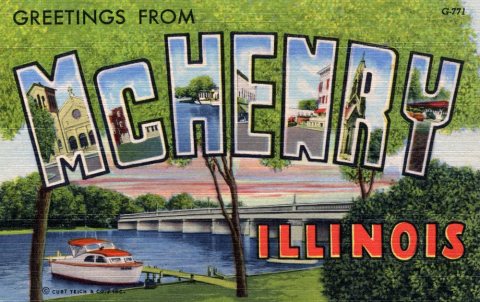
From McHenry Township’s archive · credits on each photo
Quick answers
How McHenry Township began
When was McHenry Township founded?
1837
The McHenry Township post office opened in 1837, the earliest record of the town by name. Wikidata gives 1872. Two smaller post offices, Ostend (1846) and Pistakee (1899), opened inside today’s town and later closed.
First census: 874 in 18802020 census: 46,268189 years
How historic is McHenry Township?
B+
More historic than 68% of U.S. towns, on its age, its old homes and the National Register.
Founding year: the first McHenry Township post office (Blevins & Helbock, CC0). Wikidata: 1872.The full story ↓
History grade
What drives McHenry Township’s History grade
On its age, its old homes and the National Register, McHenry Township is more historic than 68% of U.S. towns, #271 of 768 in Illinois. Its age holds the grade up; its share of homes from before 1940 pulls it down.
B+
HistoryA character grade: shown, never part of McHenry Township’s overall grade.
Few Illinois towns list much on the Register (a typical Illinois town has 0.5 per 10,000 residents, the U.S. 2.4), so McHenry Township’s 1.1 sits near the middle of its state (63% of Illinois towns have fewer) while its 5 historic buildings outnumber those of 70% of U.S. towns.
How sure. Graded on any two of the three inputs instead, the letter would range from B to A−. The pre-1940 share (±1.4 points) is firm at this size. The founding year is the first post office, not a stated founding date; Wikidata gives 1872.
Founding year: the first post office (other dates in Quick answers). Homes: Census ACS 2020–24. National Register: National Park Service, May 2026 list; each listing counted once (boundary changes and added documentation belong to their listing), and a historic district counts its contributing buildings. How TownRatings grades history →
What stands out about McHenry Township’s past
Read from the archive, the National Register and the record. The page puts what stands out first.
In the 1830s various settlers arrived in the area and created the foundation for McHenry. Some of the family names can still be seen today: McCullom, McLean, Boone, and Wheeler.
George Gage came to the area in 1835 and purchased a plot of land west of the Fox River. This area eventually came to be known as Gagetown. In 1854, George Gage played an instrumental role in bringing the railroad to the city. Gagetown was eventually renamed to West McHenry.
In 1851, a dam was built on Boone Creek which created Mill Pond. The pond encompassed an area between today's rail road tracks and Route 31 and north of Waukegan Road.
On August 4, 1875, the first issue of the city newspaper, the McHenry Plaindealer, was published by Jay Van Slyke.
Passages that mention McHenry Township, cut from the printed page as they were published.
History of McHenry County, Illinois1922 · page 440Read the page →
Read the text
<>f McHenry Township, three miles southeast of Ringwood, a station on the railroad in this township; and it is also about two miles northeast from McHenry village. This hamlet was settled by the Germans in 1852, and was named in honor of their leader, for the settlement was really a colony. His Christian name being John the place was called Johnsburg. It has ever been known almost exclusively as a German settlement.
Text read by machine from the scan; it may contain errors.
In McHenry Township the first school was taught in 1840 by a .Miss McOmber, in a small log house erected on the banks of the Fox River. This was also the first school building in the township. In the early eighties reports show seven fairly well-built frame schoolhouses in the township which property was valued at $9,000 and there was a school population of 658. The township also had a small, but most excellent library. In the village of McHenry the first school was taught in a frame building on the present public square. It cost $2,000. Another
Text read by machine from the scan; it may contain errors.
History of McHenry County, Illinois1885 · page 939Read the page →
Read the text
Hillsdale County, Mich., and in 1844 to McHenry County, 111., and settled in McHenry Township. Alpheus 0. remained in McHenry Township till 1879 when he moved to Seneca Township, and settled on section 15, where he has since lived. He owns 154 acres of land and makes a specialty of dairying and stock-raising.
Text read by machine from the scan; it may contain errors.
Scans and text from the Internet Archive. Books published in 1930 or earlier, which are in the public domain.
Every edition of the U.S. Geological Survey’s map of McHenry Township. Tap a year, or press play to watch the town change.
1926McHenry sheet · 1:62,500
U.S. Geological Survey historical topographic maps (public domain), via Esri’s collection of the scans. The red ring marks the center of McHenry Township.
Then & now
Stand where they stood
No then-and-now pairs yet. Take a photo from the same spot as an old one and they appear here side by side.
Retake this viewMcHenry House Hotel (NBY 4025)
Find the spot, match the angle, and add your photo. It becomes the first then-and-now pair on McHenry Township’s page.
The McHenry Township post office opened in 1837, the earliest record of the town by name (U.S. post office records). Wikidata gives 1872.
How does McHenry Township rank for history?
McHenry Township is more historic than 68% of U.S. towns, #271 of 768 in Illinois. The History grade combines the town’s founding era, the share of homes built before 1940 and its National Register listings. It’s a character grade, so it isn’t part of the overall grade. How it works.
How old are the homes in McHenry Township?
8% of McHenry Township’s homes were built before 1940 (Census estimate, ±1.4 points), against a typical 11% for an Illinois town; the median home was built in 1978.
Founding dates: Wikidata, Wikipedia, the U.S. post office records of Blevins & Helbock (CC0) and the Census. Homes by year built: Census ACS 2020–24. National Register of Historic Places: National Park Service (list of May 22, 2026). Old photos, postcards and papers: Wikimedia Commons, the Library of Congress and other public archives, credited on each item’s page. Maps: U.S. Geological Survey historical topographic maps (via Esri) and Sanborn fire-insurance maps (Library of Congress). History text and census tables: Wikipedia (CC BY-SA 4.0). Places that used to be: USGS Geographic Names Information System (2021).
From Wikimedia Commons (8), Wikipedia, U.S. Geological Survey historical maps, U.S. Census counts (via Wikipedia), the US Post Offices dataset (Blevins & Helbock), the USGS Geographic Names Information System and old county and town histories (Internet Archive). Archive images are copied here with their credits and licenses, shown on each photo’s page. Refreshed monthly.


 Date?
 Date?
 2016
 2012
 2010
 2009
 2009
 2005


