Lincoln dates to 1853, and 20% of its homes were built before 1940
More historic than 76% of U.S. towns · #210 of 768 in Illinois. What drives it
6 places in town are on the National Register, among them a historic district with 88 buildings. Below: 7 old photos and papers, maps from 1884 on, and the census since 1880.
Founding year: Wikidata. First post office: 1838.The full story ↓
History grade
What drives Lincoln’s History grade
On its age, its old homes and the National Register, Lincoln is more historic than 76% of U.S. towns, #210 of 768 in Illinois. Its National Register listings hold the grade up; its age pulls it down.
A−
HistoryA character grade: shown, never part of Lincoln’s overall grade.
Few Illinois towns list much on the Register (a typical Illinois town has 0.5 per 10,000 residents, the U.S. 2.4), so Lincoln’s 70.8 sits above most of its state (92% of Illinois towns have fewer) while its 94 historic buildings outnumber those of 89% of U.S. towns.
How sure. Graded on any two of the three inputs instead, the letter would range from B− to A. The pre-1940 share is a Census survey estimate (±3.6 points). Two sources give 1853.
Founding year: Wikidata (other dates in Quick answers). Homes: Census ACS 2020–24. National Register: National Park Service, May 2026 list; each listing counted once (boundary changes and added documentation belong to their listing), and a historic district counts its contributing buildings. How TownRatings grades history →
What stands out about Lincoln’s past
Read from the archive, the National Register and the record. The page puts what stands out first.
National Park Service, National Register of Historic Places. Photos from Wikimedia Commons, credited on each place’s page.
Every building
Lincoln, building by building, 1884–1914
Fire insurance maps drew every building, what it was made of and what it was used for, so insurers could price the risk of fire. Pick a year, then a sheet.
The town's standard history holds that it was officially named on August 27, 1853, in an unusual ceremony. Abraham Lincoln, having assisted with the platting of the town and working as counsel for the newly laid Chicago & Mississippi Railroad which led to its founding, was asked to participate in a naming ceremony for the town. On this date, the first sale of lots took place in the new town.
Ninety were sold at prices ranging from $40 to $150. According to tradition Lincoln was present. At noon he purchased two watermelons and carried one under each arm to the public square. There he invited Latham, Hickox, and Gillette, proprietors, to join him, saying, "Now we'll christen the new town," squeezing watermelon juice out on the ground.
Passages that mention Lincoln, cut from the printed page as they were published.
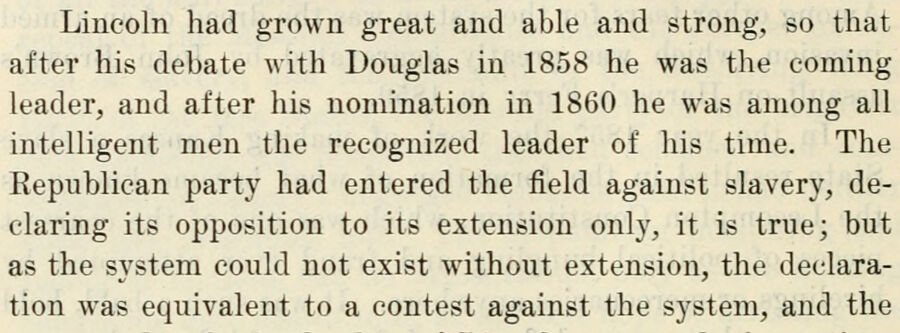
Abraham Lincoln and the men of his time1907 · page 400Read the page →
Read the text
Lincoln had grown great and able and strong, so that after his debate with Douglas in 1858 he was the coming leader, and after his nomination in 1860 he was among all intelligent men the recognized leader of his time. The Eepublican party had entered the field against slavery, declaring its opposition to its extension only, it is true; but as the system could not exist without extension, the declaration was equivalent to a contest against the system, and the
Text read by machine from the scan; it may contain errors.
Wood, Fernando, M. C. : advice to Lincoln about Vallandigham, VII, 359, 360; letters to Lincoln about peace, 366 ; letters to Seward explaining his speech, 367 ; letter to Lincoln about amnesty, 367; rejoinder to Lincoln's reply, 368, 369 ; House resolution to appoint peace commissioners, 394, 395.
Text read by machine from the scan; it may contain errors.
Lincoln lectured, and no man at the bar ever carried out this advice more conscientiously. Once he was asked to collect a claim of two and a half dollars and his client insisted, against Lincoln's advice, that suit be brought. Lincoln thereupon gravely demanded ten doUais as a retainer. Half of this he gave to the defendant, who then confessed judgment and paid the
Text read by machine from the scan; it may contain errors.
Scans and text from the Internet Archive. Books published in 1930 or earlier, which are in the public domain.
Timeline
Lincoln, 1838 to 1980
Woven from the archive, old maps, post office records, the National Register and the people born here.
Nothing in the archives for these yearsWeddings on Main Street, storms, parades, school pictures, the old store. If it’s in your family album, it belongs here.
In 1853, according to Wikidata. Lincoln’s post office opened in 1838, and the census of 1880 counted 5,639 people here.
How does Lincoln rank for history?
Lincoln is more historic than 76% of U.S. towns, #210 of 768 in Illinois. The History grade combines the town’s founding era, the share of homes built before 1940 and its National Register listings. It’s a character grade, so it isn’t part of the overall grade. How it works.
What is on the National Register in Lincoln?
6 listings: 5 buildings, among them the University Hall (listed 1973, the first), and 1 historic district, the Lincoln Courthouse Square Historic District, with 88 contributing buildings. 94 historic buildings in all.
How old are the homes in Lincoln?
20% of Lincoln’s homes were built before 1940 (Census estimate, ±3.6 points), against a typical 11% for an Illinois town; the median home was built in 1967.
Founding dates: Wikidata, Wikipedia, the U.S. post office records of Blevins & Helbock (CC0) and the Census. Homes by year built: Census ACS 2020–24. National Register of Historic Places: National Park Service (list of May 22, 2026). Old photos, postcards and papers: Wikimedia Commons, the Library of Congress and other public archives, credited on each item’s page. Maps: U.S. Geological Survey historical topographic maps (via Esri) and Sanborn fire-insurance maps (Library of Congress). History text and census tables: Wikipedia (CC BY-SA 4.0). Places that used to be: USGS Geographic Names Information System (2021).
From Wikimedia Commons (15), the Library of Congress (2), Wikidata (1), the National Register of Historic Places (6), Wikipedia, Wikidata and Wikipedia for famous people, U.S. Geological Survey historical maps, U.S. Census counts (via Wikipedia), the US Post Offices dataset (Blevins & Helbock), the USGS Geographic Names Information System, Sanborn fire insurance maps (Library of Congress) and old county and town histories (Internet Archive). Archive images are copied here with their credits and licenses, shown on each photo’s page. Refreshed monthly.











 1995
 2014
 2014
 2012
 2012
 2011
 2008
 2008
 2006
 2003
 2003


