More historic than 35% of U.S. towns · #510 of 768 in Illinois. What drives it
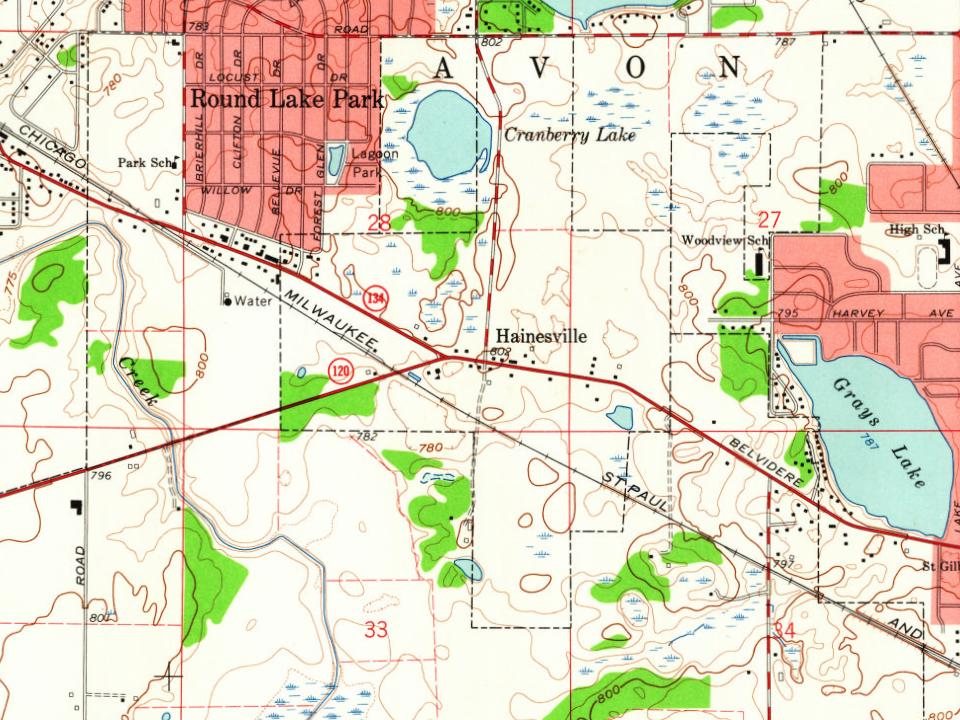
Most of Hainesville was built recently: 2% of its homes predate 1940 and the median home dates from 1997. Below: maps from 1920 on and the census since 1880.
Founding year: Wikidata. First post office: 1846.The full story ↓
History grade
What drives Hainesville’s History grade
On its age, its old homes and the National Register, Hainesville is more historic than 35% of U.S. towns, #510 of 768 in Illinois. Its age holds the grade up; its share of homes from before 1940 pulls it down.
C
HistoryA character grade: shown, never part of Hainesville’s overall grade.
Few Illinois towns list much on the Register (a typical Illinois town has 0.5 per 10,000 residents, the U.S. 2.4), so Hainesville’s 0.0 sits below most of its state (28% of Illinois towns have fewer) while its 0 listings outnumber those of 23% of U.S. towns.
NoteThe founding year comes from Wikidata alone; no second source gives 1846.
How sure. Graded on any two of the three inputs instead, the letter would range from D to B−. The pre-1940 share is a Census survey estimate (±3.6 points).
Founding year: Wikidata (other dates in Quick answers). Homes: Census ACS 2020–24. National Register: National Park Service, May 2026 list; each listing counted once (boundary changes and added documentation belong to their listing), and a historic district counts its contributing buildings. How TownRatings grades history →
What stands out about Hainesville’s past
Read from the archive, the National Register and the record. The page puts what stands out first.
In 1838, a young boy named Elijah M. Haines (1822–1889) and his family moved from New York City to the Chicago area. In 1836, the young boy purchased a farm in Hainesville. During the winter of 1841–42, Haines taught school in Waukegan, Illinois (then known as Little Fort). In 1846, he surveyed and platted Hainesville. On February 26, 1847, the village incorporation papers were drafted. It is recorded that Elijah Haines met Abraham Lincoln in 1847. The two men met frequently and became well acquainted. It has been said that Lincoln spent the night in Hainesville a few times.
Passages that mention Hainesville, cut from the printed page as they were published.
The past and present of Lake County, Illinois, containing a history of the county ... a biographical directory ... war record ... early settlers ... statistics ... history of Illinois ... the Northwest ... etc., etc ..1877 · page 244Read the page →
Read the text
At the session of the Legislature of 1846-7, an act was passed incorporat¬ ing the village of Hainesville. In the Spring following, it became organized by virtue of said act, as a town corporate, being the first village incorporated in
Text read by machine from the scan; it may contain errors.
The past and present of Lake County, Illinois, containing a history of the county ... a biographical directory ... war record ... early settlers ... statistics ... history of Illinois ... the Northwest ... etc., etc ..1877 · page 247Read the page →
Read the text
son’s. There was no congregation or society of that denomination in the town, hut he preached in the school houses in different parts of the town, whenever and wherever an audience would come together. He usually preached at the Marble School House and at Hainesville. He was liberal as to his religious views, and everybody wTent to hear him preach out of personal respect. A church of the Disciples of Christ, otherwise called Campbellites, was organized in this town, at Marble School House, January 12, 1850; J. L. Correll and A. R. Knox were elected Elders, J. L. Correll being designated as
Text read by machine from the scan; it may contain errors.
Scans and text from the Internet Archive. Books published in 1930 or earlier, which are in the public domain.
Timeline
Hainesville, 1846 to 2010
Woven from the archive, old maps, post office records, the National Register and the people born here.
In 1846, according to Wikidata. Hainesville’s post office opened in 1846, and the census of 1880 counted 103 people here.
How does Hainesville rank for history?
Hainesville is more historic than 35% of U.S. towns, #510 of 768 in Illinois. The History grade combines the town’s founding era, the share of homes built before 1940 and its National Register listings. It’s a character grade, so it isn’t part of the overall grade. How it works.
How old are the homes in Hainesville?
2% of Hainesville’s homes were built before 1940 (Census estimate, ±3.6 points), against a typical 11% for an Illinois town; the median home was built in 1997.
Founding dates: Wikidata, Wikipedia, the U.S. post office records of Blevins & Helbock (CC0) and the Census. Homes by year built: Census ACS 2020–24. National Register of Historic Places: National Park Service (list of May 22, 2026). Old photos, postcards and papers: Wikimedia Commons, the Library of Congress and other public archives, credited on each item’s page. Maps: U.S. Geological Survey historical topographic maps (via Esri) and Sanborn fire-insurance maps (Library of Congress). History text and census tables: Wikipedia (CC BY-SA 4.0). Places that used to be: USGS Geographic Names Information System (2021).
From Wikimedia Commons (1), Wikipedia, U.S. Geological Survey historical maps, U.S. Census counts (via Wikipedia), the US Post Offices dataset (Blevins & Helbock), the USGS Geographic Names Information System and old county and town histories (Internet Archive). Archive images are copied here with their credits and licenses, shown on each photo’s page. Refreshed monthly.




 2026


