Founding year: Wikidata; Wikipedia’s history section gives the same year. First post office: 1876.The full story ↓
History grade
What drives Granite City’s History grade
On its age, its old homes and the National Register, Granite City is more historic than 66% of U.S. towns, #282 of 768 in Illinois. Its share of homes from before 1940 holds the grade up; its age pulls it down.
B+
HistoryA character grade: shown, never part of Granite City’s overall grade.
Few Illinois towns list much on the Register (a typical Illinois town has 0.5 per 10,000 residents, the U.S. 2.4), so Granite City’s 1.5 sits near the middle of its state (65% of Illinois towns have fewer) while its 4 historic buildings outnumber those of 68% of U.S. towns.
How sure. Graded on any two of the three inputs instead, the letter would range from B− to A−. The pre-1940 share is a Census survey estimate (±3.6 points). Two sources give 1896.
Founding year: Wikidata (other dates in Quick answers). Homes: Census ACS 2020–24. National Register: National Park Service, May 2026 list; each listing counted once (boundary changes and added documentation belong to their listing), and a historic district counts its contributing buildings. How TownRatings grades history →
What stands out about Granite City’s past
Read from the archive, the National Register and the record. The page puts what stands out first.
The area was settled much earlier than Granite City's official founding. In the early 19th century, settlers began to farm the rich, fertile grounds east of St. Louis. Around 1801, the area had the establishment of Six Mile Settlement, a farming area that occupied the area of present-day Granite City, 6 miles (10 km) from St. Louis. Around 1806, the National Road was to be constructed through the area, but it was not completed. By 1817, the area became known as Six Mile Prairie, to distinguish it from Six Mile Township. By 1854, the first railroad was built. In 1856, the area known as Six Mile was changed to Kinder.
Passages that mention Granite City, cut from the printed page as they were published.
Centennial History of Madison County, Illinois and Its People1912 · page 800Read the page →
Read the text
Louis, he and his brother Fred G. founded and built the town of Granite City, Illinois, laying it out upon the most modern lines of town building and providing it with all the advan¬ tages known in cities of large proportions and of long time growth. The various plants un¬ der his control were built in Granite City on a much larger scale, so that at the time of his
Text read by machine from the scan; it may contain errors.
Centennial History of Madison County, Illinois and Its People1912 · page 1133Read the page →
Read the text
Johannigmeir. Here has was engaged in agricultural pursuits until 1904, in which year, seeing the necessity for an addition to Granite City, he platted out his farm into city lots and became the founder of East Granite City, a village that has grown rapidly and justified his belief in its future.
Text read by machine from the scan; it may contain errors.
Centennial history of Madison County, Illinois, and its people, 1812 to 19121912 · page 575Read the page →
Read the text
In last two returns parts of Granite City and Madison are included. The great industrial development of Nameoki in the last twenty years, is considered in treating of Granite City and Madison. The first supervisor of Nameoki, under township organization, was Philip Braden, 1876-7.
Text read by machine from the scan; it may contain errors.
Centennial history of Madison County, Illinois, and its people, 1812 to 19121912Read the page →
Read the text
“Granite City Daily Record,” 111 Granite City Hospital, 582 Granite City National Bank, 581 Granite City postoffice (illustration), 580 “Granite City Press and Herald,” 111 Granite City Steel Works, 579, 581 Granite City Trust and Savings Bank, 581 Grassy lake, 484
Text read by machine from the scan; it may contain errors.
Scans and text from the Internet Archive. Books published in 1930 or earlier, which are in the public domain.
Timeline
Granite City, 1876 to 1970
Woven from the archive, old maps, post office records, the National Register and the people born here.
National Park Service, National Register of Historic Places. Photos from Wikimedia Commons, credited on each place’s page.
Places that used to be
Lost post offices, old corners, places now gone and burying grounds
Granite City’s post office has been open since 1903. Another post office, Nameoki, opened and closed inside today’s town.
Nameoki
1876–1936
Granite City
1903–today
18701950today
Hamlets and corners on the map
Maryland PlaceNameoki
Gone or out of use
Braden SchoolschoolCentral Public SchoolschoolCentral SchoolschoolEmerson Public SchoolschoolLiberty Public SchoolschoolLogan Public SchoolschoolMcKinley Public SchoolschoolNameoki Public SchoolschoolWashington Public SchoolschoolWebster Public Schoolschool
6cemeteries and burying grounds inside Granite City
EmmertKirkpatrickNew MethodistOdd FellowsSaint JohnSaint Johns United Church of Christ Old
US Post Offices dataset (Blevins & Helbock, CC0). Places and cemeteries from the USGS Geographic Names Information System (2021).
Stories next door
History across the town line
Each neighbor’s History grade, on the same three inputs.
In 1896, according to Wikidata and Wikipedia’s history of the town. Granite City’s post office opened in 1876, and the census of 1900 counted 3,122 people here.
How does Granite City rank for history?
Granite City is more historic than 66% of U.S. towns, #282 of 768 in Illinois. The History grade combines the town’s founding era, the share of homes built before 1940 and its National Register listings. It’s a character grade, so it isn’t part of the overall grade. How it works.
What is on the National Register in Granite City?
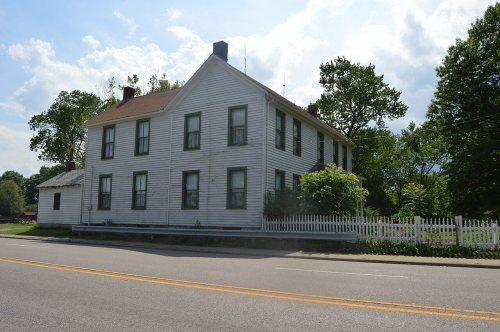
Two places: the Emmert-Zippel House (listed 1996) and the Granite City YMCA (2017).
How old are the homes in Granite City?
23% of Granite City’s homes were built before 1940 (Census estimate, ±3.6 points), against a typical 11% for an Illinois town; the median home was built in 1957.
Founding dates: Wikidata, Wikipedia, the U.S. post office records of Blevins & Helbock (CC0) and the Census. Homes by year built: Census ACS 2020–24. National Register of Historic Places: National Park Service (list of May 22, 2026). Old photos, postcards and papers: Wikimedia Commons, the Library of Congress and other public archives, credited on each item’s page. Maps: U.S. Geological Survey historical topographic maps (via Esri) and Sanborn fire-insurance maps (Library of Congress). History text and census tables: Wikipedia (CC BY-SA 4.0). Places that used to be: USGS Geographic Names Information System (2021).
From Wikidata (2), the National Register of Historic Places (2), Wikipedia, Wikidata and Wikipedia for famous people, U.S. Geological Survey historical maps, U.S. Census counts (via Wikipedia), the US Post Offices dataset (Blevins & Helbock), the USGS Geographic Names Information System, Sanborn fire insurance maps (Library of Congress) and old county and town histories (Internet Archive). Archive images are copied here with their credits and licenses, shown on each photo’s page. Refreshed monthly.