Waterloo dates to 1845, and 22% of its homes were built before 1940
More historic than 91% of U.S. towns · #24 of 140 in Iowa. What drives it
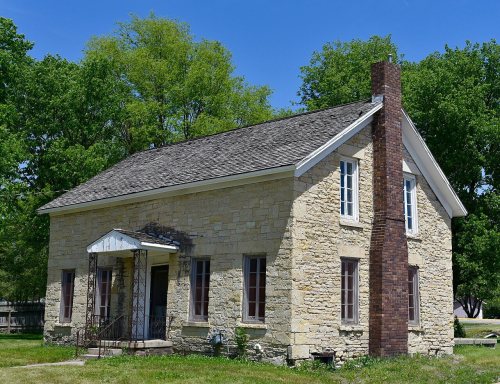
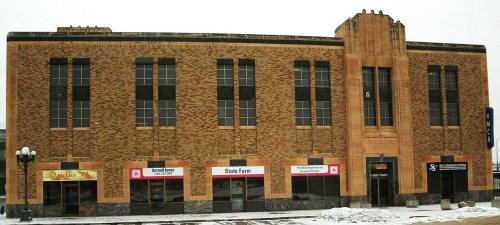
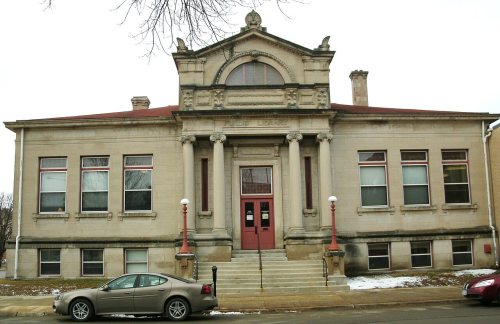
30 places in town are on the National Register, among them four historic districts with 363 buildings between them. Below: 4 old photos and papers, maps from 1885 on, and the census since 1870.
Founding year: Wikipedia. First post office: 1851.The full story ↓
History grade
What drives Waterloo’s History grade
On its age, its old homes and the National Register, Waterloo is more historic than 91% of U.S. towns, #24 of 140 in Iowa. All 3 inputs are above most U.S. towns; its National Register listings ranks highest and its share of homes from before 1940 lowest.
A
HistoryA character grade: shown, never part of Waterloo’s overall grade.
Iowa towns list more on the Register than most of the country (a typical Iowa town has 9.1 per 10,000 residents, the U.S. 2.4), so Waterloo’s 58.2 sits above most of its state (77% of Iowa towns have fewer) while its 390 historic buildings outnumber those of 96% of U.S. towns.
How sure. Graded on any two of the three inputs instead, the letter would range from A− to A. The pre-1940 share (±1.5 points) is firm at this size. Two sources give 1845.
Founding year: Wikipedia (other dates in Quick answers). Homes: Census ACS 2020–24. National Register: National Park Service, May 2026 list; each listing counted once (boundary changes and added documentation belong to their listing), and a historic district counts its contributing buildings. How TownRatings grades history →
What stands out about Waterloo’s past
Read from the archive, the National Register and the record. The page puts what stands out first.
National Park Service, National Register of Historic Places. Photos from Wikimedia Commons, credited on each place’s page.
Places that used to be
Lost post offices, old corners, places now gone and burying grounds
Waterloo’s post office has been open since 1851. Three other post offices opened and closed inside today’s town.
Waterloo
1851–today
East Waterloo
1858–1862
Mount He
1889–1889
Calvin
1895–1900
18501940today
Hamlets and corners on the map
ArmourCastle HillCedar Falls JunctionCedar Knoll ParkEastgate Estate ParkHilltopOrangeSky View Terrace Mobile Home ParkSouthview Estates Mobile Home ParkWoodland Terraces Mobile Home Park
Gone or out of use
Calvin Post Officepost officeCedar Falls JunctionlocaleHawkeye AirportairportMount Hope Post Officepost office
13cemeteries and burying grounds inside Waterloo
Black Hawk CountyCalvaryElmwoodFairviewGarden of MemoriesGeorge Wyth Memorial State ParkHillcrestMount OlivetMuslimOrange TownshipSons of JacobWaterlooWaterloo Memorial Park
US Post Offices dataset (Blevins & Helbock, CC0). Places and cemeteries from the USGS Geographic Names Information System (2021).
Waterloo was originally known as Prairie Rapids Crossing. The town was established near two Meskwaki American tribal seasonal camps alongside the Cedar River. It was first settled in 1845 when George and Mary Melrose Hanna and their children arrived on the east bank of the Red Cedar River (now just called the Cedar River). They were followed by the Virden and Mullan families in 1846. Evidence of these earliest families can still be found in the street names Hanna Boulevard, Mullan Avenue and Virden Creek.
On December 8, 1845, the Iowa State Register and Waterloo Herald was the first newspaper published in Waterloo.
Passages that mention Waterloo, cut from the printed page as they were published.
The history of Black Hawk County, Iowa, containing a history of the county, its cities, towns, &c., a biographical directory of citizens, war record of its volunteers in the late rebellion ..1878 · page 324Read the page →
Read the text
February 7, 1854, Helena was organized by the following order: It is Ordered, That the inhabitants of Congressional Township 89 north. Range 12 west, be organized as a township of said county by the name of Helena, under the laws of this State ; and that said town be attached to the town of Waterloo for all election, judicial and revenue purposes ; Provided, That the inhabitants thereof shall be allowed to vote for the town officers of said town of Waterloo.
Text read by machine from the scan; it may contain errors.
The history of Black Hawk County, Iowa, containing a history of the county, its cities, towns, &c., a biographical directory of citizens, war record of its volunteers in the late rebellion ..1878 · page 370Read the page →
Read the text
archives as a memento of railroad excitement and the sanguine hopes of the people. It is said that the County Judge at that time (1856) refused to sign these bonds, and consequently they were never issued. The reasons for this refusal are not clearly apparent; but it is said that the city of Waterloo became largely identified with the Burlington, Cedar Rapids & Minnesota Railroad, which was probably thought to be of more importance to that city than the Dubuque & Pasific. In consequence of their refusal to comply with the terms of the agreement, it is alleged that the line of the road, after being pai-tially
Text read by machine from the scan; it may contain errors.
The story of Waterloo, the factory city of Iowa1928Read the page →
Read the text
Waterloo is the division point of the Illinois Central Railroad. This road maintains a roundhouse, shops and yards in Waterloo and their emplovees for this point number 946 people with a monthly payroll of $146,672. The Chicago, Great Western Railroad and the Chicago,
Text read by machine from the scan; it may contain errors.
History of Black Hawk County, Iowa, and its people1915 · page 293Read the page →
Read the text
Waterloo. He afterward became locating engineer for the Waterloo, Cedar Falls & Northern Railroad Company, with which he continued until the spring of 191 1, since which time he has engaged in the general practice of civil engineering in Waterloo. In 1912 he also turned his attention to the automobile business which he conducts under the name of the Interstate Motor Car Company. Extending his efforts over a still wider field, he organized, in 1914, the Waverly Stone & Gravel Company, of which he is the president and general manager, operating a gravel pit and stone crusher at Waverly. His business interests, extensive and
Text read by machine from the scan; it may contain errors.
Scans and text from the Internet Archive. Books published in 1930 or earlier, which are in the public domain.
Timeline
Waterloo, 1845 to 1963
Woven from the archive, old maps, post office records, the National Register and the people born here.
Nothing in the archives for these yearsWeddings on Main Street, storms, parades, school pictures, the old store. If it’s in your family album, it belongs here.
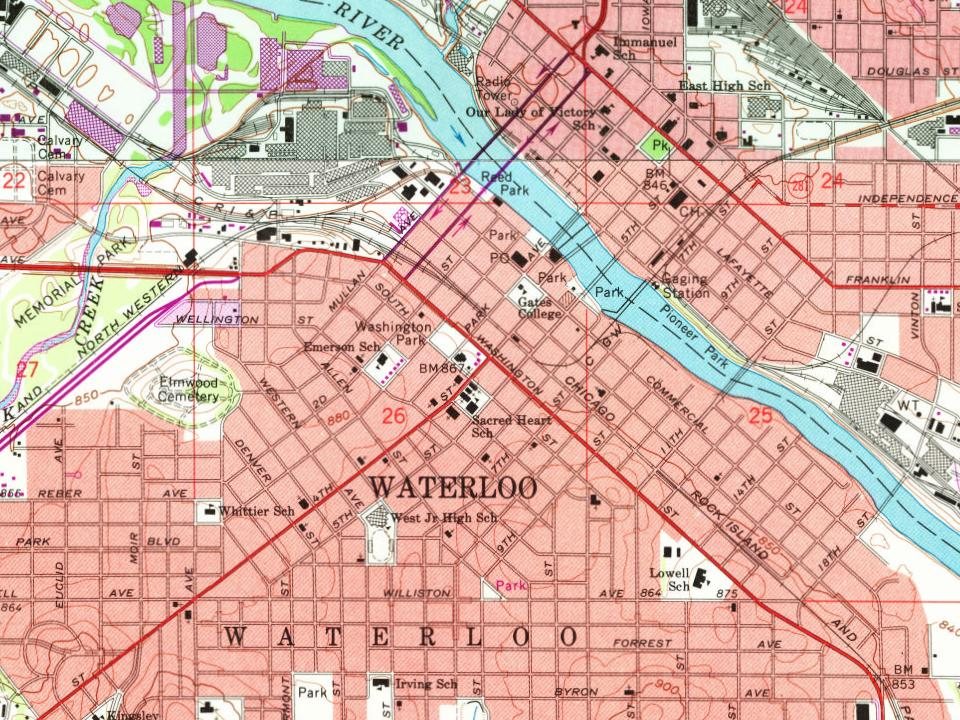
Every edition of the U.S. Geological Survey’s map of Waterloo. Tap a year, or press play to watch the town change.
1963Waterloo South sheet · 1:24,000
U.S. Geological Survey historical topographic maps (public domain), via Esri’s collection of the scans. The red ring marks the center of Waterloo.
Every building
Waterloo, building by building, 1885–1918
Fire insurance maps drew every building, what it was made of and what it was used for, so insurers could price the risk of fire. Pick a year, then a sheet.
In 1845, according to Wikipedia’s history of the town. Waterloo’s post office opened in 1851, and the census of 1870 counted 4,337 people here.
How does Waterloo rank for history?
Waterloo is more historic than 91% of U.S. towns, #24 of 140 in Iowa. The History grade combines the town’s founding era, the share of homes built before 1940 and its National Register listings. It’s a character grade, so it isn’t part of the overall grade. How it works.
What is on the National Register in Waterloo?
30 listings: 26 buildings, among them the Rensselaer Russell House (listed 1973, the first), and 4 historic districts with 363 contributing buildings. 390 historic buildings in all.
How old are the homes in Waterloo?
22% of Waterloo’s homes were built before 1940 (Census estimate, ±1.5 points), against a typical 22% for an Iowa town; the median home was built in 1962.
Founding dates: Wikidata, Wikipedia, the U.S. post office records of Blevins & Helbock (CC0) and the Census. Homes by year built: Census ACS 2020–24. National Register of Historic Places: National Park Service (list of May 22, 2026). Old photos, postcards and papers: Wikimedia Commons, the Library of Congress and other public archives, credited on each item’s page. Maps: U.S. Geological Survey historical topographic maps (via Esri) and Sanborn fire-insurance maps (Library of Congress). History text and census tables: Wikipedia (CC BY-SA 4.0). Places that used to be: USGS Geographic Names Information System (2021).
From Wikimedia Commons (4), Wikidata (1), the National Register of Historic Places (30), Wikipedia, Wikidata and Wikipedia for famous people, U.S. Geological Survey historical maps, U.S. Census counts (via Wikipedia), the US Post Offices dataset (Blevins & Helbock), the USGS Geographic Names Information System, Sanborn fire insurance maps (Library of Congress) and old county and town histories (Internet Archive). Archive images are copied here with their credits and licenses, shown on each photo’s page. Refreshed monthly.