Founding year: Wikidata. First post office: 1851.The full story ↓
History grade
What drives Glenwood’s History grade
On its age, its old homes and the National Register, Glenwood is more historic than 62% of U.S. towns, #85 of 140 in Iowa. Its age holds the grade up; its National Register listings pull it down.
B
HistoryA character grade: shown, never part of Glenwood’s overall grade.
Iowa towns list more on the Register than most of the country (a typical Iowa town has 9.1 per 10,000 residents, the U.S. 2.4), so Glenwood’s 0.0 sits below most of its state (17% of Iowa towns have fewer) while its 0 listings outnumber those of 23% of U.S. towns.
How sure. Graded on any two of the three inputs instead, the letter would range from C+ to A−. The pre-1940 share is a Census survey estimate (±6.1 points). Two sources give 1848.
Founding year: Wikidata (other dates in Quick answers). Homes: Census ACS 2020–24. National Register: National Park Service, May 2026 list; each listing counted once (boundary changes and added documentation belong to their listing), and a historic district counts its contributing buildings. How TownRatings grades history →
What stands out about Glenwood’s past
Read from the archive, the National Register and the record. The page puts what stands out first.
Fire insurance maps drew every building, what it was made of and what it was used for, so insurers could price the risk of fire. Pick a year, then a sheet.
Located in a hollow of the Loess Hills on the east side of the Missouri River, Glenwood was established by Mormons in 1848 as Coonsville. It prospered during the California Gold Rush largely due to the grain mill on Keg Creek. Coonsville was the scene of anti-Mormon mob violence. It became the county seat of Mills County in 1851. In 1852, after most Mormons left for Utah, it was renamed Glenwood after a Presbyterian minister, Glenn Wood.
Passages that mention Glenwood, cut from the printed page as they were published.
History of Mills County, Iowa, containing a history of the county, its cities, towns, etc., a biographical directory of many of its leading citizens, war record of its volunteers in the late rebelllion, general and local statistics ... history of Iowa and1881 · page 399Read the page →
Read the text
Comes now on the 4th day of January, 1869, Wm. F. Kramer and files certificate of good character, signed by twelve citizens of Glenwood township, for the purpose of procuring a permit to buy and sell intoxicating liquors in the town of Glenwood, Mills county, Iowa, for medicinal, mechanical, culinary and sacramental purposes only; whereupon January 14, 1869, is fixed as the time of final hearing in this matter before the judge of the court in term time at Glenwood, Iowa, and it is ordered that notice of the application and the time of final hearing be given by posting at the door of the post ofBce in Glenwood, Iowa, at least ten days before the time of final hearing.
Text read by machine from the scan; it may contain errors.
History of Mills County, Iowa, containing a history of the county, its cities, towns, etc., a biographical directory of many of its leading citizens, war record of its volunteers in the late rebelllion, general and local statistics ... history of Iowa and1881 · page 464Read the page →
Read the text
therefore, no power to convey them as provided by the terms of the compromise. It will be noted that it was a condition of the settlement that the railroad company should continue its road through Mills county, and should locate a station at Glenwood. The county set forth that the lands could not be legally transferred on the grounds that there was no proper or adequate consideration for such transfer, in reply to which the defendant held that the company was not bound by the act of Congress to locate its line by the way of Glenwood, nor to establish a station there, and that
Text read by machine from the scan; it may contain errors.
Scans and text from the Internet Archive. Books published in 1930 or earlier, which are in the public domain.
By decade
Glenwood, decade by decade
3 decades in the archive, from the 1870s to the 1910s. Scroll each row; tap a photo for its story.
Nothing in the archives for these yearsWeddings on Main Street, storms, parades, school pictures, the old store. If it’s in your family album, it belongs here.
In 1848, according to Wikidata. Glenwood’s post office opened in 1851, and the census of 1860 counted 614 people here.
How does Glenwood rank for history?
Glenwood is more historic than 62% of U.S. towns, #85 of 140 in Iowa. The History grade combines the town’s founding era, the share of homes built before 1940 and its National Register listings. It’s a character grade, so it isn’t part of the overall grade. How it works.
How old are the homes in Glenwood?
23% of Glenwood’s homes were built before 1940 (Census estimate, ±6.1 points), against a typical 22% for an Iowa town; the median home was built in 1971.
Founding dates: Wikidata, Wikipedia, the U.S. post office records of Blevins & Helbock (CC0) and the Census. Homes by year built: Census ACS 2020–24. National Register of Historic Places: National Park Service (list of May 22, 2026). Old photos, postcards and papers: Wikimedia Commons, the Library of Congress and other public archives, credited on each item’s page. Maps: U.S. Geological Survey historical topographic maps (via Esri) and Sanborn fire-insurance maps (Library of Congress). History text and census tables: Wikipedia (CC BY-SA 4.0). Places that used to be: USGS Geographic Names Information System (2021).
From Wikimedia Commons (4), the Library of Congress (2), Wikipedia, Wikidata and Wikipedia for famous people, U.S. Geological Survey historical maps, U.S. Census counts (via Wikipedia), the US Post Offices dataset (Blevins & Helbock), the USGS Geographic Names Information System, Sanborn fire insurance maps (Library of Congress) and old county and town histories (Internet Archive). Archive images are copied here with their credits and licenses, shown on each photo’s page. Refreshed monthly.


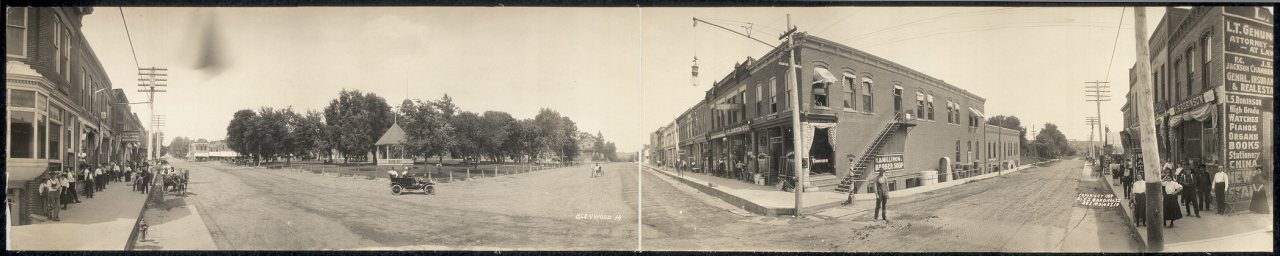


 1908
 1908
 1915


