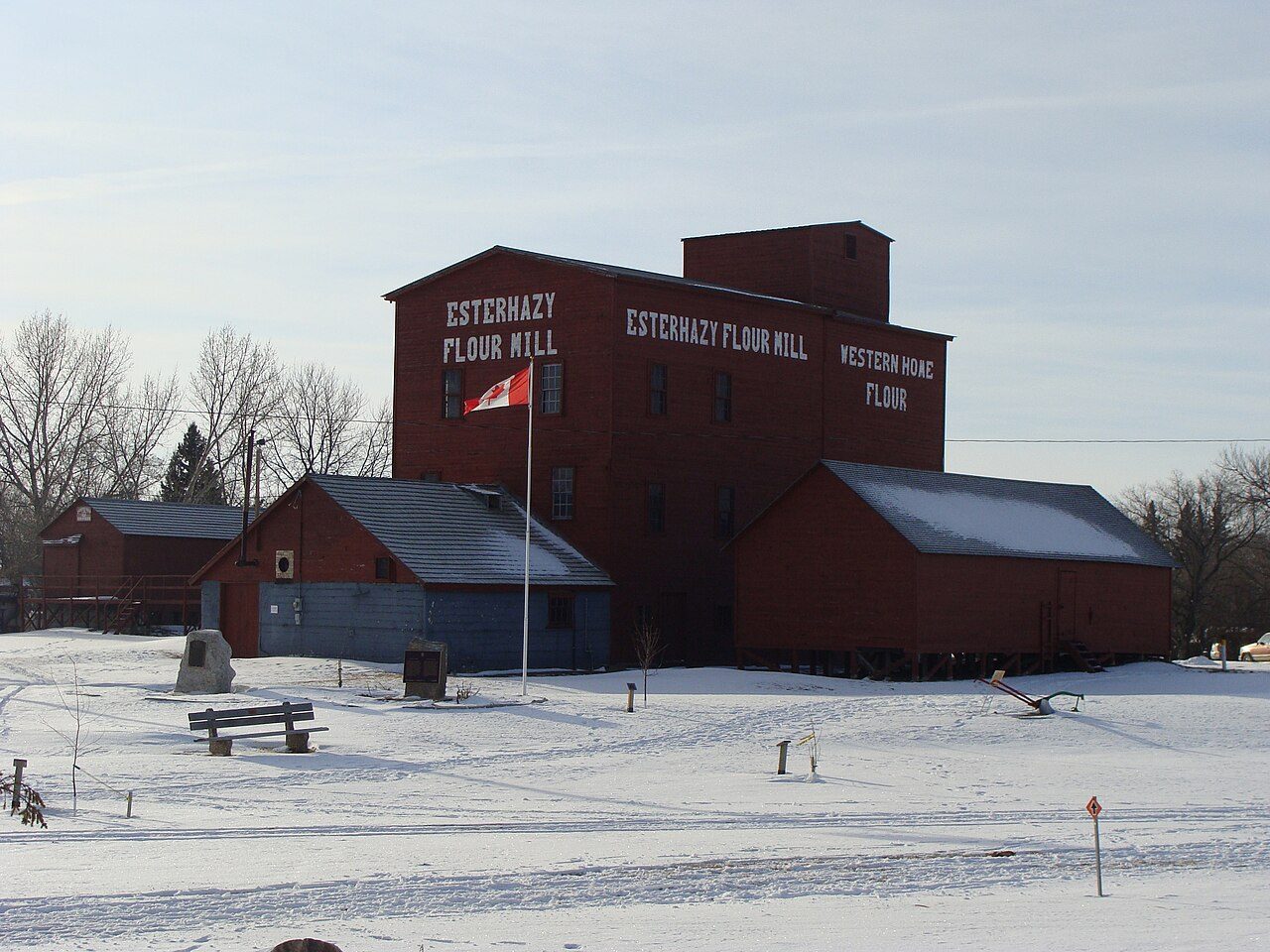
Esterhazy Flour Mill · Photo: Susan Drader · Public domain
1historic place on the registers
History of Esterhazy · Canada’s heritage registers
One place in Esterhazy, at the top of the registers
Few towns have as much for their size as Esterhazy: 4 for every 10,000 residents, more than 93% of Canadian towns. The one entry is Esterhazy Flour Mill (1904), a national historic site.
National Historic Sites and Classified Federal Heritage Buildings
Oldest building
1904
the first construction date on its record
Homes built before 1961
21%
typical town: 18%
How it began
Esterhazy’s first recorded year: 1903
On the open record, Esterhazy as a municipality goes back to 1903, though that may be a charter rather than a first settlement. Esterhazy takes its name from Pál Oszkár Esterházy, american clerk.
Every place on the registers inside the town, by its designation.
Highest designations
Names show on hover, and a tap takes you to the place’s page.
The 1, by tier
1 Highest designations
Parks Canada’s Directory of Federal Heritage Designations lists the places the Government of Canada has recognized; outside Québec, provincial and municipal listings come only through Wikidata, and only those with an encyclopedia article get a page.
Points from Wikidata (Parks Canada’s files carry none) and from Québec’s register, as mapped there.
Highest designations
One place in Esterhazy with the highest designation
National Historic Sites and Classified Federal Heritage Buildings, Canada’s highest federal recognition. Each one opens its own page.
The heritage closest to Esterhazy: “Canadian National Railways Station, Melville, Saskatchewan”, at 59 km
4 places lie within 100 km. By age, R. D. McNaughton Building leads, from 1882, at 64 km. For the highest designation, go 66 km to Inglis Grain Elevators.
The biggest share of Esterhazy’s homes dates from 1961 to 1980: 51%
Only 14% of Esterhazy’s homes were built from 1981 to 2000, less than the typical town’s 23%. 21% of Esterhazy’s homes predate 1961, close to the typical town’s 18%. Homes built from 2016 to 2021 are 3.3% of Esterhazy’s, about the typical 4.1%.
21%
Before 1961
51%
1961–80
14%
1981–2000
13%
2001–15
3.3%
2016–21
EsterhazyTypical town
2021 Census, private dwellings by period of construction (Statistics Canada); the typical town is the middle Canadian town of 2,500 or more.
Towns its size
Esterhazy has the 1st most of 16 towns its size
Towns of 2,500 to 2,500 residents, by places on the registers.
Their median is 0. 10 of them have nothing on the registers.
In brief
Esterhazy in brief
The 2021 Census dates 21% of Esterhazy’s homes before 1961, against 18% in the typical town. All told, the registers hold 1 historic place, one with the highest designation, Esterhazy Flour Mill among them. Of the 16 towns closest in size, it has the most historic places. Otherwise the figures are ordinary: its one place was designated in 2009.
How to read these numbers
What this data can and can’t tell you
•
Protection. Federal recognition isn’t a planning control: buildings the federal government owns follow its heritage policy, while others are protected only by a provincial or municipal designation.
•
The grade. History isn’t one of Canada’s graded pillars, so this page describes and compares without a letter.
•
The tiers. National Historic Sites and the most protected buildings form the top tier; recognized federal buildings, stations and lighthouses the second; provincial and municipal listings the third.
•
Provincial and municipal lists. Outside Québec, provinces’ and municipalities’ heritage registers aren’t open data; their places are known only through Wikidata items with a register number, and only those with an encyclopedia article get a page.
•
The federal register. Federal places come from Parks Canada’s directory, which counts National Historic Sites, federal heritage buildings, stations and lighthouses; their statements are the register’s own.
•
People and events. Persons of national historic significance come with no location; a town gets one only by birthplace (name and both life years agreeing) or by one of its own places that bears the name and whose record tells the story. Events, which can’t be tied, are left out.
•
Map points. Federal places get their map points from Wikidata, since Parks Canada’s files carry none; they are as mapped there.
Questions about Esterhazy’s history
Which places in Esterhazy have the highest designation?
Esterhazy Flour Mill.
What is the oldest building in Esterhazy?
Esterhazy Flour Mill — its record dates it to 1904 (National Historic Site).
How old are the homes in Esterhazy?
21% of its homes were built before 1961, against 18% in the typical Canadian town.
Contains information licensed under the Open Government Licence – Canada (Parks Canada).
Sources: Parks Canada, Directory of Federal Heritage Designations · Canadian Register of Historic Places (federal extract) · Wikidata (CC0) for map points, other names and articles · Statistics Canada, 2021 Census (homes by period of construction). Under the Statistics Canada Open Licence.
 Top