 Top
National Historic Site · 1889–1895Saint-Hyacinthe Post Office1915 Girouard Street WestPhoto: Tango7174 · CC BY-SA 4.0 · Commons file
 Hôtel de ville de Saint-Hyacinthe · Photo: SamuelFreli · CC BY-SA 3.0
7historic places on the registers
History of Saint-Hyacinthe · Canada’s heritage registers
Saint-Hyacinthe: 7 historic places, one with the highest designation
On the list: 4 municipal citations, a Recognized Federal Heritage Building and a heritage railway station. Marché public de Saint-Hyacinthe, begun in 1876, is the oldest by its record. Wikidata’s date for the municipality is 1849; it may record a founding, an incorporation or an amalgamation. Scaled to its population, Saint-Hyacinthe’s 1.1 per 10,000 residents beats 80% of Canadian towns.
Historic places
7
1.1 per 10,000 residents
Highest designations
1
National Historic Sites, classified federal buildings and Québec’s classements
Other federal designations
2
Recognized buildings, railway stations, lighthouses
Provincial and local listings
4
municipal citations on Québec’s register
Oldest building
1876
the first construction date on its record
Homes built before 1961
24%
typical town: 18%
In pictures
Saint-Hyacinthe’s historic places in 6 photos
Look out for Saint-Hyacinthe Post Office and Hôtel de ville de Saint-Hyacinthe. 6 designated places in Saint-Hyacinthe have a photo. 5 photographers took them.
 Saint-Hyacinthe Post Office
 Pavillon de l'aqueduc
 Marché public de Saint-Hyacinthe
 Porte des Anciens Maires
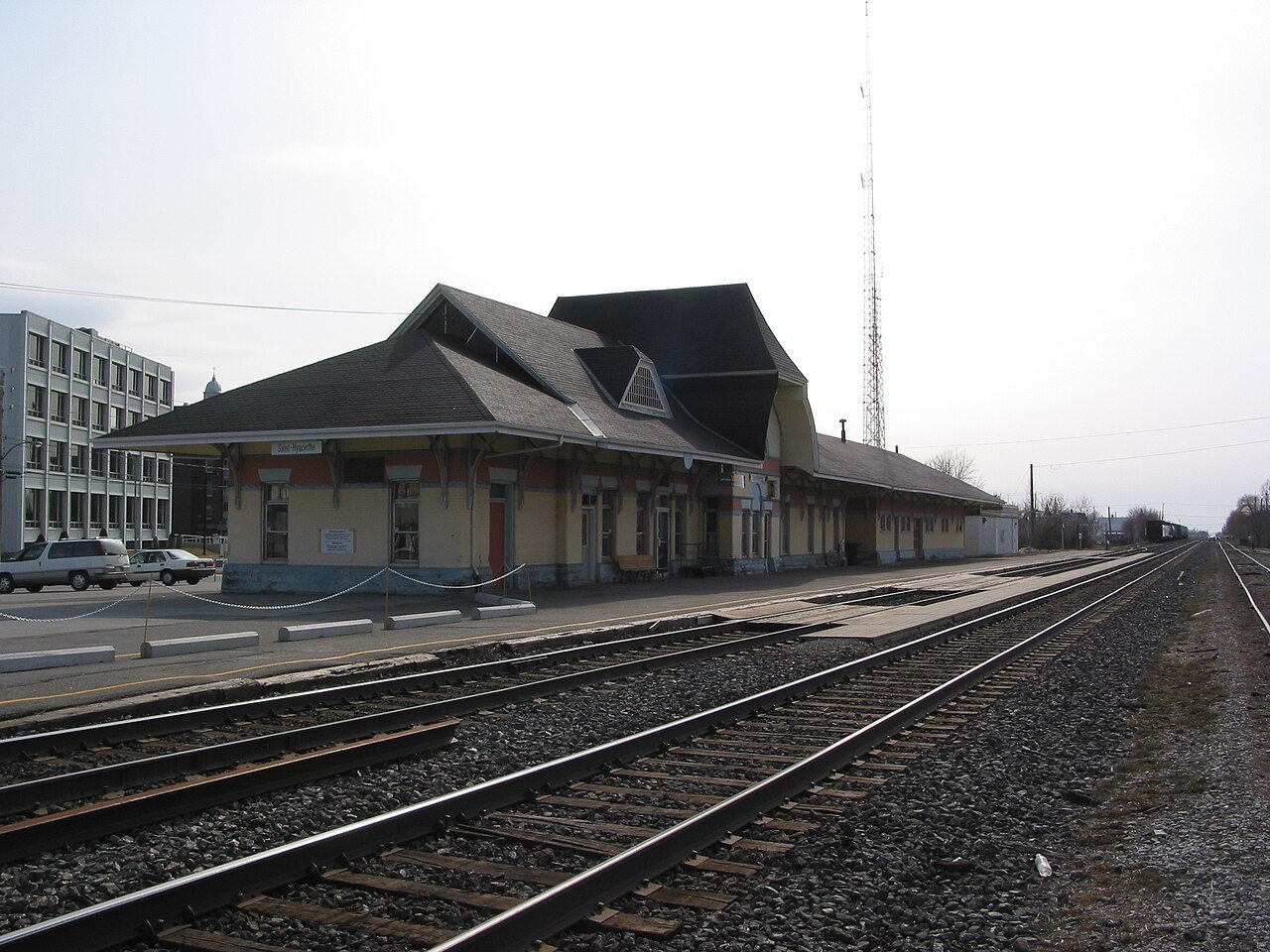 Canadian National Railways Station, Sainte-Hyacinthe, Quebec+1See all photos
Photos from Wikimedia Commons, each credited to its photographer with its licence; names open the place’s page. Tap a photo to step through them full screen.
The map
Where Saint-Hyacinthe’s history is
Every place on the registers inside the town, by its designation.
Highest designationsOther federal designationsProvincial and local listings
Dots open their places’ pages; hover first to read the name.
The 7, by tier
1 Highest designations2 Other federal designations4 Provincial and local listings
Federal designations come from Parks Canada; Québec’s own register adds what the province has classified and what the municipality has cited.
Points from Wikidata (Parks Canada’s files carry none) and from Québec’s register, as mapped there.
Highest designations
One place in Saint-Hyacinthe with the highest designation
National Historic Sites and Classified Federal Heritage Buildings, Canada’s highest federal recognition. Each one opens its own page.
Other federal designations
2 other places Canada recognizes in Saint-Hyacinthe
The group holds a Recognized Federal Heritage Building and a heritage railway station. Recognized Federal Heritage Buildings, heritage railway stations and lighthouses. Their dates run from 1899, with “Canadian National Railways Station, Sainte-Hyacinthe, Quebec”, to 1905. Each one opens its own page.
 Fed
Heritage Railway Station · 1899–1900Canadian National Railways Station, Sainte-Hyacinthe, Quebec1450 Sicotte StreetPhoto: Michel Robichaud · CC BY 3.0 · Commons file
Recognized Federal Heritage Building · 1905–1907Armoury2155 Laframboise Blvd.
What’s designated
In Saint-Hyacinthe, public buildings lead the list (29%)
All told, 6 kinds of place appear. Two of the highest-ranked are Saint-Hyacinthe Post Office and Armoury.
Public buildings2
Forts and military buildings1
Stations, lighthouses and bridges1
Mills, shops and works1
Theatres, museums and memorials1
Other places1
The groups come from each place’s name and its recorded functions, by what it was built as.
Provincial and local listings
4 local listings in Saint-Hyacinthe
The first was designated in 2011, the latest in 2012. Citations the municipality has made, registered with Québec’s ministry of culture. Their dates run from 1876, with Marché public de Saint-Hyacinthe, to 1927. Each one opens its own page.
 Local
Municipal citation (Québec) · 1876–1877Marché public de Saint-Hyacinthe1555 rue des CascadesPhoto: Sébastien Maltais · CC BY 2.5 · Commons file
 Local
Municipal citation (Québec) · 1895Hôtel de ville de Saint-Hyacinthe700 avenue de l'Hôtel-de-VillePhoto: SamuelFreli · CC BY-SA 3.0 · Commons file
 Local
Municipal citation (Québec) · 1897–1898Pavillon de l'aqueduc900 avenue de l'ÉcolePhoto: Challwa · CC BY-SA 4.0 · Commons file
 Local
Municipal citation (Québec) · 1927Porte des Anciens Mairesrue Girouard OuestPhoto: Sébastien Maltais · CC BY 2.5 · Commons file
How old
In Saint-Hyacinthe, the decades after Confederation left the most behind
Each place by the first construction date on its record.
British North America 1760–18660
After Confederation 1867–19136
Wars and Depression 1914–19451
Since 1946 1946 on0
Homes by age
A town of older homes: 24% of Saint-Hyacinthe’s were built before 1961 (18% is typical)
From 2016 on, Saint-Hyacinthe built 4.8% of its homes, near the typical 4.1%. The largest single period is from 1961 to 1980, with 32% of Saint-Hyacinthe’s homes. Over half of the homes in Saint-Hyacinthe were already standing by 1981.
24%
Before 1961
32%
1961–80
24%
1981–2000
16%
2001–15
4.8%
2016–21
Saint-HyacintheTypical town
2021 Census, private dwellings by period of construction (Statistics Canada); the typical town is the middle Canadian town of 2,500 or more.
Born here
One of Canada’s national historic persons, tied to Saint-Hyacinthe
Fame, by Wikipedia: Felix Hebert first, in 10 languages. Before 1914, 42 births here made the record. The most recent birth is Marcel Choquette’s, in 1913. Georges-Casimir Dessaulles reached 103, the longest life here, ending in 1930. The timeline shows the 20 best known.
Joseph Casavant
Louis-Antoine Dessaulles
Georges-Casimir Dessaulles
Pierre-Samuel Gendron
Catherine-Aurélie Caouette
Pierre Boucher de la Bruère
François Langelier
Michel Esdras Bernier
Charles Langelier
Caroline Dessaulles-Béique
Henriette Dessaulles
Louis-Philippe Laurendeau
Thomas Morris
Victor Morin
Adèle Bourgeois
Felix Hebert
Télesphore-Damien Bouchard
René Morin
Gaspard Fauteux
Gérald Fauteux
1800182518501875190019251950

Felix Hebert1874–1969 · American politician

Gérald Fauteux1900–1980 · Canadian judge (1900–1980); 13th Chief Justice of Canada

François Langelier1838–1915 · Canadian politician

Henriette Dessaulles1860–1946 · Canadian writer, diarist and journalist

Louis-Antoine Dessaulles1819–1895 · Canadian politician
CC
Catherine-Aurélie Caouette1833–1905

Michel Esdras Bernier1841–1921 · Canadian politician

Charles Langelier1850–1920 · Canadian politician
Everyone born in Saint-Hyacinthe → Born before 1914. Birthplaces from Wikidata, each checked against Wikipedia; national historic persons from Parks Canada’s Directory of Federal Heritage Designations, matched by name and life years.
Towns its size
Saint-Hyacinthe has the 1st most of 16 towns its size
Towns of 54,500 to 67,700 residents, by places on the registers.
Saint-Hyacinthe7
The typical town its size has 2. 7 of them have nothing on the registers.
Neighbours
Saint-Hyacinthe and its neighbours
| Town | People | Places | Highest | Oldest |
|---|---|---|---|---|
| Saint-Hyacinthe | 60,874 | 7 | 1 | 1876 |
| La Présentation | 2,696 | 2 | 2 | 1817 |
| Saint-Barnabé-Sud | 1,053 | 0 | 0 | — |
| Saint-Dominique | 3,062 | 0 | 0 | — |
| Sainte-Madeleine | 2,387 | 0 | 0 | — |
| Sainte-Marie-Madeleine | 2,940 | 0 | 0 | — |
| Saint-Simon | 1,474 | 0 | 0 | — |
In brief
Saint-Hyacinthe in brief
Saint-Hyacinthe has 24% of its homes from before 1961, against 18% in the typical town. The lists come to 7 historic places, one with the highest designation, including Saint-Hyacinthe Post Office. No town its size has more historic places: it leads the 16 nearest in population.
Of the 7 with a date, 6 come from the decades after Confederation. Felix Hebert (1874), Gérald Fauteux (1900) and François Langelier (1838) lead its people of the past. The rest is about typical: the list grew between 1983 and 2012.
How to read these numbers
What this data can and can’t tell you
- People and events. Parks Canada’s open file gives its national historic persons no place. A town’s page names one only when the person was born there (matched by name and both life years) or one of its own historic places carries the name and its record speaks of them; national historic events stay off.
- The tiers. Tiers follow the designation: national recognition and classement first, other federal designations next, provincial and local listings last.
- Québec’s register. Québec is the one province whose register is open: classements, declarations and municipal citations, described by the ministry in French.
- The federal register. Every federal designation is in Parks Canada’s directory, and the Canadian Register of Historic Places gives most of them a bilingual statement of significance.
- The grade. There is no history grade: the page sets out the record and compares it with other towns.
- Map points. Parks Canada publishes no coordinates, so federal places are pinned where Wikidata puts them.
- Protection. In Québec, a classement or a municipal citation under the Loi sur le patrimoine culturel protects the building in law; a federal designation recognises significance and binds only federal owners.
Questions about Saint-Hyacinthe’s history
Which places in Saint-Hyacinthe have the highest designation?
Just one: Saint-Hyacinthe Post Office.
What is the oldest building in Saint-Hyacinthe?
Marché public de Saint-Hyacinthe, a Municipal citation (Québec), begun in 1876.
How old are the homes in Saint-Hyacinthe?
The 2021 Census dates 24% of its homes before 1961 (18% in the typical town).
Contains information licensed under the Open Government Licence – Canada (Parks Canada). Québec register data: Ministère de la Culture et des Communications du Québec, CC BY 4.0.
Sources: Parks Canada, Directory of Federal Heritage Designations · Canadian Register of Historic Places (federal extract) · Répertoire du patrimoine culturel du Québec (MCC, Données Québec) · Wikidata (CC0) for map points, other names and articles · Statistics Canada, 2021 Census (homes by period of construction). Under the Statistics Canada Open Licence.
Adapted from Statistics Canada (Census of Population 2021, population estimates 2025, 2021 census boundaries) under the Statistics Canada Open Licence; this does not constitute an endorsement by Statistics Canada. Neighbourhood names in some cities © OpenStreetMap contributors (ODbL).