Église Notre-Dame-de-Bonsecours de L'Islet · Photo: Bernard Gagnon · CC BY-SA 3.0
3historic places on the registers
History of L'Islet · Canada’s heritage registers
Église Notre-Dame-de-Bonsecours de L'Islet, from 1768, is L'Islet’s oldest designated place
Homes from before 1961 make up 50% of L'Islet’s stock, above the 18% of the typical town. All 3 historic places listed here are of the highest rank. Per resident it outdoes 97% of Canadian towns, with 7.7 for every 10,000 people.
Photos from Wikimedia Commons, each credited to its photographer with its licence; names open the place’s page. Tap a photo to step through them full screen.
Through time
L'Islet, long ago
A single old picture: the oldest view of one of its historic places. Tap the picture to enlarge it.
c. 1910Boom yearsL'église de Notre-Dame-du-Bon-Secours-de-L'Islet . - 1910Public domain
Public domain or CC0, made before 1950, from Wikimedia Commons; old views of places can be drawings, prints or maps of their time. Each credit opens the image’s page.
How it began
2000 and after: L'Islet’s milestones
L'Islet-sur-Mer–Saint-Eugène–L'Islet was the name of L'Islet until 2000. The municipality succeeded L'Islet, L'Islet-sur-Mer and Saint-Eugène in 2000. Wikidata holds January 1, 2000 as the start of the municipality of L'Islet, a date that can just as well be an incorporation.
Every place on the registers inside the town, by its designation.
Highest designations
Each dot is a place: point at it for the name, tap it for its page.
The 3, by tier
3 Highest designations
Federal designations come from Parks Canada; Québec’s own register adds what the province has classified and what the municipality has cited.
Points from Wikidata (Parks Canada’s files carry none) and from Québec’s register, as mapped there.
Highest designations
3 places in L'Islet with the highest designation
Designations came from 1957 to 1981. National Historic Sites and Classified Federal Heritage Buildings, Canada’s highest federal recognition. The oldest, Église Notre-Dame-de-Bonsecours de L'Islet, dates from 1768; the newest from 1835. Each one opens its own page.
Little new building in L'Islet: 2.3% of homes date from 2016 to 2021, against 4.1%
More than half of L'Islet’s housing predates 1961. Homes built from 2001 to 2015 make up just 10% of L'Islet’s, against 15% in the typical town. Few of L'Islet’s homes date from 1981 to 2000: 17%, the norm 23%.
50%
Before 1961
21%
1961–80
17%
1981–2000
10%
2001–15
2.3%
2016–21
L'IsletTypical town
2021 Census, private dwellings by period of construction (Statistics Canada); the typical town is the middle Canadian town of 2,500 or more.
Born here
Born in L'Islet before the First World War: 9 lives
It starts with Jean-Baptiste Fortin, born in 1764. Fame, by Wikipedia: Joseph-Elzéar Bernier first, in 7 languages. Joseph-Elzéar Bernier carries a national designation as a historic person. Of the 9, 6 were born in the years before Confederation.
Jean-Baptiste Fortin
Hospice-Anthelme Verreau
Louis-Bonaventure Caron
Édouard-Séverin Fafard
Alphonse-Arthur Miville Déchêne
Joseph-Elzéar Bernier
Ivanhoe Caron
Adine Fafard-Drolet
Fernand Fafard
175017751800182518501875190019251950
Joseph-Elzéar Bernier1852–1934 · Designated nationally in 1961 · Canadian explorer
HV
Hospice-Anthelme Verreau1828–1901 · Canadian historian
Alphonse-Arthur Miville Déchêne1848–1902 · Canadian politician
Ivanhoe Caron1875–1941 · Canadian catholic priest, historian and archivist
Adine Fafard-Drolet1876–1963 · Canadian opera singer
FF
Fernand Fafard1882–1955 · Canadian politician
JF
Jean-Baptiste Fortin1764–1841 · Canadian politician
Louis-Bonaventure Caron1828–1915 · Canadian judge
Everyone born in L'Islet → Born before 1914. Birthplaces from Wikidata, each checked against Wikipedia; national historic persons from Parks Canada’s Directory of Federal Heritage Designations, matched by name and life years.
Towns its size
L'Islet has the 2nd most of 16 towns its size
Towns of 3,800 to 3,900 residents, by places on the registers.
Before 1961: 50% of L'Islet’s homes, against 18% in the typical town. There are 3 historic places in all, 3 with the highest designation. Of the 16 towns closest in size, just one has more historic places. Joseph-Elzéar Bernier (1852), Hospice-Anthelme Verreau (1828) and Alphonse-Arthur Miville Déchêne (1848) are the best known of its historic lives. The rest is about typical: the designations ran from 1957 to 1981.
How to read these numbers
What this data can and can’t tell you
•
The federal register. The federal list is complete and open: Parks Canada’s directory for the designations, the Canadian Register of Historic Places for what each one is and why it matters.
•
Québec’s register. Québec is the one province whose register is open: classements, declarations and municipal citations, described by the ministry in French.
•
People and events. National historic persons carry no place in the open file. They appear on a town’s page when born there (same name, same birth and death years) or when a historic place inside it carries their name and its record names them with their dates; national historic events don’t appear.
•
The tiers. The highest designations are National Historic Sites, Classified Federal Heritage Buildings and Québec’s classements; then come the other federal designations; then provincial and local listings.
•
Protection. A place classified or cited under Québec’s law is protected; National Historic Site status alone protects only what the federal government owns.
•
The grade. This page gives no grade; history doesn’t count toward a Canadian town’s letter.
Questions about L'Islet’s history
How old are the homes in L'Islet?
50% predate 1961, where the typical town has 18%.
What is the oldest building in L'Islet?
By its record, Église Notre-Dame-de-Bonsecours de L'Islet, from 1768 (Classified heritage building (Québec)).
Which places in L'Islet have the highest designation?
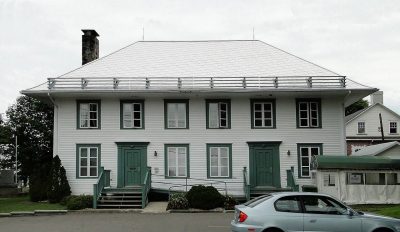
Église Notre-Dame-de-Bonsecours de L'Islet, Salle des habitants de L'Islet-sur-Mer and Chapelle des Marins (L'Islet).
Contains information licensed under the Open Government Licence – Canada (Parks Canada). Québec register data: Ministère de la Culture et des Communications du Québec, CC BY 4.0.
Sources: Parks Canada, Directory of Federal Heritage Designations · Canadian Register of Historic Places (federal extract) · Répertoire du patrimoine culturel du Québec (MCC, Données Québec) · Wikidata (CC0) for map points, other names and articles · Statistics Canada, 2021 Census (homes by period of construction). Under the Statistics Canada Open Licence.


 c. 1910
 Top
 Top
 Top


