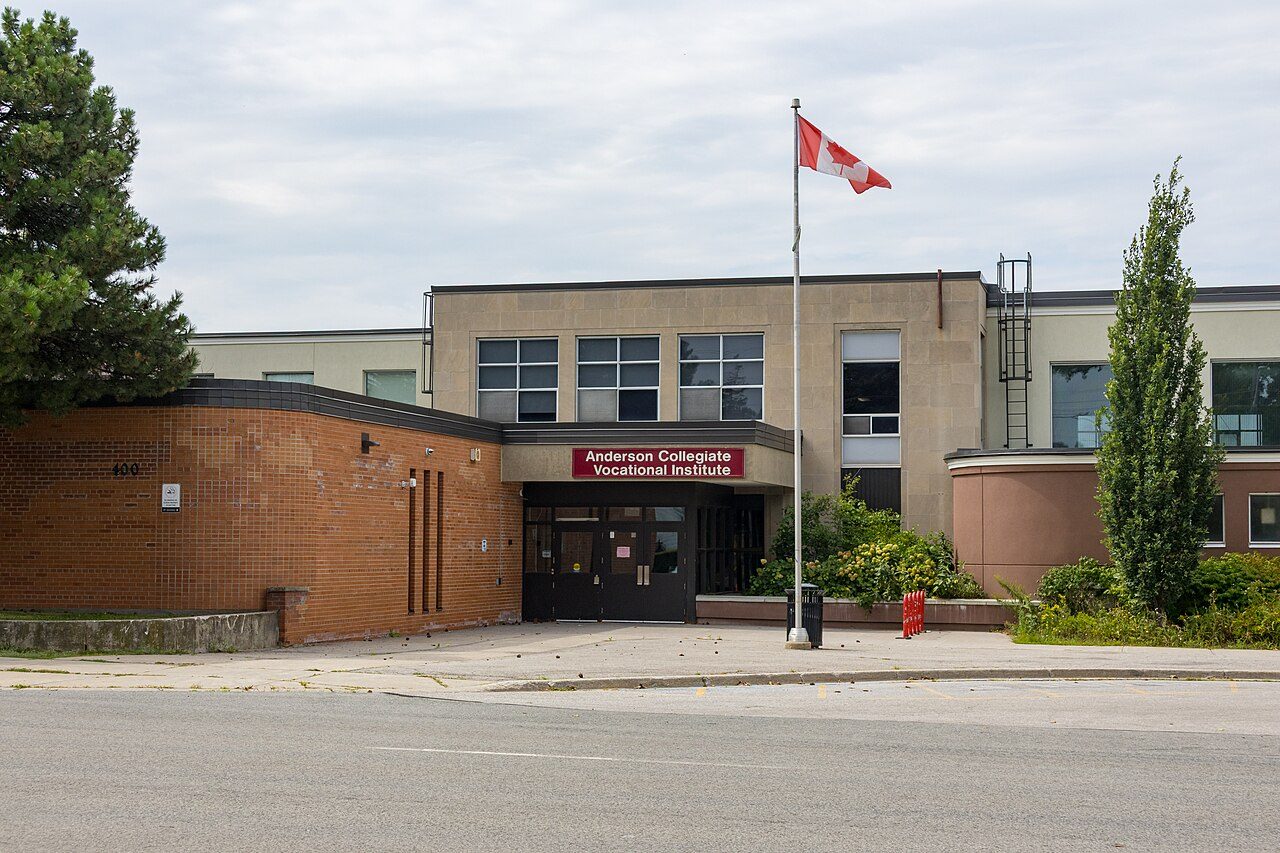
Anderson Collegiate and Vocational Institute
400 Anderson St · Whitby · L1N3V6 · Durham DSB
Counting 3 km around Whitby, Anderson Collegiate and Vocational Institute is one of 13 secondary schools. Every school in and around Whitby →
What stands out about Anderson Collegiate and Vocational Institute
- 1,175 students, well above the 810 of a typical secondary school in Ontario.
- On the measures with a value, it lands in the middle fifth in Ontario.
- On Grade 9 math it reaches 62%, above the 55% in Ontario.
- An English public school, run by Durham DSB.
How Anderson Collegiate and Vocational Institute does on Ontario’s tests
EQAO’s Grade 3, 6 and 9 assessments and the literacy test, 2024-25: each school against every school in Ontario.
With 2 of 2 measures reported, Anderson Collegiate and Vocational Institute averages the middle fifth in Ontario.
| Measure | Here | Middle, Ontario | Band | 3-year change |
|---|---|---|---|---|
| Grade 9 math | 62% | 55% | Second fifth | −5 |
| Literacy test (OSSLT), first try | 84% | 85% | Middle fifth | −3 |
N/R: EQAO doesn’t report groups too small to keep students anonymous. The three-year change is in percentage points, as the ministry publishes it.
A standing for Anderson Collegiate and Vocational Institute, not a grade
Against the other schools in Ontario, Anderson Collegiate and Vocational Institute’s results fall in the middle fifth. That band is its measure here: the letters on this site are for towns.
The letter belongs to Whitby: its School Grade weighs Anderson Collegiate and Vocational Institute with every other school around it.
Getting a place at Anderson Collegiate and Vocational Institute
Registration happens with the board, not the school; the board names the school for the address.
The provinces’ education acts and the boards’ own admission policies; check with the board for a given address.
Side by side with the nearest secondary schools
The closest schools of its level, by straight-line distance.
Of the 6 secondary schools nearest Anderson Collegiate and Vocational Institute, 4 are larger.
| School | System | Language | Students | Band | Away |
|---|---|---|---|---|---|
| Anderson Collegiate and Vocational Institute | English public | English | 1,175 | Middle fifth | |
| Henry Street High School | English public | English | 1,120 | Second fifth | 2.3 km |
| Father Leo J Austin Catholic Secondary School | English Catholic | English | 1,125 | Middle fifth | 2.9 km |
| Donald A Wilson Secondary School | English public | English | 1,275 | Top fifth | 3.3 km |
| All Saints Catholic Secondary School Secondary School | English Catholic | English | 1,285 | Second fifth | 3.4 km |
| R S Mclaughlin Collegiate and Vocational Institute | English public | English | 1,250 | Middle fifth | 3.5 km |
| Monsignor Paul Dwyer Catholic High School | English Catholic | English | 1,200 | Fourth fifth | 3.7 km |
Secondary schools near Anderson Collegiate and Vocational Institute
Nearest first, as the crow flies, up to 25 km. Each school’s own admission policy decides who gets a place.
Questions about Anderson Collegiate and Vocational Institute
Who runs Anderson Collegiate and Vocational Institute?
Anderson Collegiate and Vocational Institute belongs to Durham DSB (English public).
What language does Anderson Collegiate and Vocational Institute teach in?
English.
How do pupils get a place at Anderson Collegiate and Vocational Institute?
Ask the board which school serves your street, then register through it.
Which schools of the same kind are near Anderson Collegiate and Vocational Institute?
The nearest are Henry Street High School (2.3 km), Father Leo J Austin Catholic Secondary School (2.9 km) and Donald A Wilson Secondary School (3.3 km).
Sources: Ontario Ministry of Education, School Information Finder 2024–25 and school contact list (Open Government Licence – Ontario) · Ontario Ministry of Education, School Information Finder 2024–25 (EQAO results; N/R where groups are too small). Open Government Licence – Ontario. · map tiles © OpenStreetMap contributors. Under the Statistics Canada Open Licence.
Adapted from Statistics Canada (Census of Population 2021, population estimates 2025, 2021 census boundaries) under the Statistics Canada Open Licence; this does not constitute an endorsement by Statistics Canada. Neighbourhood names in some cities © OpenStreetMap contributors (ODbL).