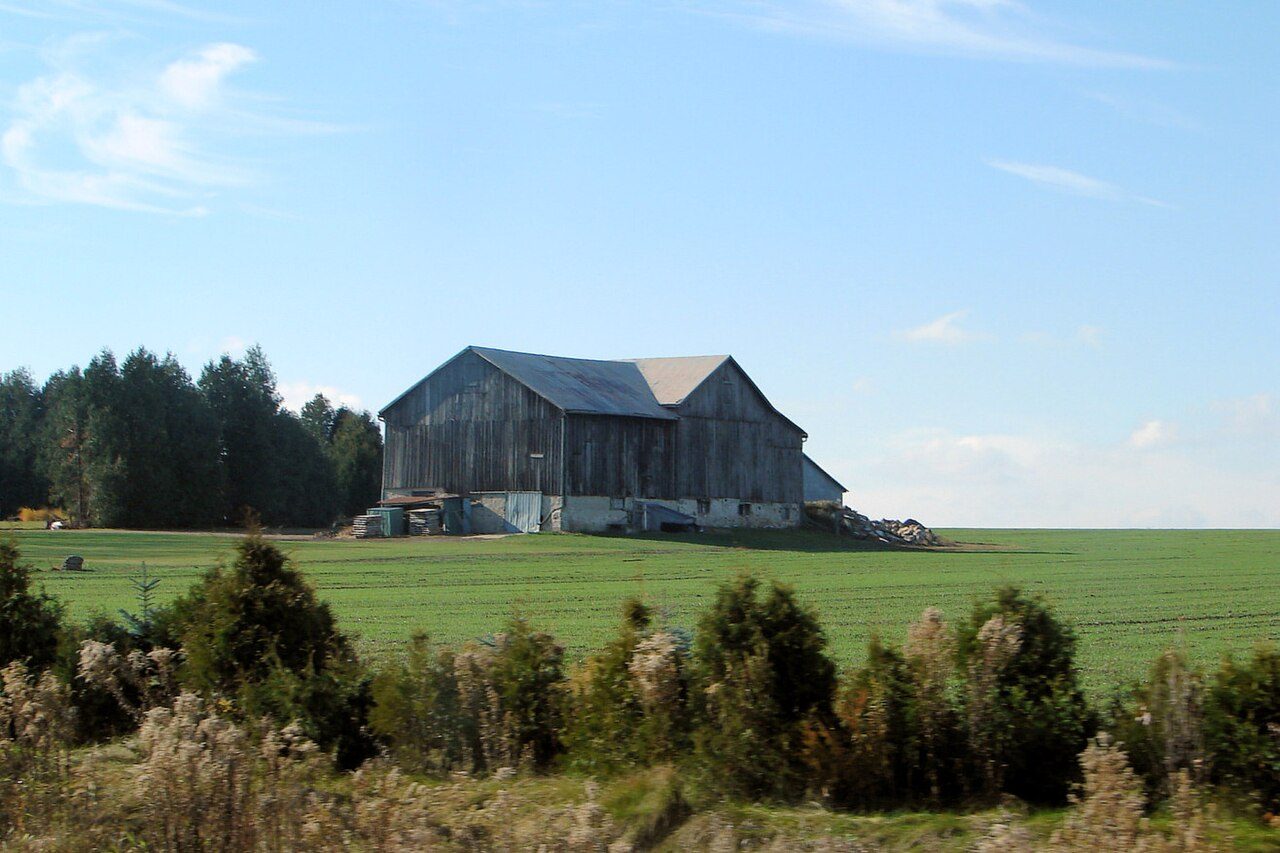
 Photo: P199 · CC BY-SA 3.0
Neither notably warm, cold, wet nor dry, Mono sits near the middle of Canadian towns
A typical July afternoon reaches 26.0°C, a January night drops to −11.3°C, and 793 mm of rain and snow falls in a year. Winter and summer sit 37°C apart. By precipitation alone, it ranks drier than 65% of Canadian towns. Picnics, hikes and garden evenings come into their own from June to September, with highs of 21–26°C.
No ECCC station in Mono has 1991–2020 normals; the page reads Egbert, 37 km north-east, instead.
A year in Mono at a glance
Each month’s typical high and low, in °C.
What stands out about Mono’s climate
Compared with Canadian towns, with its place among towns of 2,500+ in Ontario beside it.
What a year in Mono feels like
Seasons and months as ECCC’s 1991–2020 normals give them: a typical day’s high and low.
Frost on 155 days, 20°C on 114
Frost comes from October to May; in January almost every night freezes. On about 9 nights a year the air falls below −20°C.
Frost days by month
Average days at 0°C or below
Days above 20°C by month
Average days
793 mm of precipitation in a typical year
The most falls in June, the least in February. Some 115 days a year see 1 mm of rain or snow or more.
Rain and snow by month
Millimetres
Rain alone by month
Millimetres
Snowfall: about 174 cm in a normal year
The snow season runs October to April; December brings the most, about 42 cm.
Snowfall by month
Centimetres
Heating a home in Mono
91% of a year’s heating need falls between October and April. Months averaging under 10°C: October to April.
Behind the figure: the degrees each day’s mean falls under 18°C, summed for the year. That means homes here need less heating than 65% of Canadian towns.
Living with Mono’s climate
Gardening, time outside, winter cold and summer heat, from the 1991–2020 normals.
Count on about 141 frost-free days: the last frost averages 16 May, the first 5 October.
Plan time outside for Jun, Jul, Aug and Sep: highs of 17–27°C and nights no colder than 8°C.
Parks & trails →Expect around 26 days a year when the wind chill sinks below −20.
A humidex above 30 marks about 49 days in a normal year.
A typical year is calm by definition; Mono’s hazards page covers the exceptions.
Flood & hazards →ECCC’s normals location: Egbert
Egbert is a composite: ECCC joins 2 stations’ readings to make its 1991–2020 normals.
| Distance from the town | 37 km north-east |
| Station altitude | 251 m |
| Completeness | meets the WMO “3 and 5” rule |
| WMO standard normals | No |
| Coldest reading, 1991–2020 | −35.5°C |
| Hottest reading, 1991–2020 | 36.5°C |
| Average wind | 11.3 km/h on average, most often from the south |
| Next-nearest location | Elora, 46 km |
How Mono compares
Against the 2,611 Canadian towns and neighbourhoods of 2,500 or more, each read from its own normals location; the dots are the other locations those towns use in Ontario.
Nearby towns’ climate
Nearby places read from a different ECCC location (places on Mono’s own would show the same figures).
| Town | July high | January low | Rain & snow |
|---|---|---|---|
| Mono Egbert | 26.0°C | −11.3°C | 793 mm |
| Orangeville 6.9 km · Elora | 25.4°C 0.6°C cooler | −10.7°C 0.6°C milder | 793 mm |
| Shelburne 17 km · Egbert | 26.0°C about the same | −11.3°C about the same | 793 mm |
Mono weather by month
Month by month, 1991–2020: the usual high, low and mean, the rain and snow, and the snowfall.
| Month | High | Low | Mean | Rain & snow | Snow |
|---|---|---|---|---|---|
| January | −2.9°C | −11.3°C | −7.2°C | 55 mm | 40 cm |
| February | −2.0°C | −10.8°C | −6.4°C | 45 mm | 33 cm |
| March | 3.2°C | −5.9°C | −1.3°C | 48 mm | 26 cm |
| April | 10.9°C | 0.3°C | 5.6°C | 62 mm | 9 cm |
| May | 18.4°C | 6.2°C | 12.3°C | 74 mm | under 1 cm |
| June | 23.4°C | 11.5°C | 17.5°C | 83 mm | 0 cm |
| July | 26.0°C | 14.2°C | 20.1°C | 78 mm | 0 cm |
| August | 25.0°C | 13.3°C | 19.2°C | 83 mm | 0 cm |
| September | 21.1°C | 9.5°C | 15.3°C | 72 mm | 0 cm |
| October | 13.6°C | 4.1°C | 8.9°C | 65 mm | 3 cm |
| November | 6.4°C | −1.1°C | 2.7°C | 72 mm | 22 cm |
| December | 0.3°C | −6.6°C | −3.2°C | 58 mm | 42 cm |
| Year | 11.9°C | 2.0°C | 7.0°C | 793 mm | 174 cm |
From −29.0°C to 26.5°C: March’s coldest and warmest days since 1991
The month to count on least is January: one year in three its average strays more than 3.1°C from −7.2°C. August moves least, typically by 1.2°C.
Where Mono’s numbers come from
Averages over 30 years, not a forecast.
- Normals: Environment and Climate Change Canada’s 1991–2020 normals, Egbert: the nearest of its locations with every month’s temperatures.
- Comparisons: Canada’s towns and neighbourhoods of 2,500+ (no city totals, no reserves), each through its own nearest location.
- Not on this page: sunshine, which none of ECCC’s 450 locations publishes for 1991–2020, and the town’s own height above sea level, so no figure is adjusted for altitude.
Canadian Climate Normals 1991–2020 · ECCC Data Services End-use Licence. Data Source: Environment and Climate Change Canada
Questions about Mono’s climate
How warm does Mono get in summer?
A normal July afternoon tops out at about 26.0°C, the year’s high point.
How cold does Mono get in winter?
Deep winter means January, when nights average −11.3°C.
How much rain and snow does Mono get?
Rain and snow add up to about 793 mm of water a year; June brings the most (83 mm), February the least (45 mm).
Are these figures for Mono itself?
The figures are ECCC’s for Egbert; Mono has no normals station.
Data Source: Environment and Climate Change Canada · ECCC Data Services End-use Licence Today’s forecast for Mono →
Adapted from Statistics Canada (Census of Population 2021, population estimates 2025, 2021 census boundaries) under the Statistics Canada Open Licence; this does not constitute an endorsement by Statistics Canada. Neighbourhood names in some cities © OpenStreetMap contributors (ODbL).