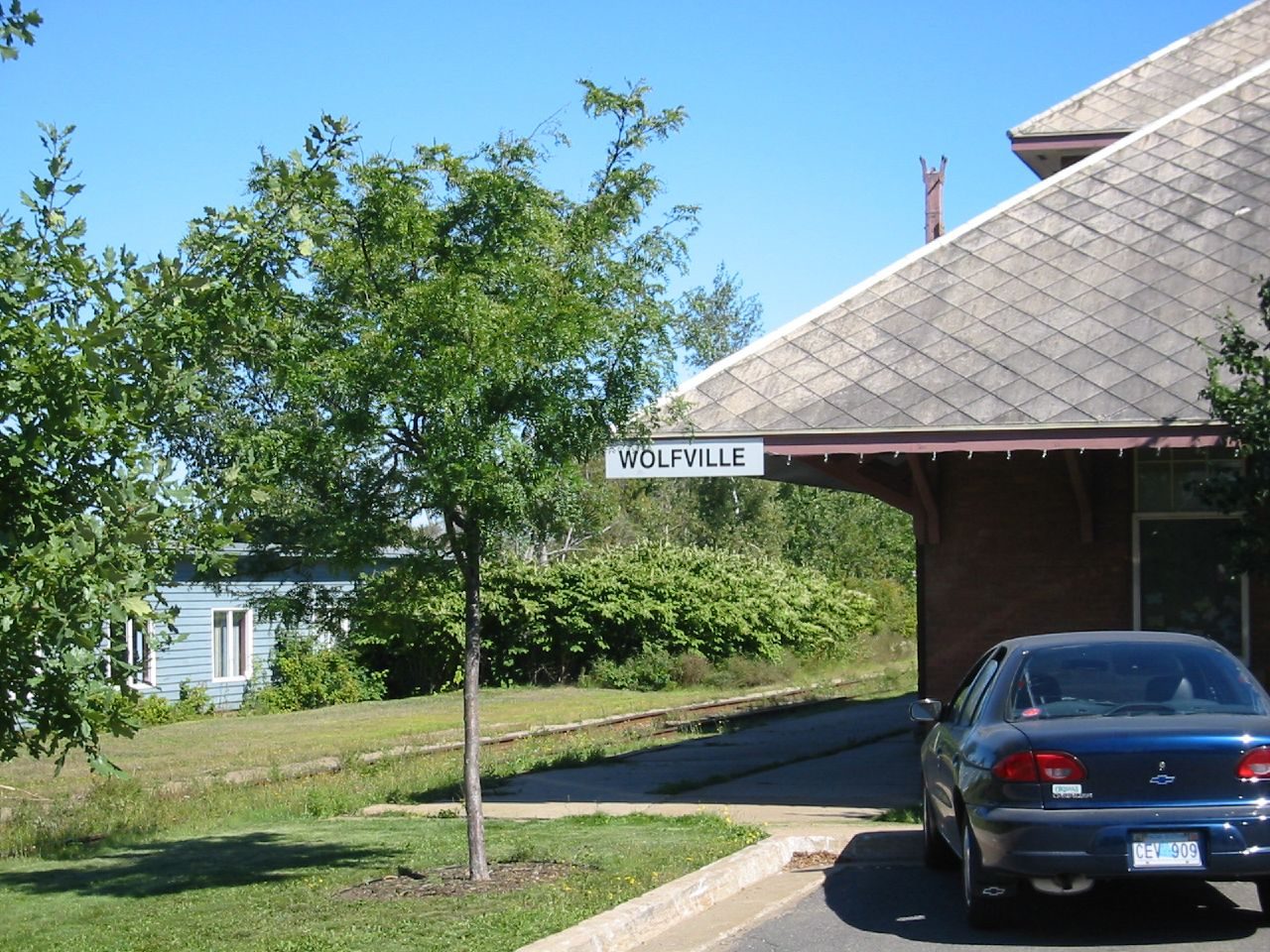
Wolfville Canadian Pacific, Wolfville, Nova Scotia · Photo: Mike James from Reston, VA, USA · CC BY 2.0
2historic places on the registers
History of Wolfville · Canada’s heritage registers
Wolfville has 2 historic places on the registers, one in the top tier
On the list: a heritage railway station. Scaled to its population Wolfville’s record is long: 3.6 per 10,000 residents, more than 92% of Canadian towns. Ladies' Seminary, begun in 1878, is the oldest by its record. 27 further listings on provincial or municipal registers are known only through Wikidata, so they have no page of their own.
Wikidata holds 1755 as the start of the municipality of Wolfville, a date that can just as well be an incorporation. Wolfville takes its name from Nathan DeWolf. In 1868 the railway came to Wolfville.
Every place on the registers inside the town, by its designation.
Highest designationsOther federal designations
Tap any dot to open that place’s own page; hovering shows its name.
The 2, by tier
1 Highest designations1 Other federal designations
Parks Canada’s Directory of Federal Heritage Designations lists the places the Government of Canada has recognized; outside Québec, provincial and municipal listings come only through Wikidata, and only those with an encyclopedia article get a page.
Points from Wikidata (Parks Canada’s files carry none) and from Québec’s register, as mapped there.
Highest designations
One place in Wolfville with the highest designation
National Historic Sites and Classified Federal Heritage Buildings, Canada’s highest federal recognition. Each one opens its own page.
Top-ranked heritage near Wolfville: 5 places within 5 km
The nearest is Acacia Grove / Prescott House, 3.4 km away in Kings County, Subdivision B. They stand in 2 towns, Kings County, Subdivision D and Kings County, Subdivision B among them. Oldest of them is Grand-Pré Rural Historic District (1680), 4.7 km off.
New homes stand out in Wolfville: 8% from 2016–21, where most towns have 4.1%
At 23%, Wolfville’s share of pre-1961 homes is above the typical town’s 18%. The busiest building years in Wolfville were from 1981 to 2000, which account for 25% of today’s homes. Wolfville has an unusual share of homes built from 2001 to 2015: 21%, where most towns have 15%.
23%
Before 1961
23%
1961–80
25%
1981–2000
21%
2001–15
8%
2016–21
WolfvilleTypical town
2021 Census, private dwellings by period of construction (Statistics Canada); the typical town is the middle Canadian town of 2,500 or more.
Born here
6 Wolfville births on record from before 1914
The decades after Confederation gave 5 of the 6. Best known is Ashley Mulgrave Gould, with articles in 3 Wikipedia languages. It starts with Ashley Mulgrave Gould, born in 1859. William Pearly Oliver closes the list, born in 1912.
Ashley Mulgrave Gould
Edward Blackadder
Ronald M. Keirstead
Angus Elderkin
Bob Chambers
William Pearly Oliver
18501875190019251950
Ashley Mulgrave Gould1859–1921 · United States federal judge
EB
Edward Blackadder1874–1922 · Canadian politician
RK
Ronald M. Keirstead1895–1970 · Canadian flying ace
AE
Angus Elderkin1896–1985 · Canadian politician
BC
Bob Chambers1905–1996 · Canadian artist
William Pearly Oliver1912–1989 · Nova Scotian social justice leader
Everyone born in Wolfville → Born before 1914 (the page’s periods: Confederation to the First World War). Birthplaces from Wikidata, each checked against the person’s Wikipedia article.
Towns its size
Wolfville has the 2nd most of 16 towns its size
Towns of 5,500 to 5,600 residents, by places on the registers.
Wolfville has 23% of its homes from before 1961, against 18% in the typical town. The lists come to 2 historic places, one with the highest designation, including Ladies' Seminary. Of the 16 towns closest in size, just one has more historic places. Ashley Mulgrave Gould (1859), Edward Blackadder (1874) and Ronald M. Keirstead (1895) are the best known of its historic lives. For the rest, its places were designated between 1992 and 1998.
How to read these numbers
What this data can and can’t tell you
•
The federal register. Every federal designation is in Parks Canada’s directory, and the Canadian Register of Historic Places gives most of them a bilingual statement of significance.
•
Protection. Being on these registers doesn’t mean a building can’t change. Federal designation commemorates; protection is provincial or municipal, and those lists aren’t open here.
•
Provincial and municipal lists. Provincial and municipal listings here come from Wikidata alone, since the provinces’ own registers can’t be reused; a listing needs an encyclopedia article to get a page.
•
People and events. Parks Canada’s open file gives its national historic persons no place. A town’s page names one only when the person was born there (matched by name and both life years) or one of its own historic places carries the name and its record speaks of them; national historic events stay off.
•
The tiers. Three tiers: the top for National Historic Sites, classified federal buildings and Québec’s classements, a second for the other federal designations, a third for provincial and municipal listings.
•
The grade. History is described, not graded, for every Canadian town.
•
Map points. Pins for federal places come from Wikidata rather than Parks Canada, which gives no points.
Questions about Wolfville’s history
Which places in Wolfville have the highest designation?
Ladies' Seminary.
What is the oldest building in Wolfville?
Ladies' Seminary — its record dates it to 1878 (National Historic Site).
Why might a heritage building in Wolfville be missing here?
Provincial and municipal registers outside Québec aren’t open data. Wikidata knows 27 more listings in Wolfville, but without an open description or an encyclopedia article they get no page.
How old are the homes in Wolfville?
23% of its homes were built before 1961, against 18% in the typical Canadian town.
Contains information licensed under the Open Government Licence – Canada (Parks Canada).
Sources: Parks Canada, Directory of Federal Heritage Designations · Canadian Register of Historic Places (federal extract) · Wikidata (CC0) for map points, other names and articles · Statistics Canada, 2021 Census (homes by period of construction). Under the Statistics Canada Open Licence.
 Fed

