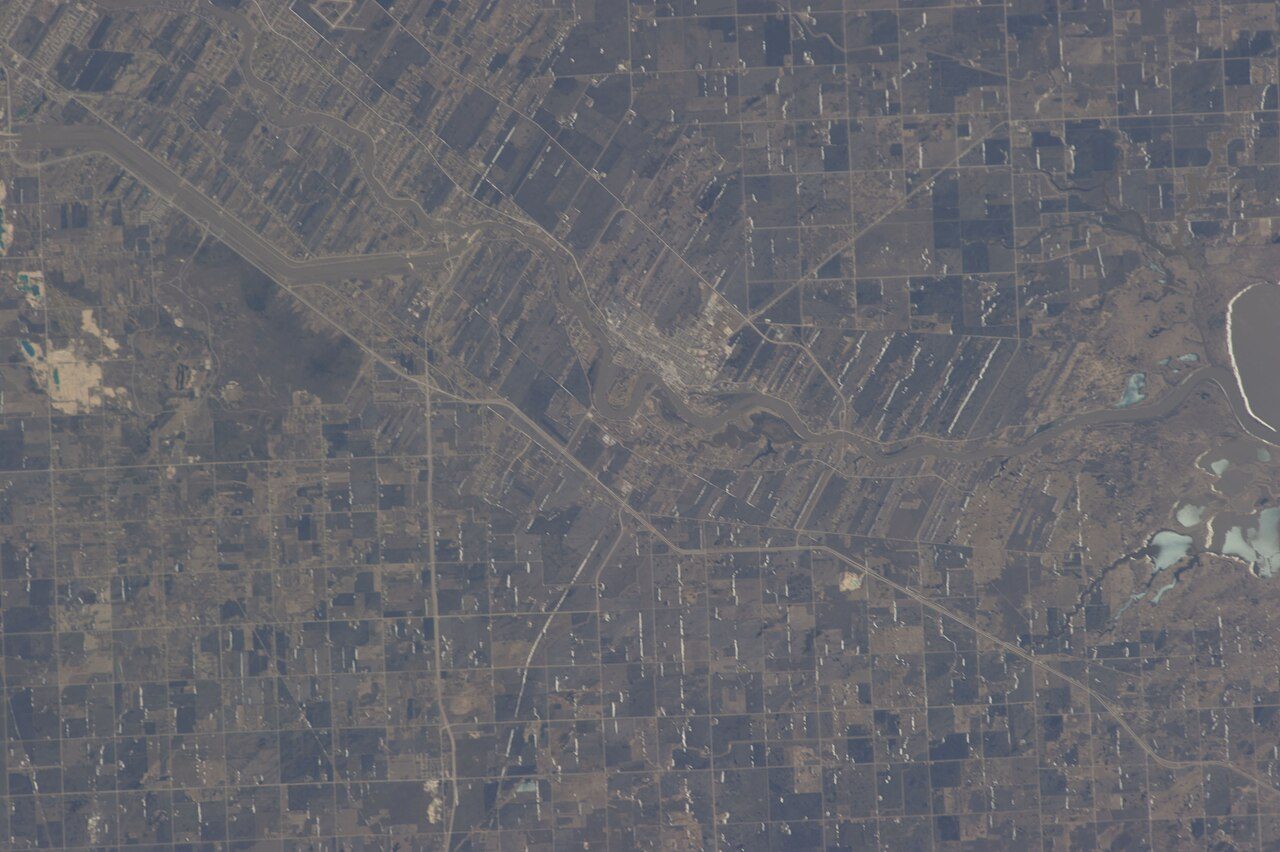
 Photo: Earth Science and Remote Sensing Unit , Lyndon B. Johnson Space Center · Public domain
Around Division No. 1, Unorganized, 2 historic places within 100 km
Division No. 1, Unorganized has kept more old homes than most towns: 30% were built before 1961, against 18%. Homes from 2016 to 2021 make up 4.7% of the stock; the typical town has 4.1%.
“Former Canadian National Railway Station, Minaki, Ontario”, 51 km from Division No. 1, Unorganized, is the closest
Within 100 km there are 2 in all. The record reaches back to 1899 with “Canadian Pacific Railway Station, Kenora, Ontario”, 63 km away. Their towns number 2: Kenora, Unorganized and Kenora first.
The 2 nearest, within 100 km
| Former Canadian National Railway Station, Minaki, OntarioHeritage Railway Station · 1910–1911 · 51 km away, in Kenora, Unorganized |
| Canadian Pacific Railway Station, Kenora, OntarioHeritage Railway Station · 1899–1900 · 63 km away, in Kenora |
30% of Division No. 1, Unorganized’s homes were built before 1961
Half of the homes standing in Division No. 1, Unorganized today were built before 1981. Division No. 1, Unorganized built little from 1981 to 2000: 16% of its homes, where most towns have 23%. 20% of Division No. 1, Unorganized’s homes date from 2001 to 2015, well above the typical 15%.
2021 Census, private dwellings by period of construction (Statistics Canada); the typical town is the middle Canadian town of 2,500 or more.
Division No. 1, Unorganized in brief
Housing in Division No. 1, Unorganized includes 30% built before 1961, against 18% in the typical town.
What this data can and can’t tell you
- People and events. Parks Canada’s open file gives its national historic persons no place. A town’s page names one only when the person was born there (matched by name and both life years) or one of its own historic places carries the name and its record speaks of them; national historic events stay off.
- The tiers. Tiers follow the designation: national recognition and classement first, other federal designations next, provincial and local listings last.
- Protection. A National Historic Site designation recognises significance; it doesn’t by itself protect a building the federal government doesn’t own. Legal protection comes from provincial and municipal designations, whose own registers aren’t open data outside Québec.
- The federal register. Every federal designation is in Parks Canada’s directory, and the Canadian Register of Historic Places gives most of them a bilingual statement of significance.
- Provincial and municipal lists. Outside Québec, provinces’ and municipalities’ heritage registers aren’t open data; their places are known only through Wikidata items with a register number, and only those with an encyclopedia article get a page.
- The grade. There is no history grade: the page sets out the record and compares it with other towns.
Questions about Division No. 1, Unorganized’s history
How many historic places does Division No. 1, Unorganized have on the registers?
The registers have nothing inside Division No. 1, Unorganized; Former Canadian National Railway Station, Minaki, Ontario, in Kenora, Unorganized, is 51 km away.
How old are the homes in Division No. 1, Unorganized?
The 2021 Census dates 30% of its homes before 1961 (18% in the typical town).
Contains information licensed under the Open Government Licence – Canada (Parks Canada).
Sources: Parks Canada, Directory of Federal Heritage Designations · Canadian Register of Historic Places (federal extract) · Wikidata (CC0) for map points, other names and articles · Statistics Canada, 2021 Census (homes by period of construction). Under the Statistics Canada Open Licence.
Adapted from Statistics Canada (Census of Population 2021, population estimates 2025, 2021 census boundaries) under the Statistics Canada Open Licence; this does not constitute an endorsement by Statistics Canada. Neighbourhood names in some cities © OpenStreetMap contributors (ODbL).