 Esquimalt Naval Sites · Photo: IDuke · CC BY-SA 2.5
42 historic places in Esquimalt, 2 of them top designations
The list takes in 40 Recognized Federal Heritage Buildings. Esquimalt’s 22 per 10,000 residents puts it ahead of 99% of Canadian towns. Its oldest building on the record is Esquimalt Naval Sites, from 1855.
Esquimalt before 1950
A single old picture: one old photograph of the town. Tap it to see it full screen.
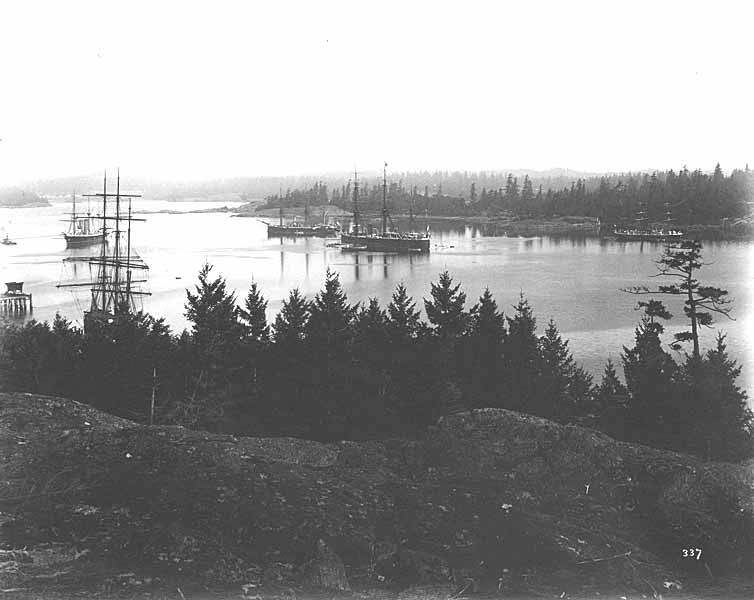 1893–1900
Public domain or CC0, made before 1950, from Wikimedia Commons; old views of places can be drawings, prints or maps of their time. Each credit opens the image’s page.
Where Esquimalt’s history is
Every place on the registers inside the town, by its designation.
Tap any dot to open that place’s own page; hovering shows its name.
Federal designations come from Parks Canada’s directory; a province’s or a council’s own listing shows here only when Wikidata holds it and an encyclopedia covers it.
Points from Wikidata (Parks Canada’s files carry none) and from Québec’s register, as mapped there. 41 places, placed by their register’s municipality, have no point and aren’t on the map.
2 places in Esquimalt with the highest designation
Their designations span 1991 to 1995. They are a National Historic Site and a Classified Federal Heritage Building. National Historic Sites and Classified Federal Heritage Buildings, Canada’s highest federal recognition. Each one opens its own page.
 Top
Federal heritage in Esquimalt: 40 more places
The oldest, Veterans' Cemetery Chapel, dates from 1868; the newest from 1955. Recognized Federal Heritage Buildings, heritage railway stations and lighthouses. They were designated between 1986 and 2006. Each one opens its own page.
All 40, A to Z
Esquimalt’s record leans to forts and military buildings: 55%
4 places make houses the second group. The first by rank are Esquimalt Naval Sites and Building D101. All told, 7 kinds of place appear.
Grouped by what each register says the place is or was; a converted building counts as what it was built for.
Most of Esquimalt’s dated places come from the decades after Confederation
Each place by the first construction date on its record.
Before 1867: one of the 41 with a date.
Most of Esquimalt’s designations came in 1991
The places by the year of their designation.
It began with Warehouse Building D85 in 1986. The busiest year was 1991, with 28. Nothing has been added since 2011.
Esquimalt keeps more old homes than most towns: 30% from before 1961, against 18%
Count back from today and half of Esquimalt’s homes are older than 1981. Esquimalt’s largest group of homes, 41%, went up from 1961 to 1980. New building has been slow in Esquimalt: 3% of homes date from 2016–21, where most towns have 4.1%.
2021 Census, private dwellings by period of construction (Statistics Canada); the typical town is the middle Canadian town of 2,500 or more.
Esquimalt has the most of 16 towns its size
Towns of 19,400 to 19,700 residents, by places on the registers.
The middle one has 0. For 9, the registers list nothing.
Esquimalt and its neighbours
| Town | People | Places | Highest | Oldest |
|---|---|---|---|---|
| Esquimalt | 19,512 | 42 | 2 | 1855 |
| New Songhees 1A | 2,052 | 0 | 0 | — |
| Victoria | 103,888 | 80 | 23 | 1843 |
| View Royal | 12,795 | 1 | 1 | 1853 |
| Saanich | 126,011 | 2 | 2 | 1854 |
| Colwood | 22,794 | 27 | 7 | 1859 |
| Oak Bay | 18,626 | 3 | 2 | 1903 |
Esquimalt in brief
Housing in Esquimalt includes 30% built before 1961, against 18% in the typical town. The lists come to 42 historic places, 2 with the highest designation, including Esquimalt Naval Sites. Among the 16 towns nearest its size, none has more historic places. Of the whole list, 55% are forts and military buildings.
By date, the decades after Confederation lead: 24 of 41. 1991 brought 28 of the 42 designations. Otherwise the figures are ordinary: its past has lives on the record such as Anthony Armstrong (1897) and Robert Henry Pooley (1878).
What this data can and can’t tell you
- The grade. This page gives no grade; history doesn’t count toward a Canadian town’s letter.
- The federal register. Every federal designation is in Parks Canada’s directory, and the Canadian Register of Historic Places gives most of them a bilingual statement of significance.
- Map points. Pins for federal places come from Wikidata rather than Parks Canada, which gives no points.
- The tiers. The highest designations are National Historic Sites, Classified Federal Heritage Buildings and Québec’s classements; then come the other federal designations; then provincial and local listings.
- Protection. A National Historic Site designation recognises significance; it doesn’t by itself protect a building the federal government doesn’t own. Legal protection comes from provincial and municipal designations, whose own registers aren’t open data outside Québec.
- Provincial and municipal lists. The local and provincial lists outside Québec aren’t published openly, so this page counts what Wikidata records and pages only the places an encyclopedia describes.
- People and events. Parks Canada’s open file gives its national historic persons no place. A town’s page names one only when the person was born there (matched by name and both life years) or one of its own historic places carries the name and its record speaks of them; national historic events stay off.
Questions about Esquimalt’s history
Which places in Esquimalt have the highest designation?
These: Esquimalt Naval Sites and Building D101.
What is the oldest building in Esquimalt?
Esquimalt Naval Sites (National Historic Site): the first construction date on its record is 1855.
How old are the homes in Esquimalt?
30% predate 1961, where the typical town has 18%.
Contains information licensed under the Open Government Licence – Canada (Parks Canada).
Sources: Parks Canada, Directory of Federal Heritage Designations · Canadian Register of Historic Places (federal extract) · Wikidata (CC0) for map points, other names and articles · Statistics Canada, 2021 Census (homes by period of construction). Under the Statistics Canada Open Licence.
Adapted from Statistics Canada (Census of Population 2021, population estimates 2025, 2021 census boundaries) under the Statistics Canada Open Licence; this does not constitute an endorsement by Statistics Canada. Neighbourhood names in some cities © OpenStreetMap contributors (ODbL).