Santa Monica’s post office opened in 1875, and 14% of its homes were built before 1940
More historic than 67% of U.S. towns · #67 of 847 in California. What drives it
11 places in town are on the National Register, among them the Santa Monica Looff Hippodrome, a National Historic Landmark, and three historic districts with 45 buildings between them. Below: 17 old photos and papers, maps from 1887 on, and the census since 1880.
From Santa Monica’s archive · credits on each photo
Quick answers
How Santa Monica began
When was Santa Monica founded?
1875
The Santa Monica post office opened in 1875, the earliest record of the town by name. Wikidata gives 1769, the date of an exploration of the area, not of the town. Another post office, Ocean Park (1899), opened inside today’s city and later closed.
First census: 417 in 18802020 census: 93,076151 years
How historic is Santa Monica?
B+
More historic than 67% of U.S. towns, on its age, its old homes and the National Register.
Founding year: the first Santa Monica post office (Blevins & Helbock, CC0). Wikidata: 1769.The full story ↓
History grade
What drives Santa Monica’s History grade
On its age, its old homes and the National Register, Santa Monica is more historic than 67% of U.S. towns, #67 of 847 in California. Its National Register listings hold the grade up; its age pulls it down.
B+
HistoryA character grade: shown, never part of Santa Monica’s overall grade.
Few California towns list much on the Register (a typical California town has 0.0 per 10,000 residents, the U.S. 2.4), so Santa Monica’s 6.1 sits above most of its state (89% of California towns have fewer) while its 56 historic buildings outnumber those of 86% of U.S. towns.
How sure. Graded on any two of the three inputs instead, the letter would range from C+ to A−. The pre-1940 share (±1.3 points) is firm at this size. The founding year is the first post office, not a stated founding date; Wikidata gives 1769.
Founding year: the first post office (other dates in Quick answers). Homes: Census ACS 2020–24. National Register: National Park Service, May 2026 list; each listing counted once (boundary changes and added documentation belong to their listing), and a historic district counts its contributing buildings. How TownRatings grades history →
What stands out about Santa Monica’s past
Read from the archive, the National Register and the record. The page puts what stands out first.
National Park Service, National Register of Historic Places. Photos from Wikimedia Commons, credited on each place’s page.
Every building
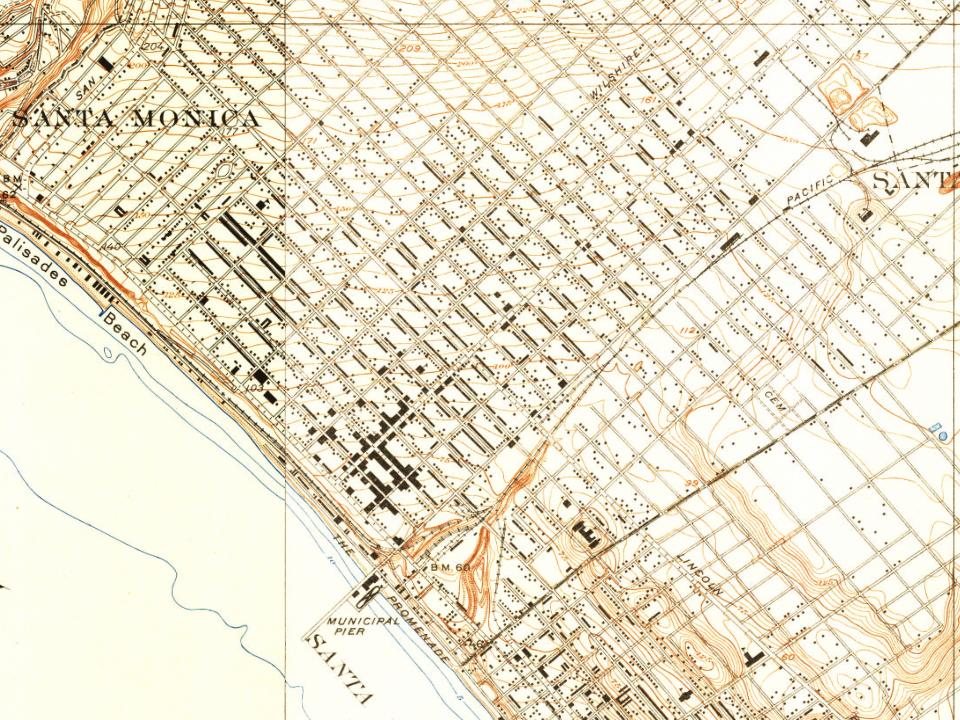
Santa Monica, building by building, 1887–1918
Fire insurance maps drew every building, what it was made of and what it was used for, so insurers could price the risk of fire. Pick a year, then a sheet.
The Tongva are indigenous to the Santa Monica area. The village of Comicranga was established in the Santa Monica area. One of the village's notable residents was Victoria Reid, who was the daughter of the chief of the village. During the Spanish period, she was taken to Mission San Gabriel from her parents at the age of six.
The first non-indigenous group to set foot in the area was the party of explorer Gaspar de Portolá, which camped near the present-day intersection of Barrington and Ohio Avenues on August 3, 1769.
Passages that mention Santa Monica, cut from the printed page as they were published.
Ingersoll's century history, Santa Monica Bay cities [microform]1908 · page 363Read the page →
Read the text
River at Buffalo Station — about forty miles west of Denver on the Rio Grande Railway. Here they lived until 1883 and then came to Santa Monica. Mr. Towner bought twenty acres of land of Judge Lucas which he improved and sold. Later he purchased twenty-four acres in the same vicinity at $300.00 an acre, which was regarded at that time as a fair price. In 1903 he, in company with W. A. Erwin, purchased three hundred acres of land comprising what is now known as Erwin Heights, promoted the Erwin Heights Land & Water Company, developed water in abundance, laid about twelve miles of water pipe and platted
Text read by machine from the scan; it may contain errors.
Ingersoll's century history, Santa Monica Bay cities [microform]1908 · page 310Read the page →
Read the text
In 1889 Messrs. Jones and Baker donated twenty acres of land along the eastern edge of Rustic canyon to the station. This tract is thus described by Inspector of Stations: ' The greatest and deepest barranca in the Santa Monica plain is that known as Santa Monica canyon. It is not really a canyon in the strict interpretation of the Spanish word, which refers to mountain ravines, but more nearly con forms to the Spanish idea of a barranca — a wide cleft across the plains from the mountains to the sea. In realty there are two large barrancas, running in a
Text read by machine from the scan; it may contain errors.
An illustrated history of Los Angeles County, California. Containing a history of Los Angeles County from the earliest period of its occupancy to the present time, together with glimpses of its prospective future ... and biographical mention of many of it1889Read the page →
Read the text
He came to Santa Monica in 1885, and since then has devoted his time to the practice of his profession, in which he has been very successful, and is now enjoying an increasing law practice. He is the attorney for the First National Bank of Santa Monica, for the Santa Monica Lumber Company, and has also recently been appointed deputy district attorney, and city
Text read by machine from the scan; it may contain errors.
An illustrated history of Los Angeles County, California1889Read the page →
Read the text
He came to Santa Monica in 1885, and since then has devoted his time to the practice of his profession, in whicli he has been very successful, and is now enjoying an increasing law pi-actice. He is the attorney for the First National Bank of Santa Monica, for the Santa Monica Lumber Company, and has also recently been appointed deputy district attorney, and city
Text read by machine from the scan; it may contain errors.
Scans and text from the Internet Archive. Books published in 1930 or earlier, which are in the public domain.
Timeline
Santa Monica, 1840 to 1998
Woven from the archive, old maps, post office records, the National Register and the people born here.
Nothing in the archives for these yearsWeddings on Main Street, storms, parades, school pictures, the old store. If it’s in your family album, it belongs here.
The Santa Monica post office opened in 1875, the earliest record of the town by name (U.S. post office records). Wikidata gives 1769.
How does Santa Monica rank for history?
Santa Monica is more historic than 67% of U.S. towns, #67 of 847 in California. The History grade combines the town’s founding era, the share of homes built before 1940 and its National Register listings. It’s a character grade, so it isn’t part of the overall grade. How it works.
What is on the National Register in Santa Monica?
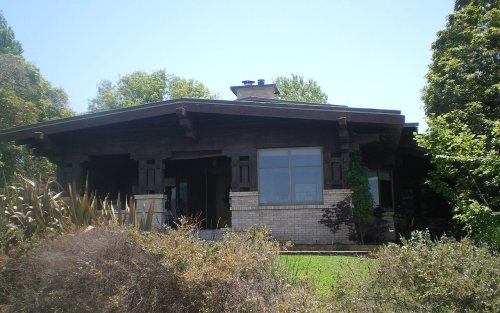
11 listings: 8 buildings, among them the Santa Monica Looff Hippodrome (a National Historic Landmark since 1987) and the Horatio West Court (listed 1977, the first), and 3 historic districts, the Henry Weaver House, the 27th Street Historic District and the Bay Street Beach Historic District, with 45 contributing buildings. 56 historic buildings in all.
How old are the homes in Santa Monica?
14% of Santa Monica’s homes were built before 1940 (Census estimate, ±1.3 points), against a typical 3.4% for a California town; the median home was built in 1968.
Founding dates: Wikidata, Wikipedia, the U.S. post office records of Blevins & Helbock (CC0) and the Census. Homes by year built: Census ACS 2020–24. National Register of Historic Places: National Park Service (list of May 22, 2026). Old photos, postcards and papers: Wikimedia Commons, the Library of Congress and other public archives, credited on each item’s page. Maps: U.S. Geological Survey historical topographic maps (via Esri) and Sanborn fire-insurance maps (Library of Congress). History text and census tables: Wikipedia (CC BY-SA 4.0). Places that used to be: USGS Geographic Names Information System (2021).
From Wikimedia Commons (15), the Library of Congress (2), the National Register of Historic Places (11), Wikipedia, Wikidata and Wikipedia for famous people, U.S. Geological Survey historical maps, U.S. Census counts (via Wikipedia), the US Post Offices dataset (Blevins & Helbock), the USGS Geographic Names Information System, Sanborn fire insurance maps (Library of Congress) and old county and town histories (Internet Archive). Archive images are copied here with their credits and licenses, shown on each photo’s page. Refreshed monthly.


 ★ Landmark






 c. 1840
 1894
 1896
 1898
 1898
 1899
 c. 1900
 c. 1900
 1900
 c. 1900
 c. 1900
 1902