Palm Springs’ post office opened in 1890, and 33 of its places are on the National Register
More historic than 49% of U.S. towns · #161 of 847 in California. What drives it
Most of Palm Springs was built recently: 3% of its homes predate 1940 and the median home dates from 1977. 33 places in town are on the National Register, among them three historic districts with 29 buildings between them. Below: 8 old photos and papers, maps from 1940 on, and the census since 1940.
From Palm Springs’ archive · credits on each photo
Quick answers
How Palm Springs began
When was Palm Springs founded?
1890
The Palm Springs post office opened in 1890, the earliest record of the town by name. Four smaller post offices, Pierce (1898), Gray (1913) and Garnett (1927), opened inside today’s city and later closed.
First census: 3,434 in 19402020 census: 44,575136 years
How historic is Palm Springs?
B−
More historic than 49% of U.S. towns, on its age, its old homes and the National Register.
Founding year: the first Palm Springs post office (Blevins & Helbock, CC0).The full story ↓
History grade
What drives Palm Springs’ History grade
On its age, its old homes and the National Register, Palm Springs is more historic than 49% of U.S. towns, #161 of 847 in California. Its National Register listings hold the grade up; its share of homes from before 1940 pulls it down.
B−
HistoryA character grade: shown, never part of Palm Springs’ overall grade.
Few California towns list much on the Register (a typical California town has 0.0 per 10,000 residents, the U.S. 2.4), so Palm Springs’ 13.3 sits above most of its state (93% of California towns have fewer) while its 60 historic buildings outnumber those of 86% of U.S. towns.
How sure. Graded on any two of the three inputs instead, the letter would range from C− to B+. The pre-1940 share (±0.6 points) is firm at this size. The founding year is the first post office, not a stated founding date.
Founding year: the first post office (other dates in Quick answers). Homes: Census ACS 2020–24. National Register: National Park Service, May 2026 list; each listing counted once (boundary changes and added documentation belong to their listing), and a historic district counts its contributing buildings. How TownRatings grades history →
What stands out about Palm Springs’ past
Read from the archive, the National Register and the record. The page puts what stands out first.
The first humans to settle in the area were the Cahuilla people, who arrived 2,000 years ago. Cahuilla Indians lived here in isolation from other cultures for hundreds of years prior to European contact. They spoke Ivilyuat, which is a Uto-Aztecan language.
Numerous prominent and powerful Cahuilla leaders were from the area, including Cahuilla Lion (Chief Juan Antonio). Palm Canyon was occupied during the winter months, but they often moved to cooler Chino Canyon during the summer months.
Passages that mention Palm Springs, cut from the printed page as they were published.
History of Riverside County, California1912 · page 215Read the page →
Read the text
PALM SPRINGS The little settlement of Palm Springs is not located in the San Qorgonio Pass, but is nestled close to the San Jacinto mountains, about five miles distant from the Palm Springs railroad station.
Text read by machine from the scan; it may contain errors.
History of Riverside County, California1912 · page 216Read the page →
Read the text
About the middle of the '80s white people began to take interest in the possibilities of raising early fruits at the oasis, and about 1887 there were two places flourishing as rivals in the vicinity of Palm Springs. The present town was one, and the loser in the race was Palm Dale. This was about three miles east of Palm Springs, a company of Riverside capitalists gaining control of 160 acres and attempting to build there a town. They planted about 100 acres to oranges, obtaining water from the Whitewater river by
Text read by machine from the scan; it may contain errors.
Scans and text from the Internet Archive. Books published in 1930 or earlier, which are in the public domain.
Timeline
Palm Springs, 1890 to 1979
Woven from the archive, old maps, post office records, the National Register and the people born here.
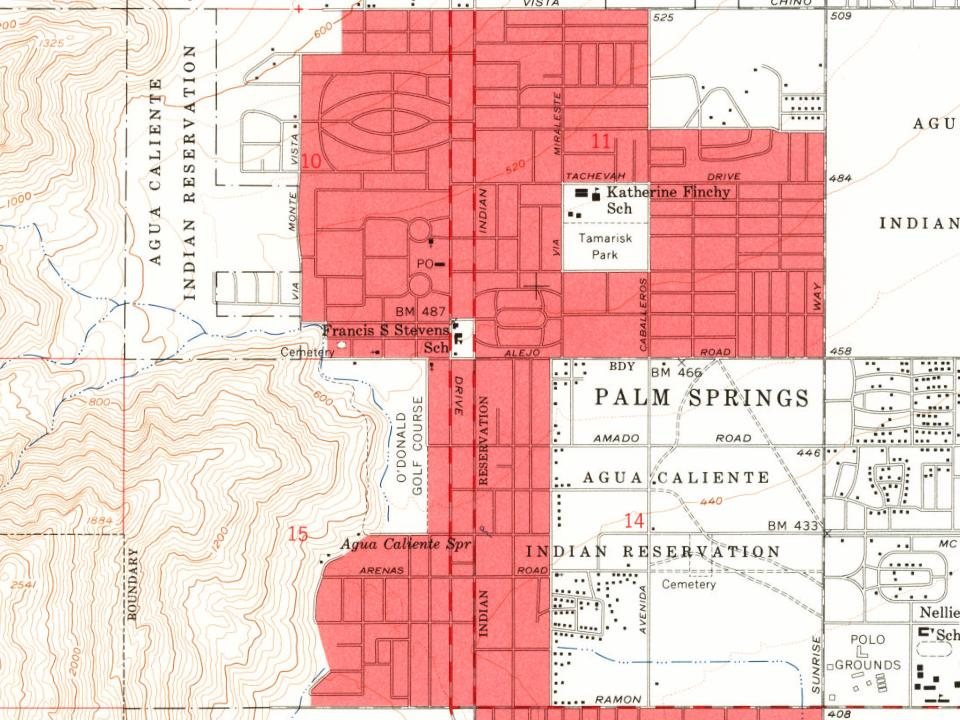
The Palm Springs post office opened in 1890, the earliest record of the town by name (U.S. post office records).
How does Palm Springs rank for history?
Palm Springs is more historic than 49% of U.S. towns, #161 of 847 in California. The History grade combines the town’s founding era, the share of homes built before 1940 and its National Register listings. It’s a character grade, so it isn’t part of the overall grade. How it works.
What is on the National Register in Palm Springs?
33 listings: 30 buildings, among them the Thomas O'Donnell House (listed 2011, the first), and 3 historic districts, the Desert Golf Course, the Riviera Gardens and the Sandcliff, with 29 contributing buildings. 60 historic buildings in all.
How old are the homes in Palm Springs?
3% of Palm Springs’ homes were built before 1940 (Census estimate), against a typical 3.4% for a California town; the median home was built in 1977.
Founding dates: Wikidata, Wikipedia, the U.S. post office records of Blevins & Helbock (CC0) and the Census. Homes by year built: Census ACS 2020–24. National Register of Historic Places: National Park Service (list of May 22, 2026). Old photos, postcards and papers: Wikimedia Commons, the Library of Congress and other public archives, credited on each item’s page. Maps: U.S. Geological Survey historical topographic maps (via Esri) and Sanborn fire-insurance maps (Library of Congress). History text and census tables: Wikipedia (CC BY-SA 4.0). Places that used to be: USGS Geographic Names Information System (2021).
From Wikimedia Commons (6), the Library of Congress (22), Wikidata (6), the National Register of Historic Places (33), Wikipedia, Wikidata and Wikipedia for famous people, U.S. Geological Survey historical maps, U.S. Census counts (via Wikipedia), the US Post Offices dataset (Blevins & Helbock), the USGS Geographic Names Information System and old county and town histories (Internet Archive). Archive images are copied here with their credits and licenses, shown on each photo’s page. Refreshed monthly.




 1890
 1890
 1990
 2013
 2013
 2013
 2013
 2013
 2011
 2009
 2009
 2009
 2009
 2009
 2009
 2009
 2009
 2009
 2009
 2009
 2009
 2009
 2009