46 years in pictures
Census counts: 2,771 in 1980, 23,820 in 2020. The archive holds 12 old photos and papers going back to 2007 and 4 maps from 1904 on.
- 1980Fountain Hills is settled
Each edition grades its towns against each other only.

For most people who can afford it, yes. Fountain Hills grades B+ overall, ranked 19th of 139 in Arizona. CDC estimates put its residents' health ahead of 90% of the country. What holds it back is price: homes are expensive, about $659K for a typical one and 7.5 times the Phoenix metro’s $88K median household income. 41% of residents are 65 or older in Fountain Hills, above both Arizona’s towns (22%) and U.S. towns (18%). Fountain Hills has 2 places on the National Register. Only 6 of the 93 Arizona towns we compare have a higher value of a typical home than Fountain Hills.
Where Fountain Hills’s working residents go each day. Line width shows the share.
Census LEHD 2023
Each subject compared with towns across the country (schools within Arizona), ordered by how far Fountain Hills is from typical.
How TownRatings grades towns →
Census counts: 2,771 in 1980, 23,820 in 2020. The archive holds 12 old photos and papers going back to 2007 and 4 maps from 1904 on.
Museums, parks, gardens and other places to visit around Fountain Hills. Close and well known come first.
Big draw31 mi Stadium & arenaState Farm Stadium
22 mi Stadium & arenaMortgage Matchup Center
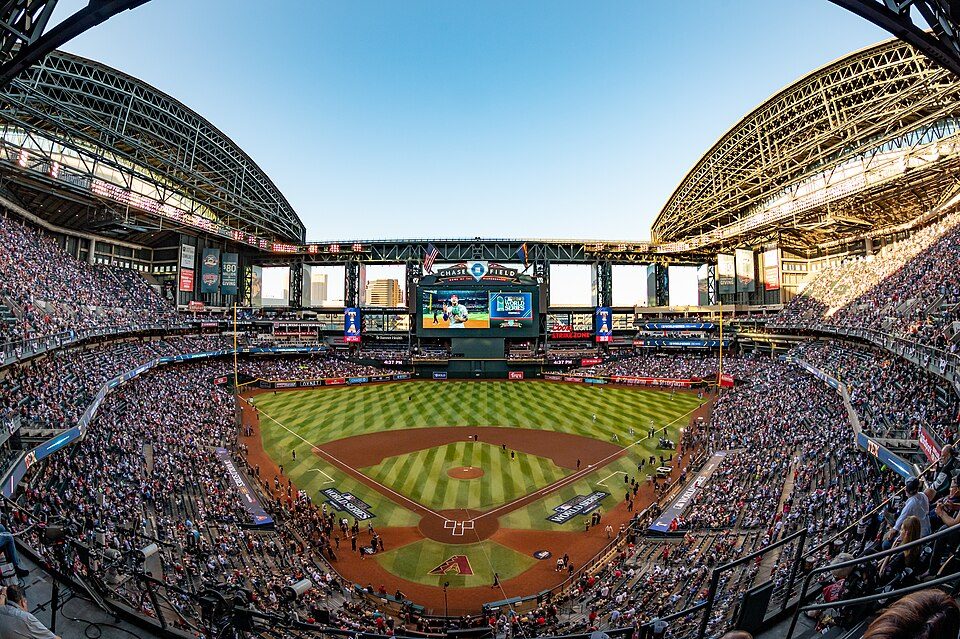
22 mi Stadium & arenaChase Field
17 mi Stadium & arenaMountain America Stadium
31 mi Stadium & arenaDesert Diamond Arena
17 mi Stadium & arenaMullett ArenaState Farm Stadium: Taken by en:Flickr user MCSixth, CC BY-SA 2.0 · Mortgage Matchup Center: Troutfarm27, CC BY-SA 4.0 · Chase Field: U.S. Air Force photo by Staff Sgt. Tyler J. Bolken, Public domain · Mountain America Stadium: Clintus McGintus, CC BY-SA 2.0 · Desert Diamond Arena: Unknown, CC BY 2.0 · Mullett Arena: Kyvuh, CC0
Who provides power, water and the rest in Fountain Hills, and how to reach them.
EPA SDWIS (Oct 9, 2026) · HIFLD + EIA-861 2025 · Census 2020 ZCTAs · NCES 2024–25 · registration: vote.gov, updated Sep 12, 2025.
Ordered by what stands out in Fountain Hills.
Fountain Hills has more 90° days than nearly all U.S. towns and has an unusually large share working from home, but it has homes that cost more against local pay than most of Arizona.
For Fountain Hills, the trail density is 2.4 miles per square mile. In 10 parks and preserves, walkers have 48 miles of trail. McDowell Sonoran Preserve, at 202 acres with 1.3 miles of trail, is the biggest park or preserve.
| Biggest places to walk | Trails | Acres |
|---|---|---|
| 1. McDowell Sonoran Preserve | 1.3 mi | 202 |
| 2. Fountain Hills Botanical Garden | 0.6 mi | 17 |
| 3. Desert Vista Park | 0.4 mi | 14 |
Trails & parks © OpenStreetMap contributors · Conserved land: USGS PAD-US
Two of its 10 schools are shown below, with the reason for each. The largest public high school is Fountain Hills High School, with 347 students. Its public schools are run by the Fountain Hills Unified District.
| School | Level | Students | Letter |
|---|---|---|---|
| McDowell Mountain Elementary SchoolLargest public elementary schoolGrades PK–5 | Grades PK–5 | 382 | A− |
| Fountain Hills High SchoolLargest public high schoolGrades 9–12 | Grades 9–12 | 347 | B+ |
NCES · EDFacts · graded within AZ on state tests and graduation
At 7.5 years of the Phoenix metro’s $88K median household income, the typical home (about $659K) costs more against local pay than in 85% of Arizona towns; that ratio is one input to that grade.
The rent at the middle of the market in Fountain Hills is $1,890 a month. The typical Fountain Hills home is worth about $659,000, up 1.3% in a year, 58% above the Arizona typical home. 84% of households live in a home they own locally.
| Fountain Hills | Arizona towns | U.S. towns | |
|---|---|---|---|
| Median rent | $1,890 a month | $1,190 a month | $1,185 a month |
| Households that own their home | 84% | 76% | 73% |
Census ACS, 2020–24 · Zillow Home Value Index · Redfin Data Center
Fountain Hills: two in five adults have high blood pressure. Among 140 Arizona towns, just 8 have a lower share of adults who sleep under 7 hours than Fountain Hills. CDC measures, 32 in all: Fountain Hills beats Arizona on 22 and trails on 6.
| Fountain Hills | Arizona towns | U.S. towns | |
|---|---|---|---|
| Frequent mental distress (CDC PLACES) | 11% | 16% | 17% |
| Sleep under 7 hours (CDC PLACES) | 28% | 35% | 36% |
| Feel lonely (CDC PLACES) | 26% | 31% | 33% |
| Yearly checkup (CDC PLACES) | 82% | 75% | 79% |
| What stands out | Fountain Hills | AZ |
|---|---|---|
| Fewer adults facing housing insecurity | 4.9% | 12% |
| Fewer uninsured adults | 5.4% | 13.2% |
| More adults who have had cancer | 15.6% | 8.8% |
CDC PLACES 2025 · modeled estimates for adults · CMS · HRSA
30.5% of workers work from home, against 18.4% across Arizona.
Only 14% of working residents stay in Fountain Hills for work; the rest commute out. Employers in Fountain Hills added 678 jobs between 2013 and 2023, to 4,815. The share of workers in Fountain Hills who do their job from home: 31%. The median commute is under 17 miles.
| Fountain Hills | Arizona towns | U.S. towns | |
|---|---|---|---|
| Work from home | 31% | 12% | 11% |
| Median household income | $113,000 | $68,000 | $80,000 |
| Average trip to work | 29 minutes | 24 minutes | 25 minutes |
| Below the poverty line | 6.2% | 12% | 9.6% |
Census LEHD 2023 · ACS
The Fountain Hills weather station records that about 167 days a year reach 90°, more than in 99% of U.S. towns. January nights average 43.1°, milder than in 96% of U.S. towns; July afternoons average 104.3°.
Fountain Hills’ peak summer temperature is 104°F. It almost never snows.
| Fountain Hills | Arizona towns | U.S. towns | |
|---|---|---|---|
| July high | 104°F | 100°F | 85°F |
| January low | 43°F | 36°F | 22°F |
NOAA U.S. Climate Normals, 1991–2020
2 flood insurance claims have been paid in Fountain Hills since 2021. Compared with 54% of U.S. communities, expected storm and flood damage here is higher. Expected losses in Fountain Hills break down as 52% from inland flooding and 36% from heat waves.
FEMA flood insurance claims · FEMA National Risk Index · OpenFEMA
3 within 15 miles of the center of Fountain Hills
About 3 of every 100 Fountain Hills residents are enrolled in college, against 6 across Arizona.
Town in Maricopa County, Arizona
Fountain Hills is a town in Maricopa County, Arizona, United States. Known for its impressive fountain, which can shoot water to a height of 560 feet (170 m), it borders the Fort McDowell Yavapai Nation, Salt River Pima-Maricopa Indian Community, and Scottsdale. The population was 23,820 as of the 2020 census. Between the 1990 and 2000 censuses it was the eighth-fastest-growing place among cities and towns in Arizona. The median value of an owner-occupied housing during the period 2016–2020 was estimated at $402,100.
From Wikipedia, licensed CC BY-SA 4.0 · facts via Wikidata (CC0)
One town shares a border with Fountain Hills.
| Town | AZ rank | Overall | Cost | Safety | Schools | Health |
|---|---|---|---|---|---|---|
| Fountain Hills | #19 | B+ | C− | — | B+ | A |
| Scottsdale | #24 | B | D | C | B+ | A+ |
Fountain Hills reports no FBI crime data of its own. Compare Fountain Hills with a neighbor →
Short answers, built from the data on this page.
For most people who can afford it, yes. Fountain Hills grades B+ overall, better than 65% of U.S. towns and #19 of 139 in Arizona. It grades A for health and B+ for schools. Cost of living is its weak spot, with a C−.
Yes. Cost of living, which also weighs rents, property taxes and how many households pay 30% or more of their income for housing, grades C−.