Among the most historic 1% of U.S. towns · #2 of 61 in West Virginia. What drives it
6 places in town are on the National Register, among them a historic district with 113 buildings. Below: 6 old photos and papers, maps from 1904 on, and the census since 1890.
On its age, its old homes and the National Register, Philippi is among the most historic 1% of U.S. towns, #2 of 61 in West Virginia. All 2 inputs put Philippi near the top nationally; its share of homes from before 1940 ranks highest.
A+
HistoryA character grade: shown, never part of Philippi’s overall grade.
West Virginia towns list more on the Register than most of the country (a typical West Virginia town has 29.6 per 10,000 residents, the U.S. 2.4), so Philippi’s 409 sits above most of its state (84% of West Virginia towns have fewer) while its 117 historic buildings outnumber those of 90% of U.S. towns.
How sure. Graded on two of the three inputs, so a change in either one moves the letter more than it would with three. The pre-1940 share is a Census survey estimate (±10.9 points).
Founding year: our sources. Homes: Census ACS 2020–24. National Register: National Park Service, May 2026 list; each listing counted once (boundary changes and added documentation belong to their listing), and a historic district counts its contributing buildings. How TownRatings grades history →
What stands out about Philippi’s past
Read from the archive, the National Register and the record. The page puts what stands out first.
The first white settlement in present-day Barbour County was established approximately three miles downriver from the future site of Philippi in 1780, at which time the area was still part of western Virginia and included within Monongalia County. The earliest settlers on the section of bottomland that would one day become Philippi were William Anglin (as early as 1783 or '84) and Daniel Booth (1787). A ford existed here as early as 1789 which served the road that had recently been surveyed between Beverly and Sandy Creek. Anglin was the original owner of the land upon which Philippi stands, hence the earliest known name for the locality — Anglin's Ford. Booth also owned and operated a commercial ferry here in the 1790s, thus the area's second popular designation — Booth's Ferry. William Friend Wilson married Booth's daughter and built a wool and grain mill on the river in 1818.
Passages that mention Philippi, cut from the printed page as they were published.
The history of Barbour County, West Virginia, from its earliest exploration and settlement to the present time1899 · page 280Read the page →
Read the text
Stephen B. Holt.- — ■= D. M. Myers A. P. Wilson The town of Philippi was incorporated by act of the Legislature February 1, JL871. After the town government was organized, the first ordinance passed ordered that all hogs and horses running at large should be "arrested." Four years later a similar ordinance was passed concerning geese. Following are lists of the town officers, no mention being made of
Text read by machine from the scan; it may contain errors.
The history of Barbour County, West Virginia, from its earliest exploration and settlement to the present time1899 · page 205Read the page →
Read the text
Alpheus Wilson was appointed deputy county clerk. On April 5, the first mention in the records is found of the town of Philippi. The exact language is this: "Ordered, that the county seat of this county be known and called Phillippa." Not until the May term, 1844, is the name Philippi, as now spelled, found on the records.
Text read by machine from the scan; it may contain errors.
Scans and text from the Internet Archive. Books published in 1930 or earlier, which are in the public domain.
Timeline
Philippi, 1843 to 1983
Woven from the archive, old maps, post office records, the National Register and the people born here.
Nothing in the archives for these yearsWeddings on Main Street, storms, parades, school pictures, the old store. If it’s in your family album, it belongs here.
Fire insurance maps drew every building, what it was made of and what it was used for, so insurers could price the risk of fire. Pick a year, then a sheet.
Philippi is among the most historic 1% of U.S. towns, #2 of 61 in West Virginia. The History grade combines the town’s founding era, the share of homes built before 1940 and its National Register listings. It’s a character grade, so it isn’t part of the overall grade. How it works.
What is on the National Register in Philippi?
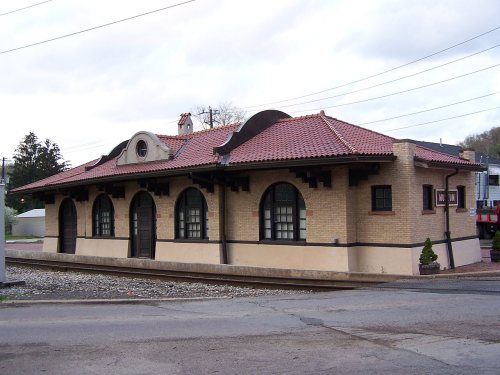
6 listings: 4 buildings, 1 historic district, the Philippi Historic District, with 113 contributing buildings, and 1 structure. 117 historic buildings in all.
How old are the homes in Philippi?
42% of Philippi’s homes were built before 1940 (Census estimate, ±10.9 points), against a typical 13% for a West Virginia town; the median home was built in 1960.
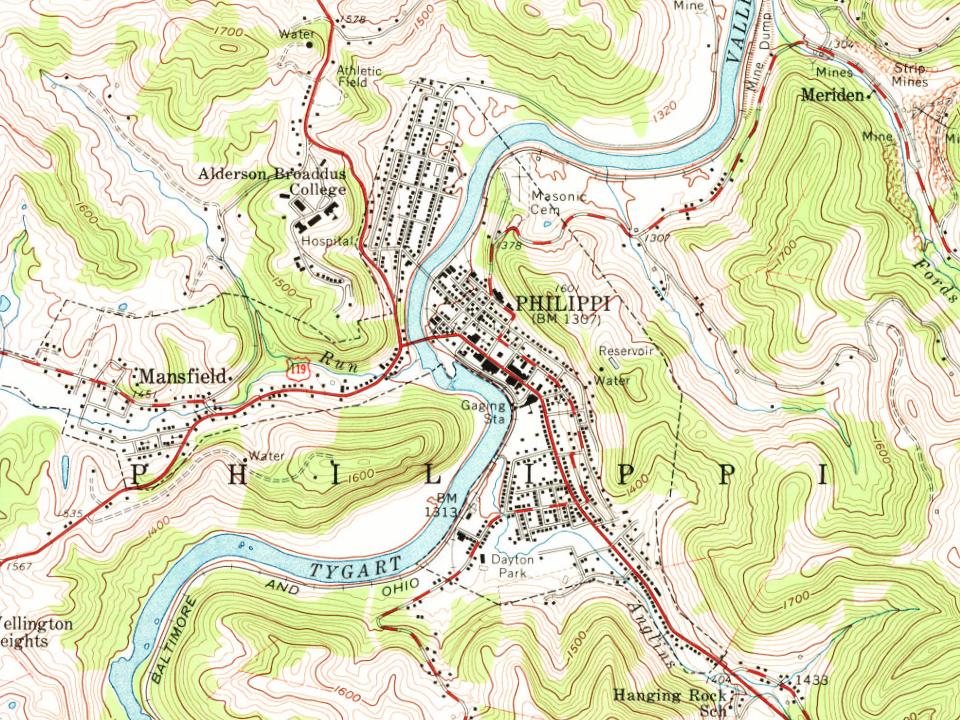
Founding dates: Wikidata, Wikipedia, the U.S. post office records of Blevins & Helbock (CC0) and the Census. Homes by year built: Census ACS 2020–24. National Register of Historic Places: National Park Service (list of May 22, 2026). Old photos, postcards and papers: Wikimedia Commons, the Library of Congress and other public archives, credited on each item’s page. Maps: U.S. Geological Survey historical topographic maps (via Esri) and Sanborn fire-insurance maps (Library of Congress). History text and census tables: Wikipedia (CC BY-SA 4.0). Places that used to be: USGS Geographic Names Information System (2021).
From Wikimedia Commons (6), the National Register of Historic Places (6), Wikipedia, Wikidata and Wikipedia for famous people, U.S. Geological Survey historical maps, U.S. Census counts (via Wikipedia), the US Post Offices dataset (Blevins & Helbock), the USGS Geographic Names Information System, Sanborn fire insurance maps (Library of Congress) and old county and town histories (Internet Archive). Archive images are copied here with their credits and licenses, shown on each photo’s page. Refreshed monthly.






 1861
 1861
 1896
 1897

